

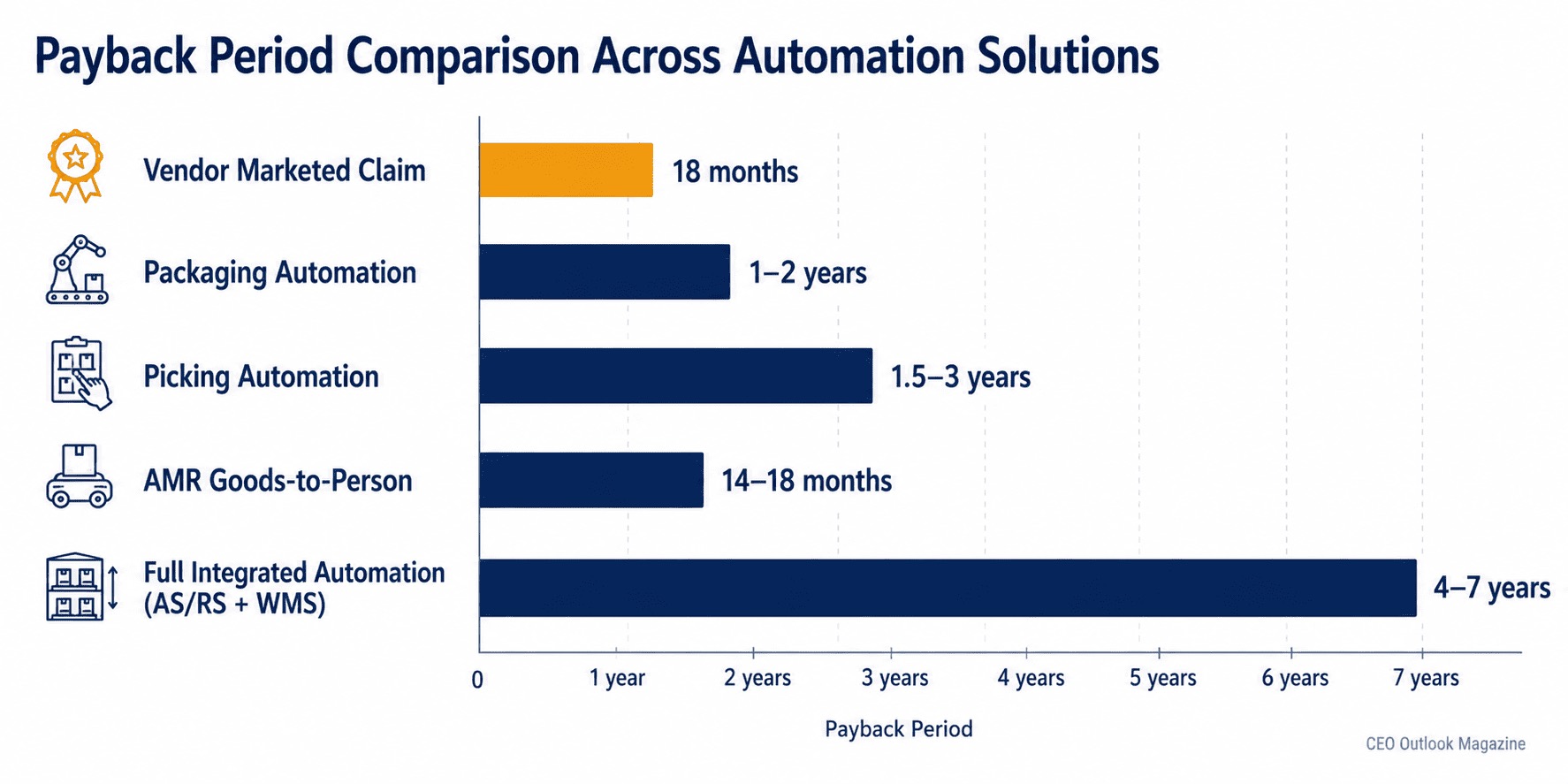
Vendor sales materials often claim an 18-month payback for major warehouse automation systems. In practice, the numbers rarely hold up. For full, integrated automation—the kind that delivers the largest returns—real payback timelines typically run four to seven years. The gap between the sales pitch and reality comes from specific costs that vendors routinely understate or ignore.
The Number on Every Vendor's Slide
Vendors tend to highlight the fastest payback scenarios, not the systems most operators actually implement. Procurement teams evaluating high-density storage technology are routinely promised 18-month paybacks. Engineers with real deployment experience report a much wider range: some projects break even in under two years, others take more than four. The difference depends on how well the automation fits the facility’s actual throughput and storage needs—not on any universal timeline a vendor can promise.
What the Honest Range Actually Looks Like
Independent data points to a much broader payback window than most marketing suggests, and the numbers vary by automation category. Full warehouse automation—integrating storage, conveyors, and management software—typically takes four to seven years to pay back, but delivers the largest returns for high-volume operations. Targeted automation categories pay back faster: packaging automation in one to two years, picking automation in one and a half to three, and autonomous mobile robots in as little as 14 to 18 months, but only in the right environment. The 18-month payback figure is real for the fastest category, not for the full systems most large operators are considering.
The Cost Line Vendor Pitches Systematically Underweight
The main reason for the gap between marketed and realized ROI is ongoing operating costs that vendors often understate or ignore. Annual operating costs for automated storage and retrieval systems typically run 5 to 8 percent of the original capital investment, including maintenance contracts at 3 to 5 percent of hardware cost and software licensing fees from $20,000 to $80,000 per year. Payback projections that focus only on upfront costs and labor savings, without factoring in these recurring expenses, will consistently overstate the speed of return. This is how an 18-month sales pitch becomes a multi-year reality.
The Industry-Wide Reality Check
A 2026 Peerless Research Group study of more than 120 facilities offers a reality check. Despite $21 billion invested in warehouse automation in 2023, most processes remain manual. Full automation adoption rates are low: 24 percent for labeling, 18 percent for reporting, 13 percent for packaging. Picking—the most labor-intensive warehouse task—has reached only 12 percent full automation. This does not mean automation ROI is a myth. It means the opportunity remains largely untapped because few operators have deployed automation at the scale vendors suggest is already standard.
What a Genuinely Honest ROI Model Actually Requires
Financial teams that build defensible automation business cases use more conservative assumptions than vendor timelines suggest. They model only 70 percent of projected benefits in year one, 90 percent in year two, and full benefits from year three onward, to reflect real ramp-up time. They add a 15 percent capital expenditure contingency for the integration costs that almost every deployment encounters. They evaluate net present value using a discount rate that matches the company’s actual cost of capital, typically 8 to 12 percent, rather than relying on simple payback. Above all, they treat system fit—how well the automation matches actual throughput, order profile, and storage density—as the key variable in payback, not the sticker price or a vendor’s benchmark.
What This Means for Logistics and Finance Leadership
For logistics and finance leaders, the takeaway is not that automation fails to deliver returns. If anything, the fact that most warehouses remain unautomated in their highest-value processes points to significant untapped opportunity. The payback timeline that deserves a capital request is the one grounded in real deployment data and fully weighted operating costs, not the compressed, best-case number that closes a sales conversation but rarely survives a full fiscal year.
Most automation business cases are built on vendor timelines, not independent models. The difference is material. Leadership teams should insist on a fully weighted, independently modeled payback before committing capital.