

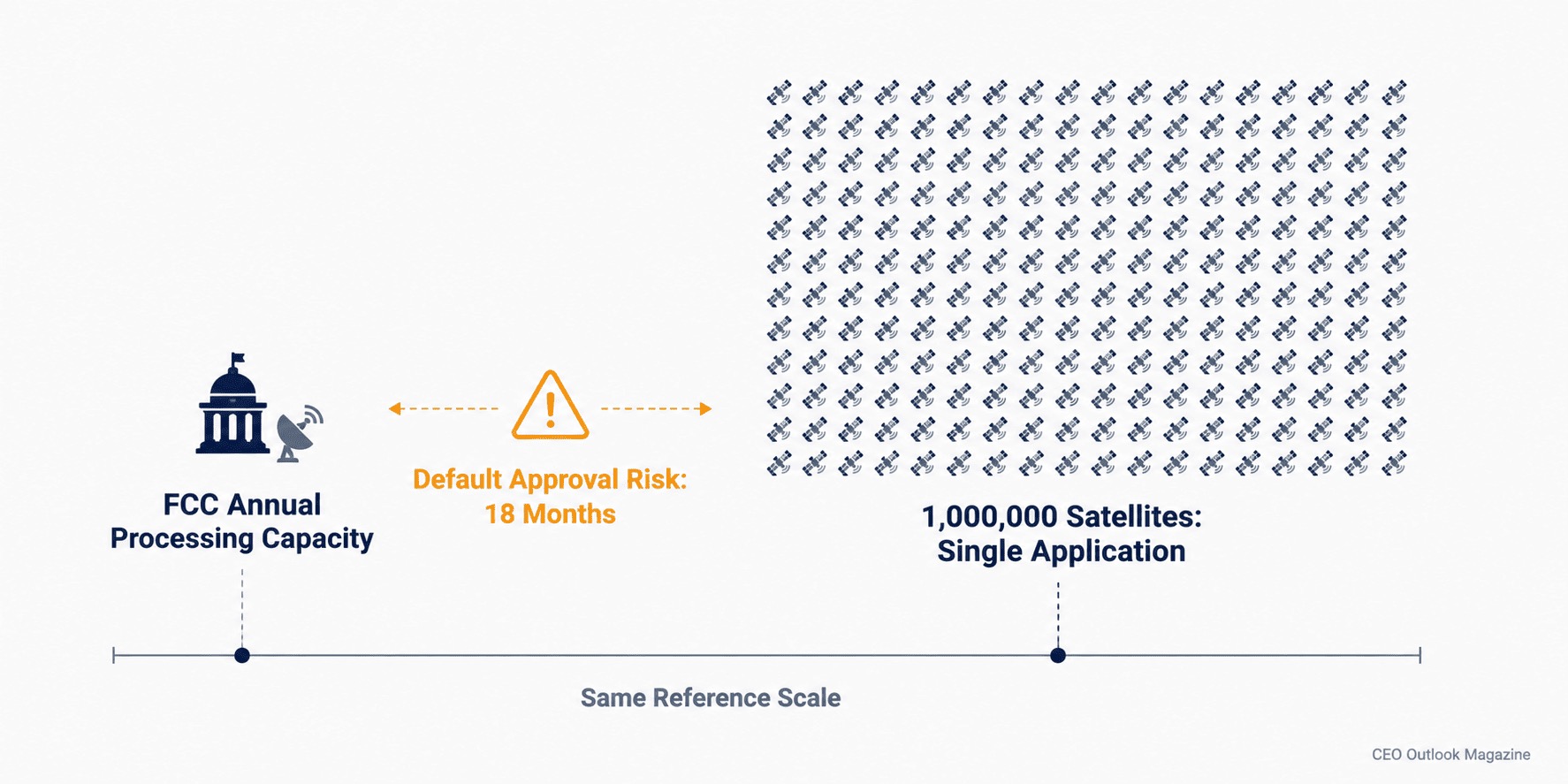
SpaceX has filed to deploy up to one million satellites for an orbital data center constellation. According to Senate testimony, the application provides little detail on spacecraft design or orbital plans. One committee member pointed out the practical risk: if the FCC does not act, all one million satellites could be approved by default within 18 months. This is not a theoretical scenario. It is the direct result of a regulatory process designed for a much smaller industry than the $630 billion space sector now represents.
The Application That Explains the Whole Problem
This filing exposes the gap between commercial ambition and regulatory capacity. No current review process is equipped to evaluate a million-satellite application with limited technical detail in any reasonable timeframe. The result is a structural risk: if the regulator cannot process the application before its statutory deadline, approval happens by default, regardless of whether technical or safety issues have been addressed.
The Reform That Stalled Right When It Was Needed
Congress has acknowledged the problem and drafted bipartisan legislation to address it, but the process stalled when it mattered. In February 2026, a Senate committee failed to advance a bill to streamline FCC satellite licensing because of a lack of quorum, not substantive disagreement. The same session also failed to move forward the Orbital Sustainability Act, which would have set standards for debris mitigation and remediation. As a result, both the licensing backlog and the debris issue remain unresolved due to procedural breakdown, not lack of consensus.
Why the Regulator Was Never Built for This Scale
The FCC's limited mandate for space regulation is not accidental. The agency has operated under broad public-interest authority since 1934, with no specific charge to manage space traffic or debris. Its enforcement record reflects this: the first orbital debris fine, $150,000 against DISH for failing to move a satellite, was widely seen as symbolic rather than material. Meanwhile, NASA's 2026 budget proposes shifting its space traffic coordination system to the private sector, signaling that government capacity may be shrinking even as the operational burden grows.
What This Actually Costs Investors
For investors, regulatory uncertainty is a direct operating risk, not a theoretical issue. Investment guidance now names licensing delays at the FCC, FAA, and under export controls as risks that can derail business plans. The FCC's five-year deorbit rule, for example, can add significant, unplanned costs. These risks compound an already long and capital-intensive development cycle: satellites and launch vehicles typically require three to seven years from concept to service, and a single launch failure can delay progress by a year or more. Litigation and jurisdictional disputes add further unpredictability, especially as new activities like in-orbit refueling and debris removal fall outside existing regulatory frameworks.
The Progress That's Real, Even If It's Not Enough
Regulators are not ignoring the problem. The FCC has taken steps in 2026 on supplemental coverage from space, direct-to-device spectrum, and satellite broadband coordination, moving satellite-terrestrial convergence into the licensing phase. Japan is also preparing to update its space law to address suborbital flights, reusable launch, and human spaceflight, with new defense guidelines in development. These changes have made the regulatory environment more mature but also more complex. Operators now face the need for earlier alignment on approvals, spectrum, and financing, but the core issue of regulatory capacity versus application volume remains unresolved.
What This Means for Space Industry and Investment Leadership
For finance and investment leaders in the space sector, regulatory risk requires the same disciplined analysis as technical or launch risk. Business plans built around megaconstellation-scale projects must recognize that the regulatory system was not designed for this volume, and that Congress has yet to address the gap, even with bipartisan support.
Most organizations assume licensing will keep pace with capital deployment. The evidence suggests otherwise. Senior leaders should revisit whether their investment strategies are pricing in real regulatory processing risk.