

LONGi's Jiaxing Production Base in Zhejiang Province is the first solar module factory to achieve both World Economic Forum Global Lighthouse Factory status for smart manufacturing and, a year later, full zero-carbon certification under the ISO 14068 standard. The progression from one milestone to the next is more instructive than the recognitions themselves. Decarbonization here was not a single event, but a multi-year process grounded in operational discipline and incremental improvement.
The Factory That Did It Twice
In December 2023, the World Economic Forum named LONGi's Jiaxing facility the solar industry's first Global Lighthouse Factory, joining a small group of 153 sites worldwide. The numbers behind the recognition are concrete: over 30 digital technologies deployed, including several patented innovations, drove a 28 percent reduction in unit manufacturing costs, a 43 percent drop in yield loss, an 84 percent shorter production delivery cycle, and a 20 percent decrease in unit energy consumption. These were the results of focused investment in automation, industrial IoT, data analytics, and 5G connectivity. Only after establishing this digital foundation did Jiaxing pursue and achieve full ISO 14068 carbon neutrality certification in 2024, making it the first facility in the sector to hold both distinctions.
What Actually Got the Facility to Zero Carbon
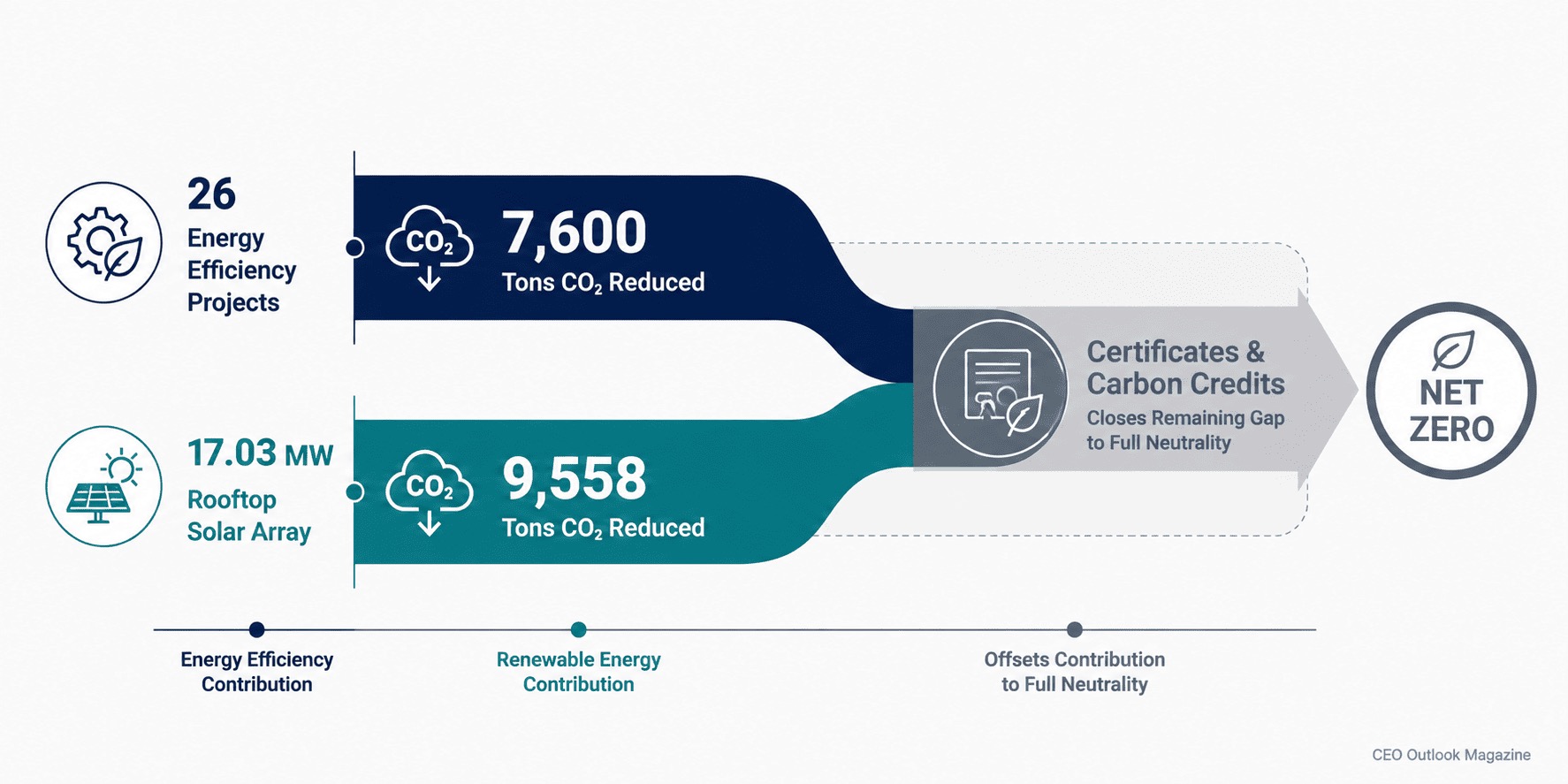
The 2024 results are grounded in specific, measured actions. The facility executed 26 energy-saving projects, including transformer upgrades, electrochemical storage, intelligent cooling controls, and ongoing improvements to its energy management system. These efforts delivered about 13 gigawatt-hours of annual energy savings, or roughly 7,600 tons of carbon emissions avoided. Separately, a 17-megawatt rooftop solar installation generated 16 gigawatt-hours in 2024, covering just over 10 percent of the facility's electricity needs and avoiding another 9,500 tons of emissions. These are not projections or estimates; they are verified reductions from operational changes and on-site generation.
The Honest Part of the Story: Certificates and Credits Closed the Rest of the Gap
A complete account requires acknowledging what efficiency and on-site generation did not achieve. According to LONGi's disclosures, the facility reached full carbon neutrality by supplementing operational reductions with purchased green electricity certificates and carbon credits. These are standard tools under ISO 14068 for bridging the gap between actual emissions cuts and full neutrality. The distinction is important: on-site measures delivered real, verified reductions, but the final step to zero-carbon status, as with most certifications, depended on offsets rather than eliminating all emissions through direct operational change.
Why the Sequencing Matters
The main lesson from Jiaxing is not about any single technology, but about sequencing. LONGi first established digital and operational maturity, confirmed by the WEF's Lighthouse criteria, before launching a full decarbonization effort. This order matters. Factories that treat operational and data infrastructure as a foundation, not a side project, can scale transformation beyond isolated pilots. Jiaxing's zero-carbon result depended on granular energy monitoring, automated controls, and robust data systems—exactly what enabled the identification and execution of 26 targeted, auditable energy-saving projects.
What This Means for Manufacturing Leadership
For manufacturing leaders considering decarbonization, Jiaxing offers a practical model. Build digital and operational maturity first; that infrastructure becomes the toolkit for identifying and delivering real emissions reductions. Prioritize on-site efficiency and renewable generation as the main, verifiable levers. Be transparent about how certificates and credits close the gap, rather than presenting the outcome as if every ton was eliminated through direct operational change.
Many organizations still treat efficiency and carbon neutrality as separate efforts, rather than building on a unified digital and operational foundation. The distinction is not academic; it determines whether decarbonization is a headline or a measurable outcome.