

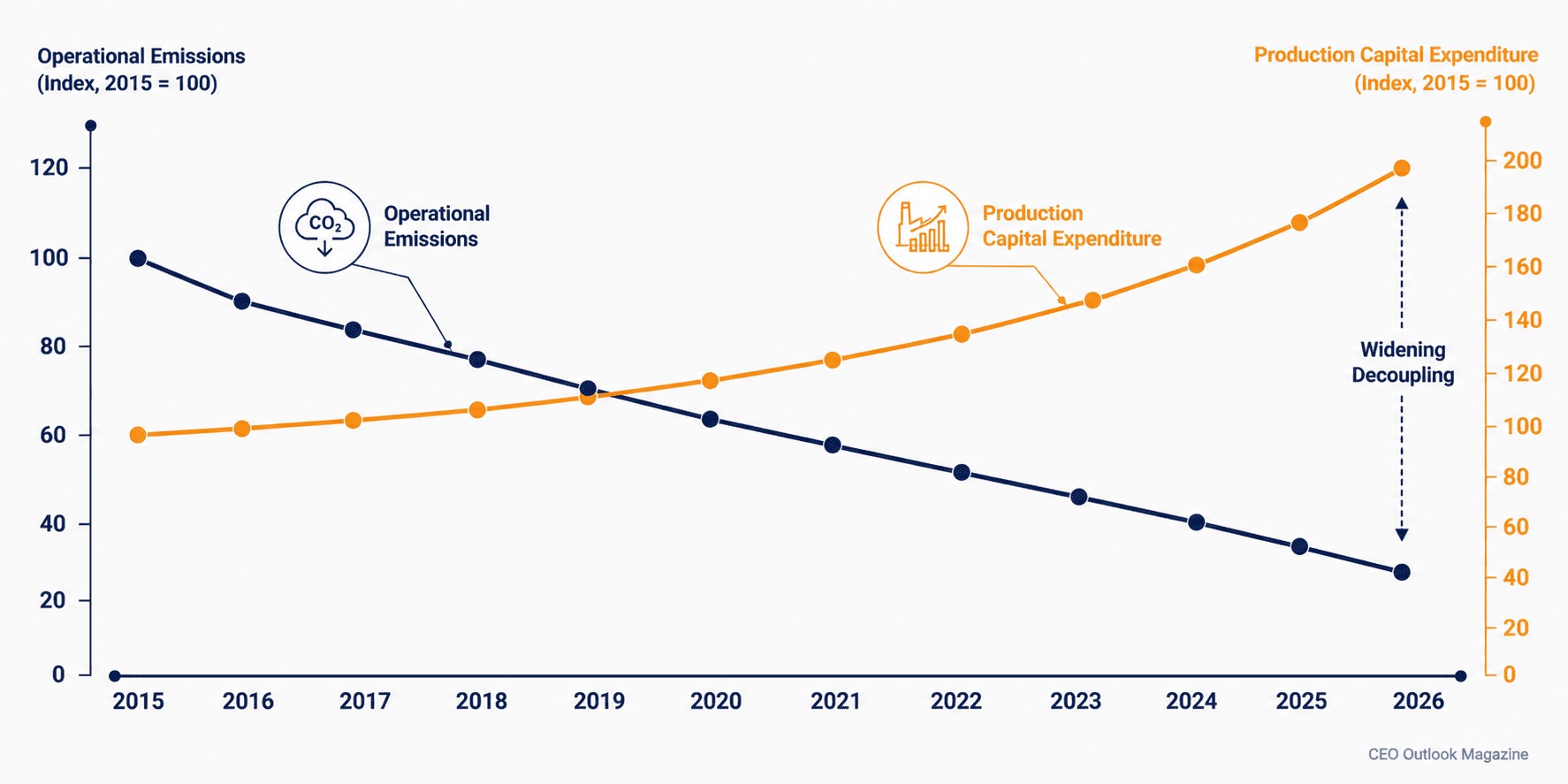
Lockheed Martin has reduced its operational emissions by about a third since 2015. Over the same period, production has not slowed; it has accelerated. The company is moving toward high-volume satellite manufacturing, joining Northrop Grumman and Boeing to meet increased demand from the Space Force and missile-defense programs. Northrop, for example, has allocated part of its $1.65 billion 2026 capital budget to expand production capacity. Emissions reductions achieved while output is rising, not falling, are more credible than those achieved by simply producing less. Lockheed’s reported numbers, confirmed by multiple independent sources, meet that standard.
Reduction Amid Production Growth
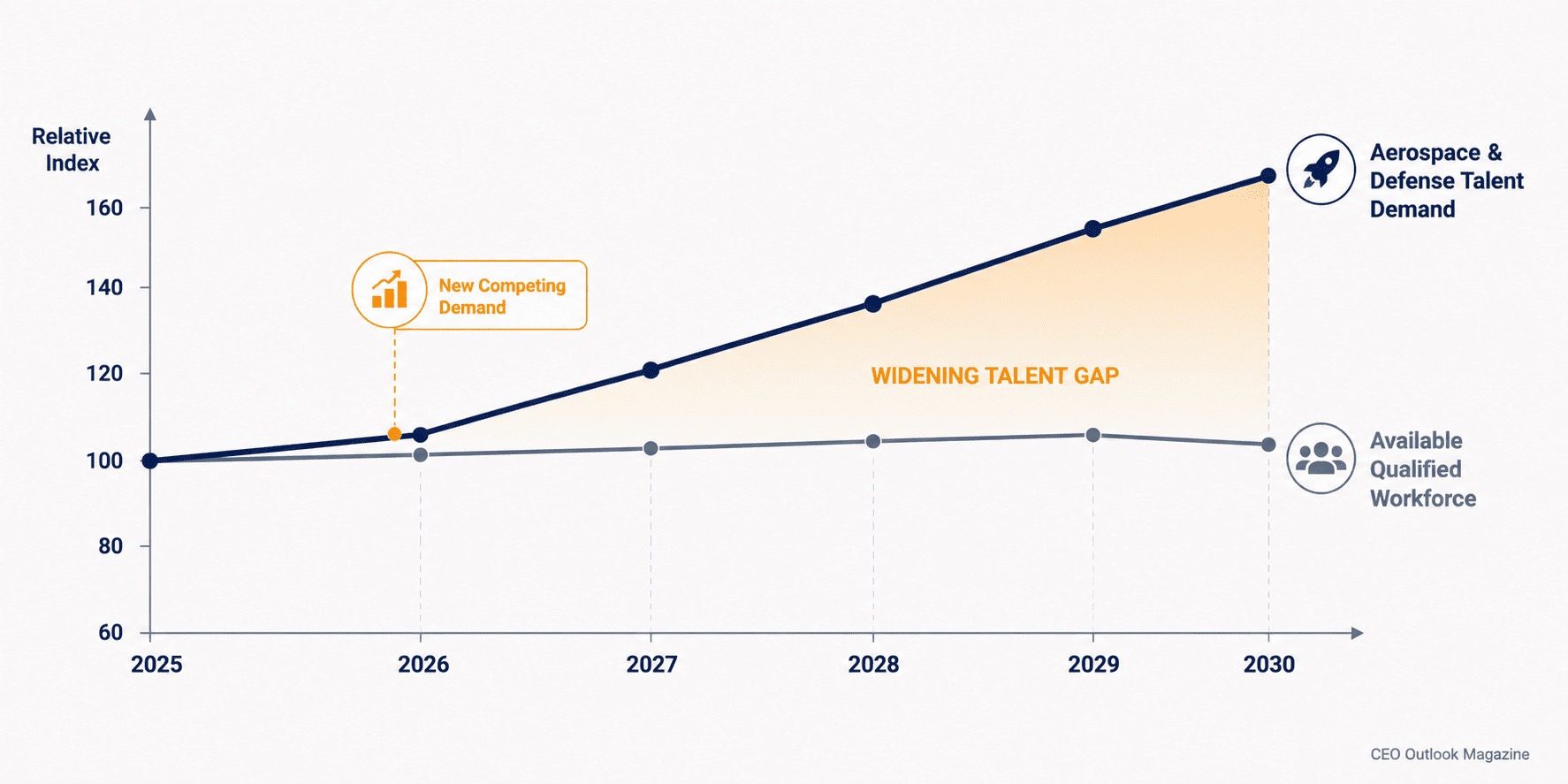
The context matters. Boeing, Northrop Grumman, and Lockheed Martin are moving from custom engineering to standardized, high-volume assembly to meet rising demand for orbital defense hardware. Northrop Grumman has committed to deliver 150 satellites for the Space Development Agency and is expanding its Space Park campus to support faster production cycles. Lockheed is scaling its digital infrastructure to connect orbital sensors with ground-based interceptors. This is not a theoretical growth plan; it is a real expansion underway. Any emissions reduction achieved in this environment is a direct test of whether decarbonization can keep pace with increased output.
The Numbers Behind the Claims
Independent sources confirm the scale of Lockheed’s reduction. Since 2015, the company has cut emissions by 34 percent, with 65 percent of its electricity now from renewables, according to its 2024 sustainability disclosures. Separate analysis shows a 53 percent reduction in Scope 1 and 2 emissions intensity from the 2015 baseline as of 2022. Lockheed’s current target is a 36 percent absolute reduction in Scope 1 and 2 emissions by 2030, measured against a 2020 baseline of 788,461 metric tonnes of CO2 equivalent. As of 2024, the company had already achieved 45 percent of the reduction needed to reach the 2030 goal. Lockheed has also set a net-zero operations target for 2050.
The Limits of the Achievement
A clear accounting requires stating what the reduction covers and what it does not. Lockheed’s total carbon footprint in 2024 was about 21.1 billion kilograms of CO2 equivalent. Scope 1 and 2 emissions—direct operations and purchased energy—make up roughly 660 million kilograms, a small share of the total. Scope 3 emissions, which include the broader value chain and suppliers, account for nearly 20 billion kilograms. The headline reduction targets apply only to Scope 1 and 2. For Scope 3, Lockheed relies on a supplier sustainability assessment program, which reached suppliers representing 60 percent of company spend a year ahead of schedule, and a renewable electricity partnership with Schneider Electric to help suppliers adopt clean power. These efforts are less precisely measured than the direct reductions.
Beyond ESG Positioning
Lockheed is not the only contractor following this approach. Northrop Grumman reports a 37 percent emissions reduction since 2017 and now requires suppliers to disclose climate-related risks. Defense industry leaders frame these efforts as supporting operational resilience, not just environmental goals. A supply chain that can be tracked for emissions can also be monitored for location and vulnerability—an operational advantage in an industry where supply chain disruption threatens readiness.
Why Progress Varies Across the Industry
This progress stands out because it is not consistent across the sector. Boeing’s 2025 sustainability report shows less than a 1 percent reduction in direct greenhouse gas emissions since 2023, despite a stated focus on direct cuts. Lockheed’s own filings disclose $669 million in environmental liabilities, a reminder that legacy costs remain significant even as new reductions are achieved. Internal debate is ongoing: in 2024, shareholder proposals pushed Lockheed and RTX to align emissions targets with peers like Airbus and Honeywell. Both companies recommended voting against these measures, reflecting real disagreement about how far and how fast to move.
Implications for Defense and Aerospace Leaders
For leaders reviewing their own emissions strategy, Lockheed’s path is instructive but incomplete: real, verified progress on direct operational emissions, achieved during a period of growth, alongside a clear admission that the larger supply chain challenge is being addressed through supplier engagement rather than hard targets. Organizations that present Scope 1 and 2 reductions as evidence of comprehensive decarbonization risk overstating what these numbers actually mean relative to the company’s total footprint.
Does your organization’s emissions narrative clearly separate direct operational progress from the much larger supply chain challenge? That distinction matters for any serious assessment of decarbonization in aerospace and defense.