

Regenerative agriculture is now positioned as a $310 billion opportunity for commercial investors, according to Boston Consulting Group. Public sector commitments, corporate supply chain investment, institutional farmland allocation, and impact capital are all increasing, with much of this activity converging in 2026. That narrative is accurate, but it misses a critical detail: venture capital investment in regenerative agriculture startups dropped from about $193 million in the first half of 2025 to just $63 million in the same period of 2026. The headline suggests capital is arriving faster than ever, but the reality is more nuanced. The type of capital entering the sector matters more than the aggregate number.
The Convergence That's Genuinely Real
Institutional capital is moving into regenerative agriculture for reasons that go beyond environmental sentiment. Historically, investors hesitated because it was difficult to verify whether regenerative practices were actually being implemented and whether the promised soil, biodiversity, and water outcomes were real. That has changed. Advances in satellite-based soil carbon monitoring, drone biodiversity assessment, and IoT soil sensors now provide continuous, field-level verification. This evidence base is what institutional investors need before deploying significant capital. The shift is less about new environmental awareness and more about the ability to measure results reliably. That is why capital is moving now, not five years ago, even though the agronomic case was already clear.
The Deal That Shows What's Actually Changed
Consider InSoil, a European climate finance company that secured a €120 million senior secured credit facility from Pollen Street Capital in 2026 to expand lending to small and medium-sized farms adopting regenerative practices. Since 2020, InSoil has financed over 3,500 agricultural SMEs and collected more than 15,000 soil samples, building one of Europe's largest proprietary soil carbon datasets. This data supports both credit underwriting and climate impact measurement. The pattern is clear: private credit and institutional capital are backing platforms that can deploy capital at scale, supported by real environmental data rather than unproven claims.
The Regulatory Engine Driving Corporate Capital Specifically
Corporate capital is moving into regenerative agriculture largely because of regulatory pressure, not just voluntary sustainability goals. The European Union's Carbon Removals and Carbon Farming framework, the first government-backed standard for certifying soil carbon removals and reductions, takes effect for agriculture in 2026. Separately, the EU's Corporate Sustainability Reporting Directive now requires companies to audit agricultural Scope 3 emissions, provide farm-level traceability, document methodologies, and clearly separate internal emissions reductions from external climate contributions. This is why food companies, agribusinesses, and financial institutions are allocating capital to verified regenerative supply chains: legal requirements now demand traceable, farm-level data.
The Honest Complication: Venture Capital Tells a Different Story
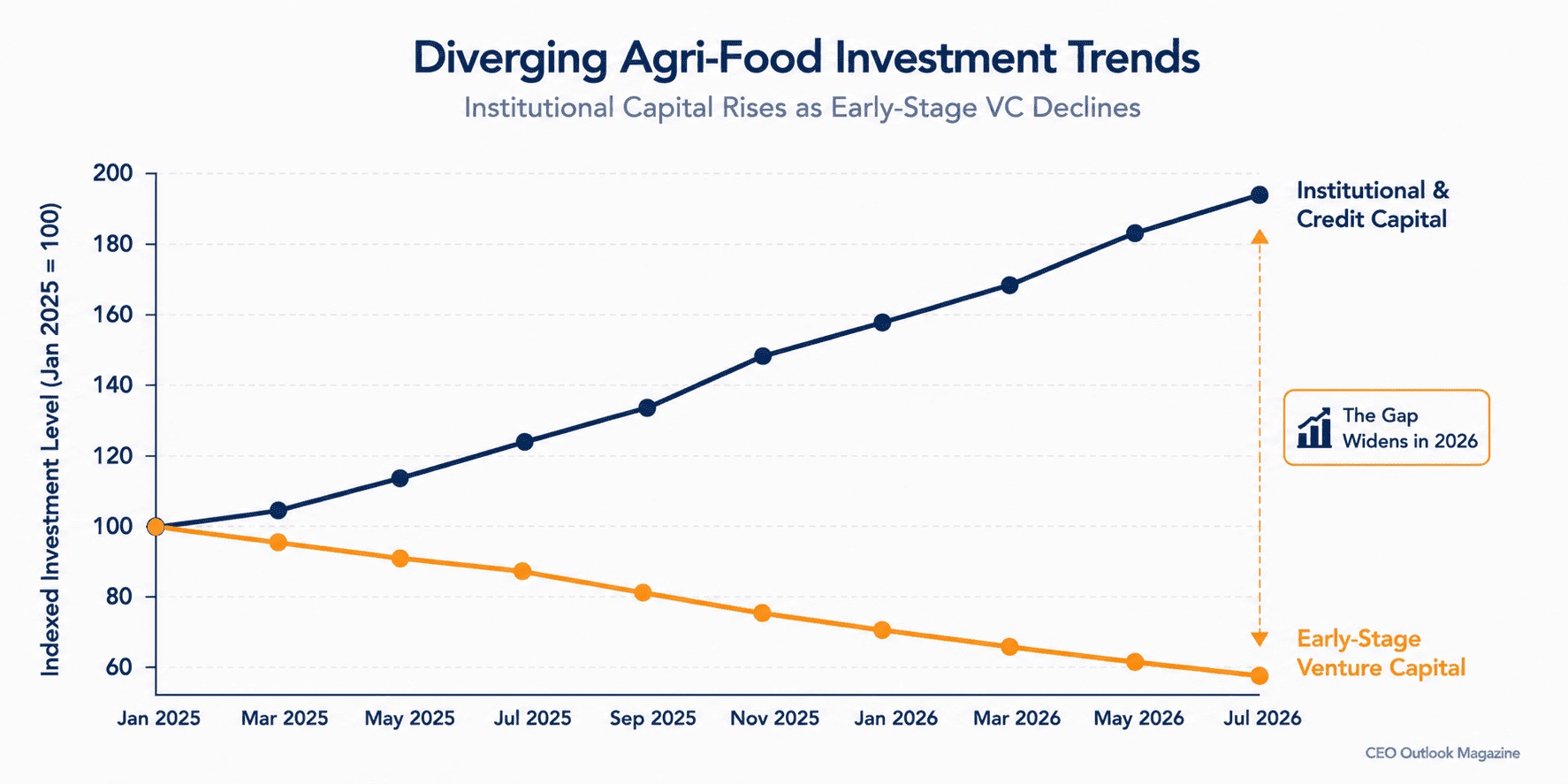
Venture capital tells a different story. While regenerative agriculture venture funding grew from about $180 million in 2024 to $255 million in 2025, the trend reversed in 2026. From January to early July, only $63 million was raised, down from $193 million in the same period a year earlier. The remaining capital is concentrated in later-stage, already-validated companies. In 2025, Series B and later rounds made up 76 percent of total venture capital, and follow-on financings accounted for 81 percent. Investors are backing companies with operating history and proven adoption, not new entrants. First financings dropped from 53 percent of deals and 19 percent of capital in 2025 to just 17 percent of deals and 3 percent of capital in 2026. The funding ladder is not maturing; it is breaking. There were no qualifying Series A rounds in 2025, and so far in 2026, no Series C, Series D-plus, or growth equity rounds.
What This Actually Means: Which Capital Is Paying Attention, and Which Isn't
There are two distinct capital markets under the regenerative agriculture label, and they are moving in opposite directions. Institutional credit, corporate supply chain investment, and farmland allocation are scaling up, driven by better verification infrastructure and regulatory compliance, especially in Europe and increasingly in North America. Early-stage venture capital for new regenerative agriculture technology companies is not keeping pace. The capital that remains is focused almost entirely on proven companies, not innovation.
What This Means for Agriculture and Finance Leadership
For agriculture and finance leaders, the distinction is critical. Established regenerative agriculture platforms with operating history and real soil or carbon data infrastructure are now in a favorable capital environment, supported by institutional credit and corporate compliance demand. Earlier-stage innovators without that track record face a much tougher funding environment than the headline narrative suggests. Treating these two markets as one risks misjudging where real capital access exists in 2026.
The practical question for leadership is whether your regenerative agriculture strategy is positioned to access institutional and credit capital, or whether it depends on an early-stage venture environment that has contracted this year. The answer will determine which opportunities are actually available.