

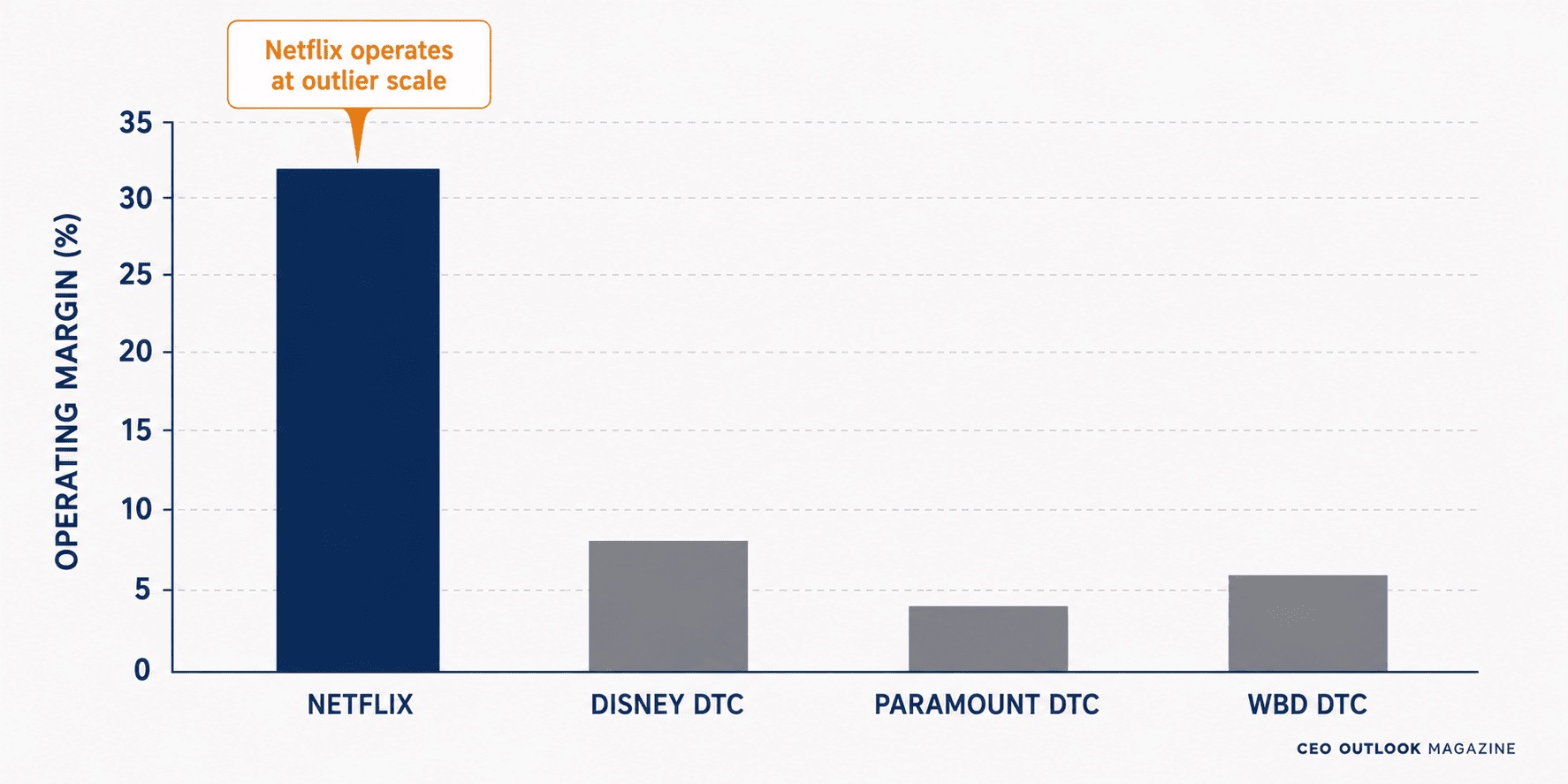
Netflix now operates at a 32.3 percent margin, generates over $5 billion in free cash flow each quarter, and has surpassed 325 million subscribers. On the surface, streaming has become a profitable business. But the path to profitability has meant discarding nearly every principle that once set streaming apart from cable. The economics now working are not the ones the industry originally promised.
The Number That Looks Like Vindication
The scale of the industry's recent profitability turn is real and worth taking seriously. Netflix's revenue climbed from roughly $ 31.6 billion. The profitability shift is real. Netflix's revenue rose from $31.6 billion in 2022 to an expected $49 billion in 2026, with margins expanding from 20 to 32.3 percent. Disney's direct-to-consumer segment moved from $143 million to $1.3 billion in profit. Paramount's streaming business turned a $211 million loss into $153 million in net income. Warner Bros. Discovery's direct-to-consumer profit rose to $977 million from $268 million. For the first time, all major platforms are growing revenue and generating profit at the same time. came from enforcing paid password sharing and launching a $6.99 ad-supported tier, which together added nine million subscribers in a quarter and lifted margins. Industry-wide, the focus has moved from growth at any cost to prioritizing profitability, mainly through price hikes, restricting password sharing, adding advertising, and consolidating content libraries. Each of these steps reverses a core promise streaming once made: no ads, simple pricing, household sharing, and broad access without multiple subscriptions.
The Merger That Reveals the Real Math
The industry's new profitability depends on consolidation, not organic growth. Netflix agreed to acquire Warner Bros. Discovery's streaming and studio assets for $45 billion, aiming to combine its distribution with HBO, Warner Bros. Studios, and CNN. The deal collapsed when Paramount Skydance offered a higher all-cash bid, which Warner Bros. Discovery's board accepted. Paramount's acquisition, valued at roughly $110 billion, merges Paramount+, HBO Max, and Pluto into a single platform with over 15,000 titles, targeting the scale now required for profitability. Even Netflix, the sector's financial leader, chose not to match the bid, unwilling to pay legacy-content multiples that current economics do not support. The limits of scale are now clear, even for the largest players.
The Promise That Didn't Survive
The core tension is now visible. As dominant platforms absorb major content libraries, the industry is rebuilding the same bundling and concentration that defined cable. Subscribers are pushed to bundle services, accept advertising, and navigate consolidated libraries controlled by a shrinking number of companies. The economics that now work are, in practice, cable's original model delivered through a streaming interface.
The Niche Counter-Example
There are exceptions. Crunchyroll has built a profitable business focused on anime, reaching 21 million subscribers in 2026, generating over $1 billion in annual customer spending, and maintaining churn rates on par with Netflix, despite a much smaller content library. This points to a viable alternative: focus on a differentiated, loyal audience instead of trying to match the largest players in scale.
What This Means for Media Leadership
For media executives, streaming's profitability proves only that the business can make money under current conditions. It does not validate the original consumer proposition that drove the industry's expansion. Leaders who assume today's model is stable, or who expect a return to the original ad-free, unbundled promise, are both missing the reality. The economics now in play are not the ones streaming was built on, and the successful platforms are those that have recognized and adapted to this shift.
Is your organization's media strategy accounting for how thoroughly streaming's profitable model has reconverged with cable's original economics? CEO Outlook Magazine wants to hear your perspective — share your view with our editorial team, and subscribe to our newsletter for more coverage on the financial forces reshaping media and entertainment.