


Biotech venture capital raised over US$9.1 billion in the first half, its highest mark since 2022. The headline number obscures the reality: 76 percent of that capital went to megarounds of US$100 million or more, and nearly two-thirds of all rounds funded companies with drug candidates already in human trials. The earliest, riskiest stage—the foundation for future breakthroughs—is now largely unfunded.
A Foundational Funder Steps Back
The US National Institutes of Health has long underwritten the basic research and early discovery work that private capital avoids. That foundation is shrinking. Legislative cuts in 2026 reduced the NIH budget by about US$18 billion, down to US$27.5 billion—a nearly 40 percent drop. Nearly every new drug approved in the US between 2010 and 2019 had roots in NIH-funded research.
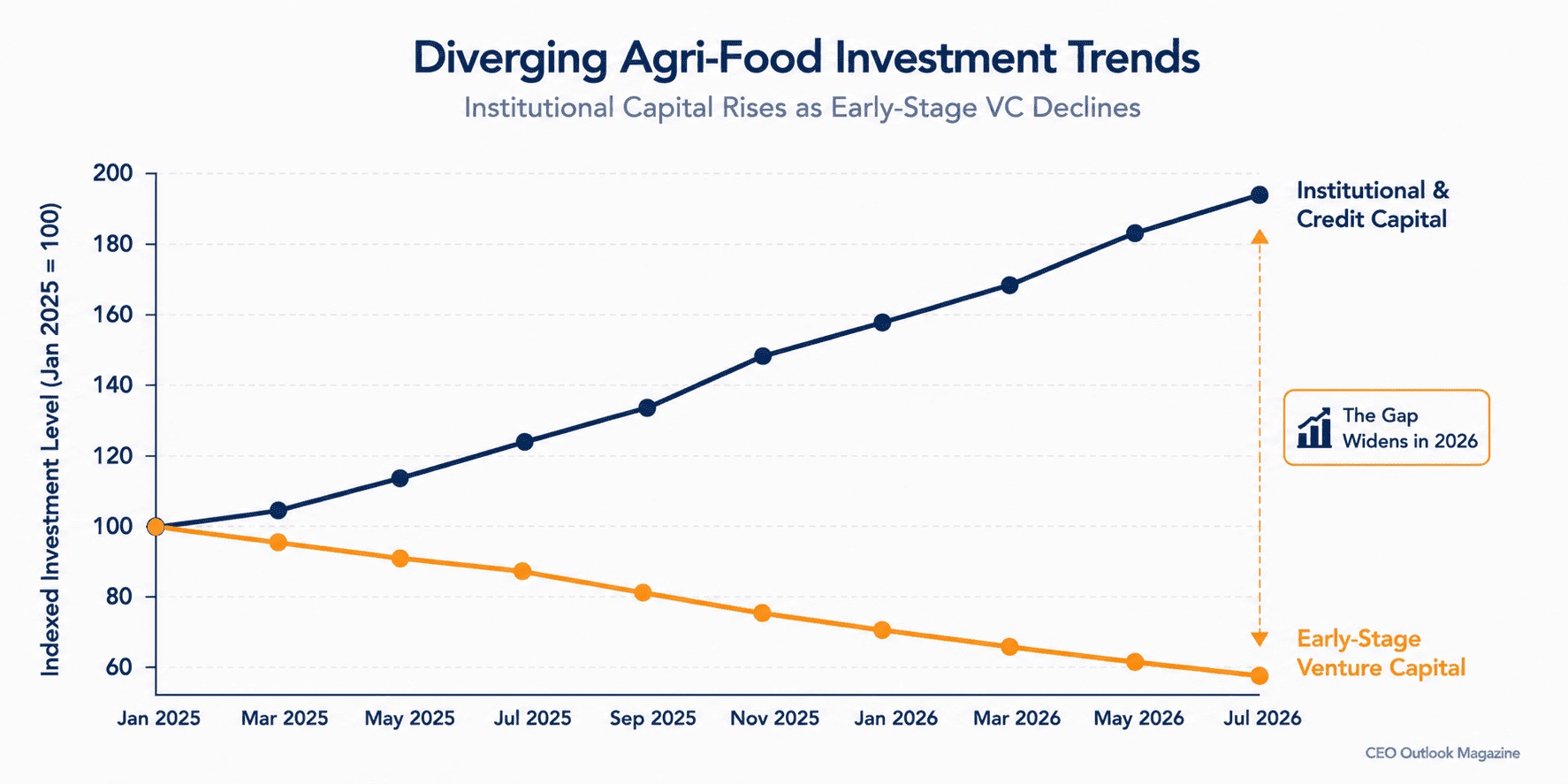
This is not a marginal line item. It is the mechanism by which fundamental discoveries made in universities become the foundation for new medicines. NIH funding turns open-ended academic research into the platform technologies biotech and pharma depend on. When that funding contracts, the impact is delayed but significant: a decade from now, the pipeline will have fewer foundational discoveries because the seed-stage research was never funded. Venture capital and pharmaceutical company R&D budgets would absorb the shortfall as public funding recedes. The data shows the opposite. Venture capital's recent rebound has flowed disproportionately toward companies with de-risked, later-stage assets, biotechs that already have a drug candidate in human testing, rather than toward the seed-stage, first-time-founder companies attempting to translate a genuinely early discovery into a viable company. Seed and Series A activity in biotech is currently on pace for its lowest annual count since before the pandemic, even as headline venture dollars climb.
Some of what gets labelled as early-stage funding is misleading on close inspection. A meaningful share of recent Series A and B megarounds have gone to companies founded five or more years earlier, now presenting as fresh early-stage opportunities while actually representing mature operations. Much of what is labelled early-stage funding does not stand up to scrutiny. Many recent Series A and B megarounds have gone to companies founded five or more years ago—mature operations presenting as early-stage. Truly nascent, first-time-founder biotech, often built around discoveries that depend on NIH seed funding, now faces a far less hospitable environment than five years ago—an allocation decision for an individual company managing its own risk. Collectively, across the industry, it means the earliest and most uncertain stage of the innovation pipeline, foundational academic discovery, has essentially no natural funder left willing to absorb that risk at scale.
Where the Risk Is Actually Landing
The financial risk in early-stage medical innovation has not vanished. It has shifted downward, onto cash-strapped academic labs, first-time biotech founders competing for a shrinking pool of seed capital, and non-traditional sources like venture philanthropy, alternative government programs, and equity crowdfunding. None of these were designed to support the full weight of early-stage innovation at scale.
There is also a geographic shift underway. As US early-stage biotech funding contracts, some venture capital is flowing to companies built around drug prospects from China or other international sources, rather than new domestic discoveries. Biotech financing in the UK is showing early signs of recovery, indicating that capital is not retreating from early-stage life sciences everywhere, even as the US model faces structural strain.
The Decision Facing Industry and Institutional Leadership
For industry leadership, the strategic implication is concrete. A funding structure concentrated at the de-risked, later stage is consuming a pipeline it is not replenishing. Leaders relying on the current environment to keep producing acquirable, clinically validated targets are betting that someone else—government, philanthropy, or under-resourced founders—will fund foundational discovery in the interim.
That is a bet, not a guarantee. Organizations with the balance sheet have a strategic opening to fund earlier-stage discovery directly—through venture arms, academic partnerships, or non-dilutive grants—instead of waiting to acquire what survives. The industry has long treated basic research funding as someone else's problem. The current gap suggests that assumption is no longer safe.
Industry leadership must decide whether to keep relying on others to fund foundational discovery or take a more active role in supporting early-stage innovation directly. Industry leadership now faces a choice: continue relying on others to fund foundational discovery, or take a more active role in supporting early-stage innovation. The current funding structure will not sustain the pipeline indefinitely. Senior executives need to decide whether to address this gap or accept the risks of a shrinking base of discoveries.