


The World Economic Forum's Global Lighthouse Network has identified 223 factories in over 30 countries that demonstrate, in operational terms, that Industry 4.0 delivers results. Yet, more than ten years after the term became mainstream, about half of small and midsized US manufacturers still rely on manual processes or basic digital tools. The technology itself is not in doubt. The real question is who can access it, and when.
A Decade of Proof at the Very Top
Industry 4.0's effectiveness is no longer up for debate. The Lighthouse Network, covering 40 industries, documents factories that have scaled digital and AI technologies into measurable gains in productivity, supply chain resilience, sustainability, and workforce outcomes. These are not isolated pilots. They are operational proof that connected, data-driven manufacturing creates real value when executed well. The unresolved issue is not whether the model works, but why so few factories outside this elite group have reached that level.
The Divide Nobody Puts on the Cover Slide
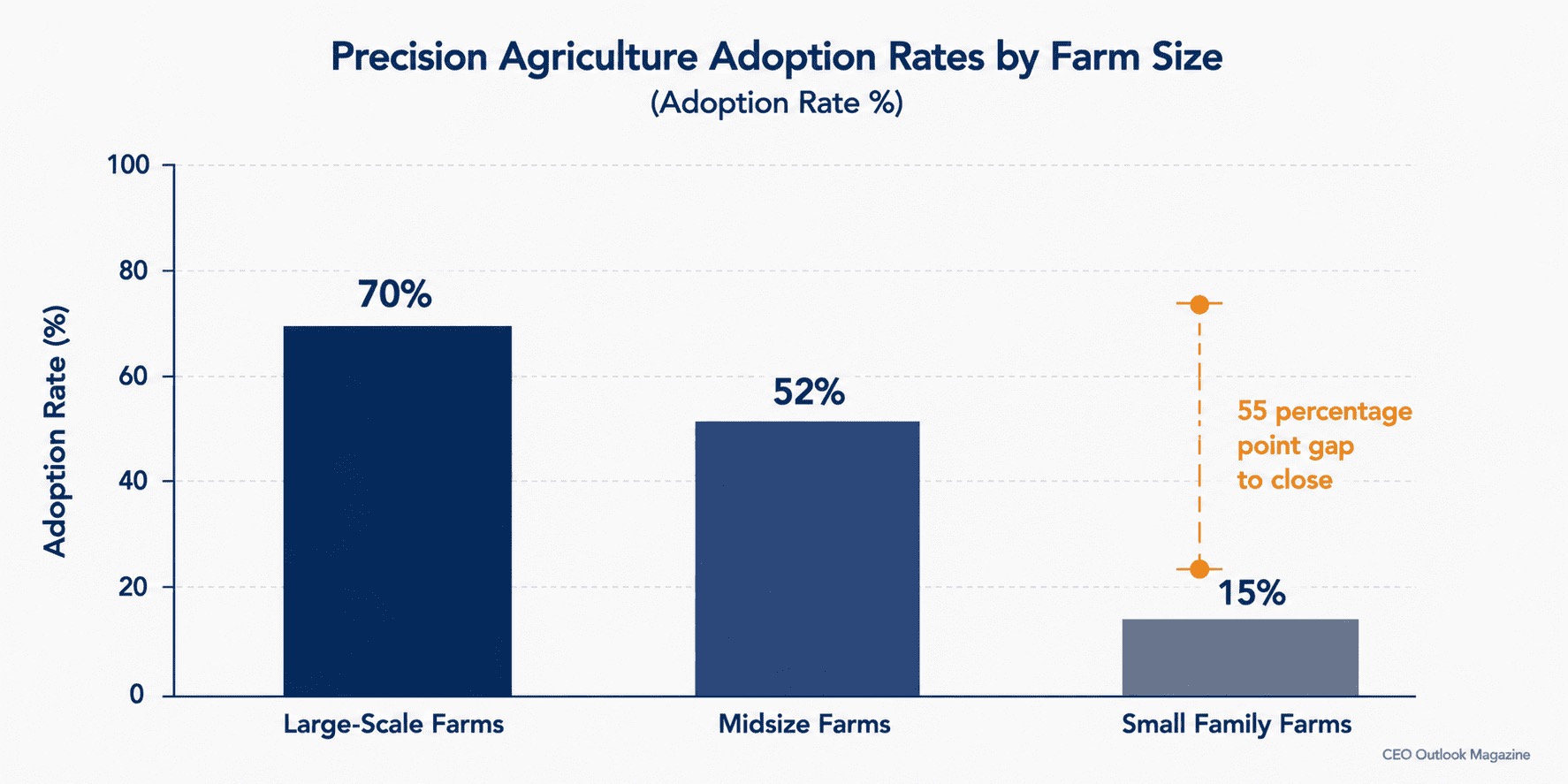
The uncomfortable data sits just beneath the Lighthouse Network's success stories. The data behind the Lighthouse Network's success stories tells a different story. In the UK, large manufacturers nearly doubled their AI adoption to 44 percent between 2023 and 2025. Small firms reached only 26 percent, according to research from the Cambridge Bennett School. In the US, a 2026 survey found that about half of small and midsized manufacturers still operate with manual processes or basic digital tools. Sectors like chemicals, wood products, and textiles remain at the bottom of digital maturity scales, with roughly 60 percent of companies in those industries reporting no digital workflow. It is a story about a genuine structural split: a well-resourced minority operating factories that would be unrecognizable to a manufacturing executive from 2015, sitting alongside a much larger population of small and midsized manufacturers whose operations remain closer to where the industry started than to where the Lighthouse Network sits today.
Why Size Determines the Timeline, Not Intent
The gap is not about smaller manufacturers missing the value of digital transformation. Research shows they lag because of tight capital, limited technical expertise, and the challenge of scaling new systems without dedicated teams. When asked, manufacturers cite lack of digital skills and culture as the main barrier, ahead of cost or technology access. Large enterprises can afford failed pilots and second attempts. Smaller manufacturers usually get one shot, with little room for error.
The Cost of Staying Behind Is Not Abstract
Remaining on the wrong side of this divide carries a real, quantifiable cost, not merely a competitive disadvantage. Staying behind is not just a competitive risk; it comes with measurable costs. Manufacturers using outdated, disconnected systems lose about 45 hours per month to debugging legacy code. Irish SMEs without integrated ERP systems face around €47,000 in annual losses from inefficiency and missed opportunities. These are not one-time hits. They show up as ongoing operational drag—wasted hours, delayed decisions, inventory mistakes, and missed business, compounding month after month whether or not leadership is watching. The gap appears to be actively widening rather than narrowing as more time passes. A 2026 survey of 847 enterprise technology leaders across 12 industry verticals found Industry 4.0 adoption explicitly bifurcating: organizations that have moved past isolated pilots into genuine factory-wide integration are seeing compounding returns that build on themselves year over year, while organizations still running disconnected proofs-of-concept face competitive gaps that grow increasingly difficult to close the longer they persist. A decade ago, a manufacturer choosing to delay digital investment was making a reversible strategic bet. Today, that same delay increasingly functions as a structural disadvantage that compounds against a company every year it continues.
What This Means for Manufacturing Leadership
For leaders of small and midsized manufacturers, copying a Lighthouse-scale transformation on a smaller budget is not a viable strategy. That approach fails for predictable reasons: not enough technical expertise, limited capital, and no room for trial and error. What works, where progress is real, is a staged approach: targeted training in automation and data, structured mentoring through the toughest implementation phases, and sometimes direct policy intervention. Saudi Arabia, for example, now proposes that new SME factories meet a minimum digital maturity from day one, building the foundation up front instead of retrofitting later.
A decade in, the technology is proven. The open question is whether manufacturers without Lighthouse-level budgets can find a practical path forward before the gap becomes impossible to close.
Most manufacturers are not operating at Lighthouse standards, and the gap is not closing on its own. The practical question for leadership is not whether to pursue digital transformation, but how to do so with the resources and constraints at hand. The difference between leaders and laggards is increasingly structural, not aspirational.