

Beyond Meat’s stock is down more than 90 percent from its 2021 high. Cultivated meat funding has fallen by a similar margin. Since September 2024, over 70 alternative protein businesses have merged, been acquired, gone insolvent or closed. By most headline metrics, the sector’s speculative phase is over. Yet global plant-based food sales still grew 3 percent in 2025. More people bought plant-based meat and dairy last year than the year before, even as funding contracted. Both trends are real. The more relevant question now is which companies have survived the correction and why.
The Collapse by the Numbers
The shakeout has been severe. Between late 2024 and early 2026, more than 40 ventures across plant-based, fermentation, cultivated meat and insect protein either closed, merged at distressed valuations or filed for bankruptcy. Nineteen plant-based companies were acquired in the past year. Meatable and Believer Meats, both cultivated meat startups, failed to secure follow-on funding and shut down. Consolidation has changed the landscape: Nexture Bio absorbed Matrix FT, Gourmey and Vital Meat merged to form Parima, and Fork & Good acquired Orbillion Bio. Insect protein saw the sharpest collapse. Ÿnsect, once the sector’s flagship with over $600 million in funding, entered judicial liquidation, triggering failures among smaller European insect farming ventures. Complication: Sales Actually Grew Globally
What complicates any simple "the hype died" narrative is what actually happened to consumer demand during this same period. The Good Food Institute's 2026 State of the Industry report found that consumer demand did not follow the same downward trajectory as funding. According to the Good Food Institute’s 2026 State of the Industry report, global plant-based food sales grew 3 percent in 2025. This growth came despite concerns about ultra-processed foods and a sharp decline in venture capital. The US market diverged: retail sales of plant-based meat and seafood fell 7 percent in 2024 to $1.2 billion, with unit sales down 11 percent. The collapse was not in global demand, but in a US-centric, venture-funded growth model that relied on continuous fundraising rather than sustainable unit economics. It relied on continued capital raises. Impossible Foods now maintains retail presence in more than 40,000 stores. Perfect Day's precision fermentation approach has generated genuine revenue at scale, shipping more than 50 million servings of animal-free dairy protein, concrete evidence of commercial viability rather than projected potential. NotCo expanded into 15 countries during the exact period when Beyond Meat's stock was collapsing, directly illustrating that the category split sharply into winners and losers rather than failing as a whole. These are not marginal survivors clinging to relevance. They prove that specific alternative protein business models can achieve real commercial scale, even as the broader sector's speculative capital dried up around them.
Where the Capital Is Actually Going Now
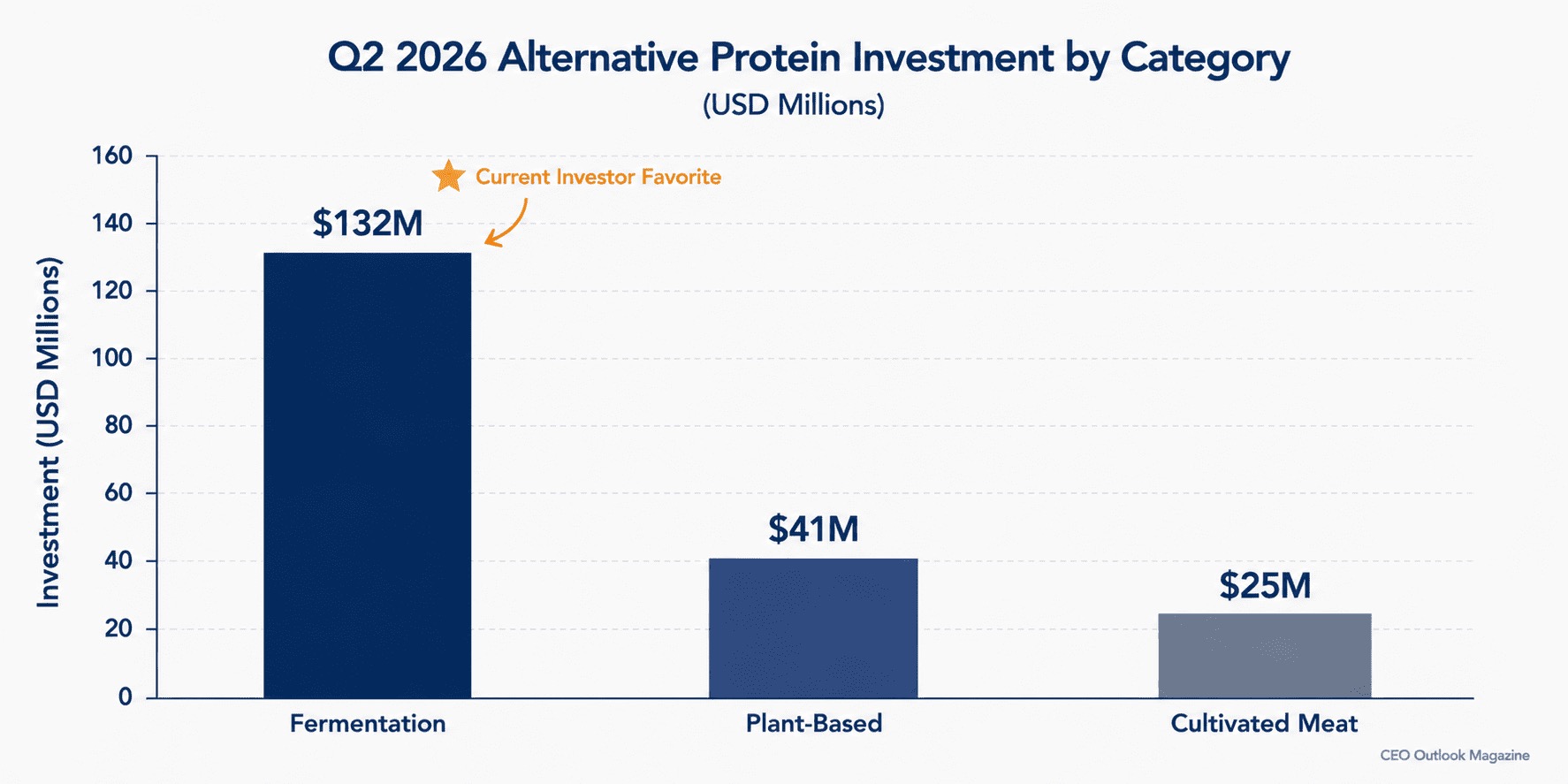
Investment data from 2026 shows capital is reallocating, not exiting. In the second quarter, fermentation companies raised $132 million, compared to $41 million for plant-based and $25 million for cultivated meat. For 2025, total alternative protein investment dropped to $881 million from $1.1 billion in 2024. Plant-based funding rose 39 percent to $450 million, while fermentation funding fell 43 percent and cultivated protein funding dropped 48 percent. Capital is concentrating in segments with near-term commercial viability and regulatory clarity, and pulling back from those with unresolved structural risks.
Why Cultivated Meat Specifically Is Stuck
Cultivated meat’s main challenge is technical, not regulatory. The FDA approved cultivated chicken for sale in 2023, but production costs are still estimated at five to one hundred times those of conventional meat, depending on the analysis. Current technology has not closed this gap. In addition, cultivated meat now faces a patchwork of state-level prohibitions in the US, limiting commercialization even where federal approval exists. Plant-based and fermentation-derived proteins continue to move through established regulatory channels, which is reflected in recent investment patterns.
What This Means for Food and Agriculture Leadership
For food and agriculture leaders, the lesson is not that alternative proteins failed or that the earlier optimism was justified. The sector is at a turning point. Continued success is not guaranteed and will depend on real operating results, not narrative. The companies worth attention now have proven revenue at scale, such as precision fermentation businesses and plant-based leaders with established retail presence. The broader category narrative that drove the funding boom is no longer relevant.
Organizations evaluating alternative protein partnerships should focus on verified commercial traction, not the broader category narrative that peaked in 2021.