

A satellite detects a missile launch and relays tracking data through a mesh network to missile defense systems or field units. Military planners call this sensor-to-shooter connectivity. Historically, defense acquisition has struggled to deliver these kinds of real-time, high-stakes technical solutions at speed. In 2026, commercial space companies are delivering them at operational scale, on timelines that contrast sharply with the multi-decade procurement cycles that have defined defense for decades.
The Architecture That Changes the Math
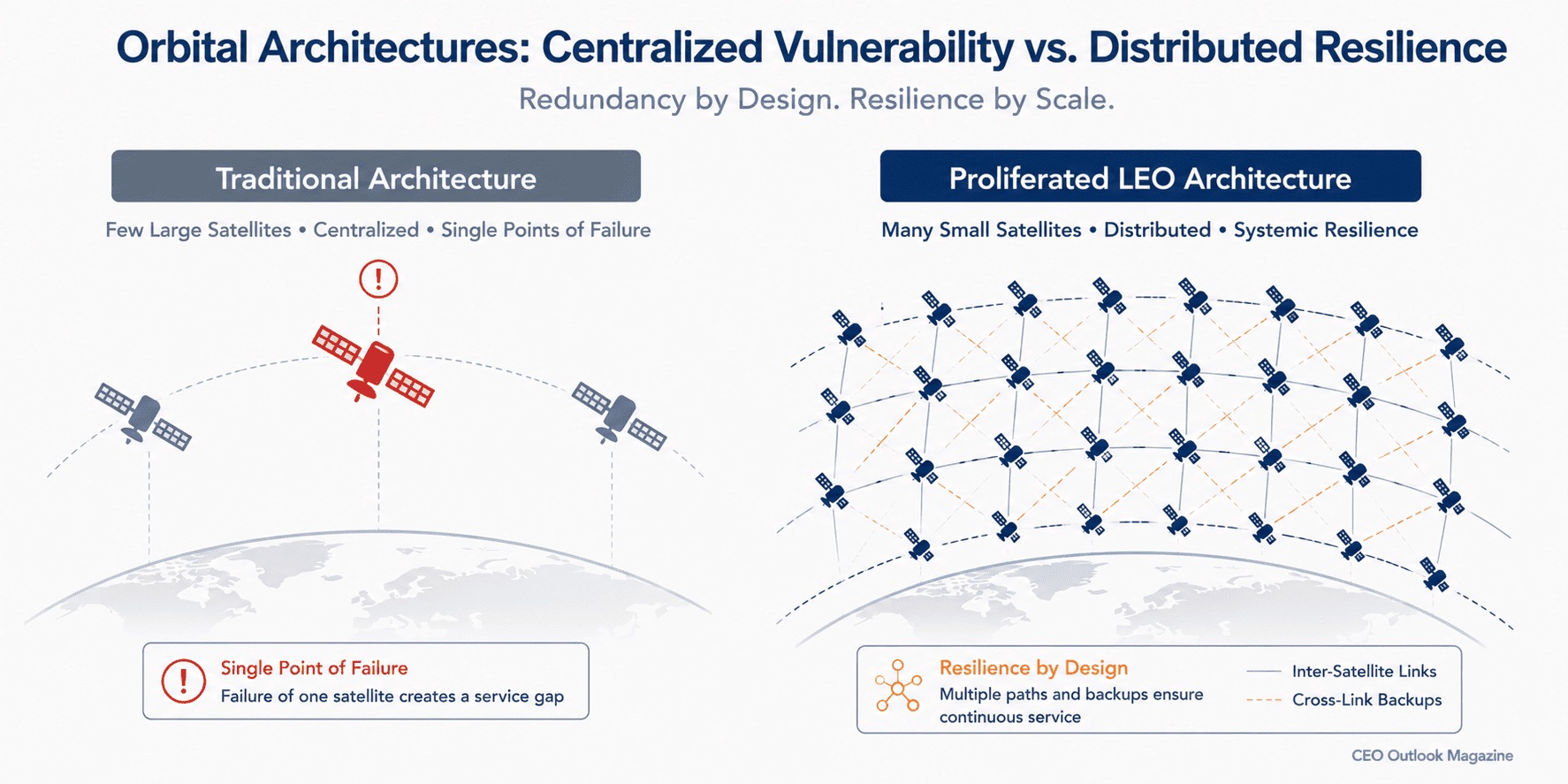
The shift is architectural, not just technological. Traditional missile warning relied on a handful of expensive satellites, each a single point of failure. The new model uses thousands of lower-cost satellites in low Earth orbit, distributed across a mesh network. This architecture is more resilient: losing one satellite does not compromise the system. Commercial space companies are positioned to mass-produce and deploy these satellites at a speed and cost structure that legacy defense contractors cannot match.
The Scale This Has Already Reached
The contract activity is significant and recent. In 2026, SpaceX secured a $2.29 billion Space Force contract to build a military data network using Starshield satellites, a variant of Starlink. The constellation will be operated by the Space Force. General Michael Guetlein, who leads the Golden Dome missile defense program, confirmed a $10 billion budget increase, in part to fund this network. Separately, SpaceX received $1.6 billion for 18 Falcon 9 launches through 2027, carrying Pentagon satellites for sensing and targeting, and $57 million to demonstrate data links for Golden Dome. SpaceX now holds about $22 billion in federal contracts across NASA, the Space Force, the National Reconnaissance Office, and the Space Development Agency, making it one of the largest non-traditional defense contractors. The Pentagon’s budget signals a shift: the proliferated LEO program ceiling rose from $900 million to $13 billion, indicating this infrastructure is now seen as essential, not experimental.
Why This Procurement Actually Moves Fast
This shift is not happening through traditional acquisition channels. The Space Development Agency’s Proliferated Warfighter Space Architecture is delivered in two-year tranches using Other Transaction Authority agreements with commercial contractors. This accelerated contracting model has expanded rapidly since 2016. In early 2026, the Missile Defense Agency approved 2,440 of 2,463 applicants for a new contract vehicle, opening a ten-year window worth up to $151 billion for Golden Dome-related work. The participant pool includes legacy primes, venture-backed entrants, launch providers, and over 340 academic institutions and small businesses. The structure is designed to move faster than traditional single-prime acquisition.
The Broader Ecosystem Beyond SpaceX
SpaceX draws the most attention, but missile warning and tracking contracts are distributed across a range of companies. In July 2026, the Space Force awarded $1.75 billion for 36 satellites: L3Harris received $955 million for 18 hypersonic and ballistic tracking variants, and Sierra Space received $798 million for 18 missile warning and tracking variants. These satellites operate on separate orbital planes and are designed for interoperability with previous tranches. Venture-backed firms like Anduril, True Anomaly, and ICEYE are now competing for roles once reserved for established primes. The result is a broader restructuring of who builds critical defense space infrastructure.
The Honest Unresolved Risk
Integrating commercial infrastructure into core national security capability carries genuine, unresolved risk that deserves acknowledgement rather than dismissal. Integrating commercial systems into wartime operations raises real, unresolved questions about denial of service and attribution when satellites are targeted or disrupted. Using commercial systems in wartime raises questions about denial of service, attribution when satellites are targeted or disrupted, and managing orbital debris as thousands more satellites enter low Earth orbit. These are not theoretical concerns. They are debated within the space and defense policy community as the architecture scales, and they remain open issues even as missile warning and tracking capabilities advance. Instead of commercial-style contracting, tranched delivery cycles, and a genuinely broad participant base spanning primes to startups to universities, the pace of actual capability delivery has moved considerably faster than traditional defense acquisition. Organizations operating in this space, whether established primes or new entrants, are competing in a genuinely different procurement environment than the one still constraining most of the broader defense industrial base.
Most organizations are still structured for traditional acquisition timelines. The question is whether they can adapt to the faster, more competitive procurement model now reshaping defense space architecture. The answer will determine who leads and who follows as the industry changes.