

In Argentina, only 10 percent of large farms use advanced precision agriculture technologies, yet these same farms control 78 percent of the country's agricultural land. The pattern is clear: technology adoption is concentrated among the operations that already dominate the landscape. Meanwhile, small, diversified farms—which account for most farming operations globally—are largely excluded from the adoption curve.
The Divide Showing Up in Every Country's Data
This is not limited to one market. The World Intellectual Property Organization's 2026 report found the same divide across every region: cost, access, and suitability consistently disadvantage smaller farms. In South Africa, for example, small farms face more barriers to adopting new technology than larger ones for these exact reasons. Globally, small farms—those under two hectares—make up most of the world's farms by number but control only a small fraction of total farmland. The result: the farms least able to adopt precision technology are also those with the least land to justify the investment.
What the US Data Shows With Precision
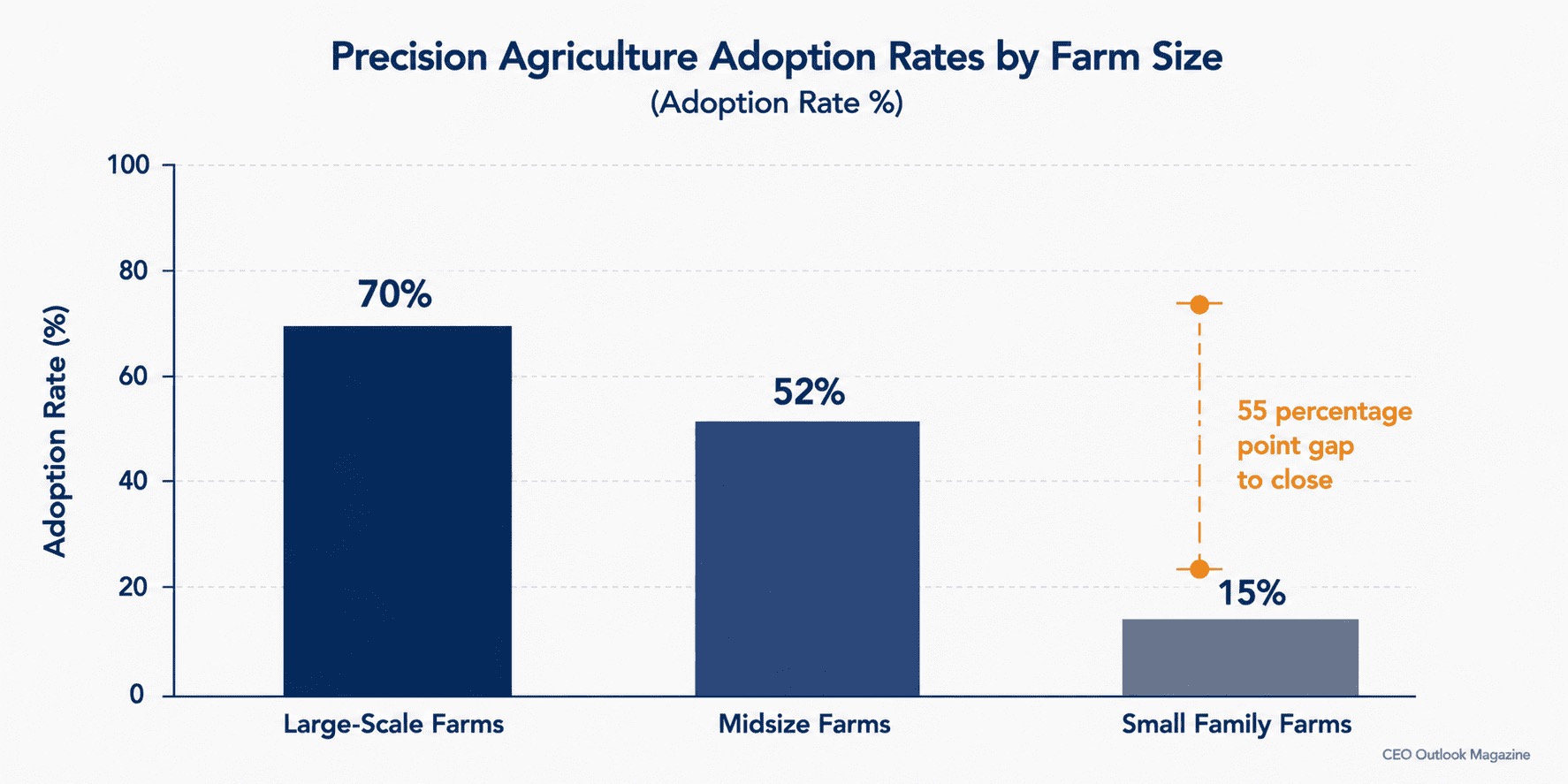
US Department of Agriculture data illustrates this gap with genuine statistical precision. US Department of Agriculture data makes the gap clear. In 2023, 70 percent of large-scale crop farms and 52 percent of midsize farms used guidance auto-steering systems, up from single-digit rates in the early 2000s. The technology has spread where the economics support it. Small family farms—those with gross cash farm income under $350,000—show the lowest adoption rates in every technology category, with the lowest levels among farms run by retired operators or with sales below $150,000. Overall, only about 27 percent of US farms used any advanced precision agriculture practice in 2023, a modest baseline after two decades of growth among the largest operations. 76 percent of surveyed farmers had not adopted any precision agriculture technology at all, meaning 76 percent had not. The reasons cited point to something more structural than simple cost aversion. Roughly 12 percent doubted whether the technology would actually prove profitable on their operation. Critically, small, diversified farms specifically struggle to see how precision tools proven effective on large corn and soybean monocultures actually apply to their own mix of vegetables, livestock, or orchards, a genuine technology-fit problem rather than a pure affordability problem. Another 10 percent found the technology too time-consuming, citing the hours required to learn new systems, manage the resulting data, and maintain the equipment on top of an already full workload. Another 10 percent cited a genuine trust gap, wanting solid proof a given technology would work on their specific farm before committing time and money, along with comparable concerns about data privacy and security.
The Infrastructure Gap Hiding Underneath the Technology Gap
A less visible but genuinely significant barrier sits beneath all of these adoption factors: connectivity. USDA estimates that fully deploying broadband connectivity across agricultural land, paired with widespread precision agriculture adoption, could unlock substantial economic value for the US economy, with more than $18 billion of it. Connectivity is a less visible but critical barrier. USDA estimates that full broadband coverage across agricultural land, combined with precision agriculture adoption, could unlock significant economic value—over $18 billion —but that value depends entirely on reliable, high-speed internet using existing tools. In many cases, the technology is not the bottleneck; access is. This is especially relevant for small and mid-sized farms, which are often in rural areas where broadband infrastructure is weakest, compounding the cost and technology-fit challenges they already face. Found that precision agriculture has already boosted annual US crop production by 5 percent over the past two decades, with the potential for an additional 6 percent gain if adoption rates continue growing. The same tools have cut water use by 5 percent and reduced fuel consumption by 7 percent. An important honest nuance complicates any assumption that simply pushing existing tools harder will close this gap: even adoption patterns among farms already using precision agriculture are shifting, with dealer support for older technologies like variable rate fertilizer application actually declining from a 2020 peak of 89 percent to 78 percent today, even as newer tools like cloud-based farm data storage have nearly doubled in dealer availability since 2020. The toolkit itself is evolving, not simply diffusing more broadly in its current form.
What This Means for Agriculture and Technology Leadership
For technology leaders and policymakers, the lesson is practical: closing the adoption gap means addressing three distinct barriers, not just one. Cost and scale economics favor large operations. Technology-fit remains a real issue for diversified small farms whose operations differ fundamentally from the monocultures precision agriculture was designed for. And the connectivity gap cannot be solved by better software alone. Organizations that treat this as only an awareness or affordability problem are missing at least two of the three barriers keeping small farms from technology that is already delivering results for larger operations.
Most AgTech strategies are built for large-scale monoculture operations. Few are genuinely adapted for smaller, diversified farms facing distinct cost, fit, and connectivity barriers. The question for leaders is whether their approach reflects these realities, or simply assumes the same tools will work everywhere.