

A rental car desk at a major airport now offers an EV as the standard economy option, not a premium upgrade. That detail says more about the state of electric mobility in 2026 than any technical specification. The first wave of EV adoption was driven by enthusiasm, status, and incentives. The second wave is defined by EVs becoming the default for buyers who never cared about the powertrain to begin with.
The Buyer Who Doesn't Care About the Technology
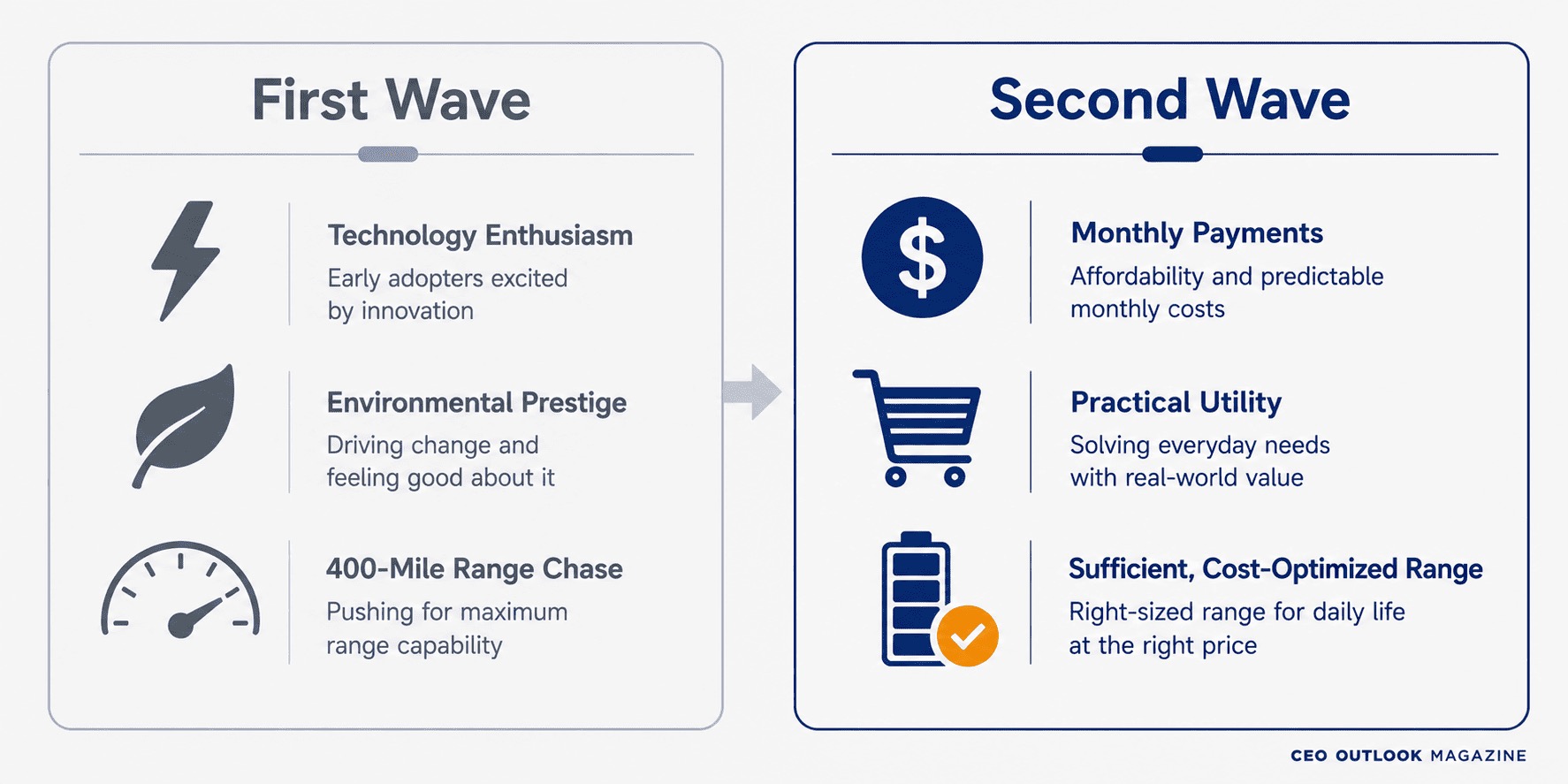
The first wave of EV buyers fit the classic profile of innovators and early adopters: motivated by technology, environmental status, and incentives. The current buyers are the early majority, and their priorities are different. Mainstream EV shoppers in 2026 focus on monthly payments, fuel savings, charging access, insurance, cargo space, and resale value—the same criteria as any practical car buyer. This group is also more cautious about battery longevity and reliability, because they are not joining a movement. They are simply buying a car.
The Spec Sheet Got Less Ambitious, on Purpose
Second-wave EV technology reflects this shift in buyer priorities. Lithium iron phosphate batteries, now common in lower-priced vehicles, trade some energy density for lower cost, longer cycle life, and less reliance on nickel and cobalt. Instead of chasing 400-mile range figures, most current models target 250 to 325 miles, with better efficiency and faster charging—enough for typical use, not just for marketing. Automakers have also moved away from experimental styling, focusing on practical packaging, usable cargo space, rear headroom, and straightforward controls. The priorities now are practical, not aspirational.
The Number That Actually Changed Everything
The real shift in the second wave is pricing, not marketing. Battery pack costs have dropped below the $100 per kilowatt-hour threshold, allowing EVs to match or undercut comparable gas vehicles in several markets, even before incentives. This is a different equation from the first wave, when subsidies were essential for price competition. For years, a capable, affordable EV was more promise than reality. In 2026, it is now available.
The Company Leading This Wave Isn't the One That Led the First
The clearest sign that this is a different wave is who is leading it. BYD sold over 2 million EVs in 2025, surpassing Tesla in global deliveries for the first time. BYD's growth is built on affordable compact cars, crossovers, and plug-in hybrids across multiple price points, not a single flagship model. Tesla defined the first wave; BYD now defines the second. The strategy is clear: serve a broad market, not just the premium segment. However, this shift is not uniform. The United States has imposed tariffs and domestic content rules to keep the lowest-cost Chinese EVs out, so American buyers are not seeing the same prices as those in Europe or developing markets. Regional fragmentation is now a defining feature of global EV adoption.
The Honest Complication: Hybrids, Not Just More EVs
The second wave is not just about more consumers buying pure EVs. Charging anxiety and infrastructure gaps, especially outside major cities, have led to a resurgence in hybrids. Many mainstream buyers now see hybrids as a practical, low-risk choice rather than a full commitment to electric. Analysts are moving away from the idea that EV adoption follows a smooth, predictable curve. Instead, the reality is a patchwork of markets moving at different speeds, shaped by charging access, incentives, tariffs, and consumer risk tolerance.
What This Means for Automotive Leadership
For industry leaders, the second wave demands a different approach. Early adopters responded to technology, prestige, and maximum range. The early majority wants practical pricing through cost discipline, sufficient range, and proven reliability. Automakers still focused on first-wave priorities—impressive range or futuristic design—are targeting a shrinking segment. The larger, more price-sensitive mainstream market is making decisions on different terms.
Many organizations still build their EV strategy around first-wave assumptions. The question is whether your approach is aligned with the practical, cost-driven priorities of today's mainstream buyer.