

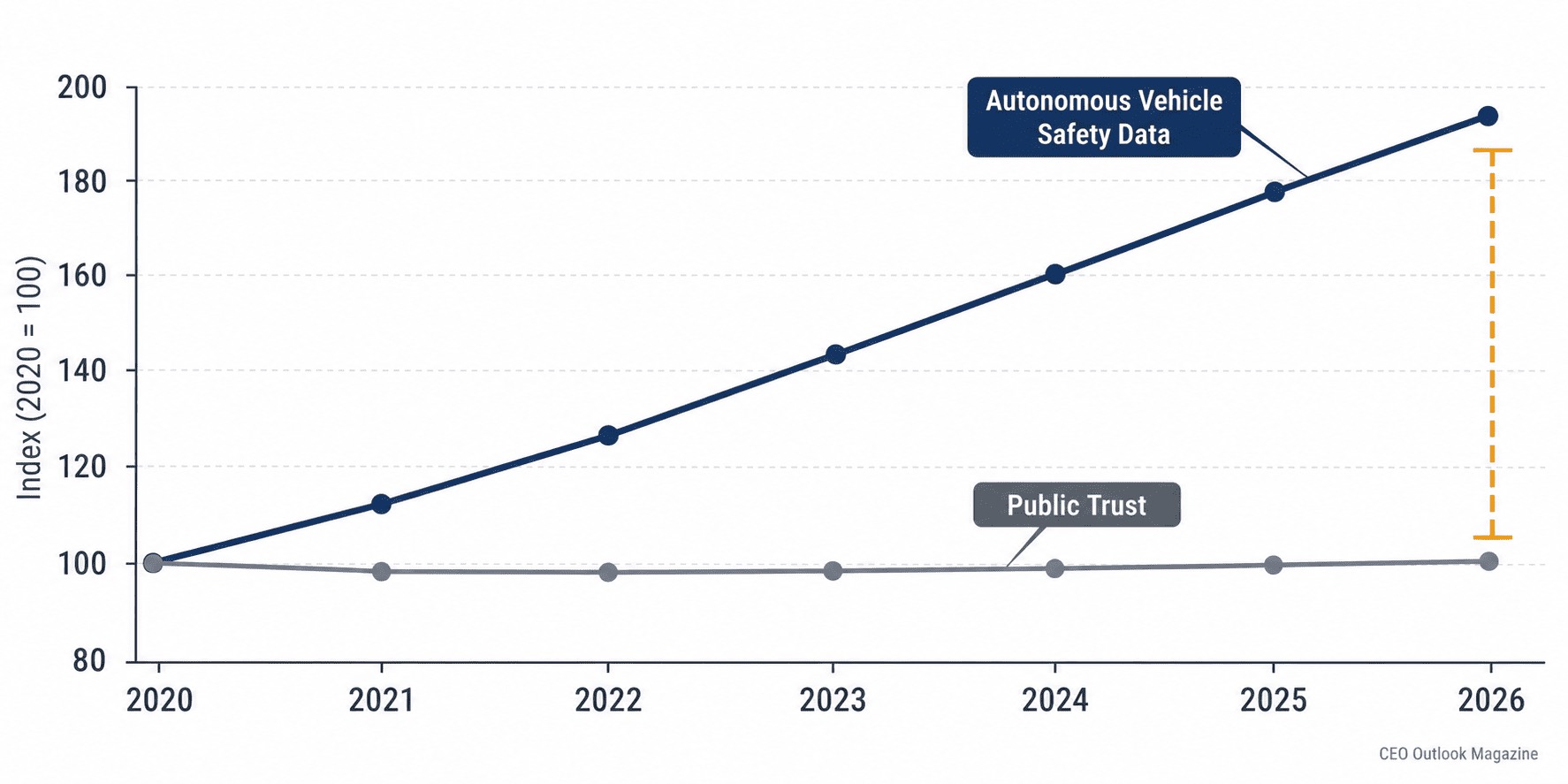
Waymo has logged more than 170 million autonomous miles and claims a 91 to 92 percent reduction in serious injury crashes compared to human drivers. Despite this, only 13 to 14 percent of US drivers say they would trust a self-driving car, while 61 percent remain apprehensive. The industry’s standard prescription—more safety data, transparency, and education—has not moved the needle. By 2026, the evidence shows this strategy has failed, and in at least one high-profile case, the underlying data was manipulated.
The Paradox at the Center of the Industry
The safety argument for autonomous vehicles is not just marketing. Independent studies, including work from the University of Central Florida, show self-driving vehicles are generally safer than human-driven ones. Waymo’s safety data is among the most comprehensive available. Yet public perception remains unmoved. According to AAA’s 2026 survey, 61 percent of drivers are still afraid to ride in a fully self-driving car, and only 14 percent say they would trust it—a marginal increase from 9 percent in 2024. The concerns are not limited to safety and reliability, which lead at 36 percent, but also include overreliance, driver complacency, cybersecurity, and loss of control or enjoyment. Better crash statistics alone will not close this trust gap.
The Scandal That Undermined the Industry's Own Fix
The industry’s default answer to skepticism has been to double down on safety data transparency. The fragility of this approach became clear in May 2026, when Reuters reported that Tesla had overstated its Full Self-Driving safety claims by a factor of three. Tesla compared internal airbag-deployment data to a broader federal crash dataset that included minor incidents where airbags never deployed, creating a misleading safety advantage. The same investigation revealed internal doubts among Tesla’s own AI data trainers about the system’s readiness. The National Highway Traffic Safety Administration has since launched a formal investigation into 2.88 million Tesla vehicles, with potential penalties of $139.4 million for noncompliance. A trust strategy built on safety data fails the moment that data is shown to be unreliable.
The Counterintuitive Death Data Nobody's Talking About
Fatality data exposes a risk the industry tends to ignore. At least 64 deaths have been linked to Level 2-plus driver-assistance systems through early 2026, most involving Tesla Autopilot or FSD in supervised mode. In contrast, only three fatalities have involved fully driverless, Level 4 vehicles: one Uber ATG incident in 2018 and two Cruise incidents in 2023. The pattern is clear. Supervised autonomy, where humans remain responsible but the system handles most driving, can be more dangerous than full autonomy because it breeds complacency without removing accountability. Tesla’s own data highlights this: FSD in supervised mode averages one major collision every 5.3 million miles, outperforming human drivers, but separate data shows Tesla’s driverless robotaxi fleet crashes about four times more often than human-driven vehicles.
The Second Trust Problem Nobody's Even Trying to Fix
Safety is not the only trust issue the industry has left unresolved. Connected vehicles generate vast amounts of location and driving-pattern data, but in the US, this data is governed by a fragmented mix of state-level rules, such as California’s Consumer Privacy Act, with no unified federal policy. The result is inconsistent data-sharing standards nationwide. This data is increasingly monetized for targeted advertising based on detailed driving behavior and location history, a practice that many find invasive and that adds to the sense of constant surveillance. The privacy gap compounds the trust deficit already facing the industry.
Why Deployment Is Racing Ahead of Trust Anyway
The trust gap is not slowing deployment. Morgan Stanley calls 2026 a 'singularity moment' for the industry, projecting autonomous driving availability in US cities to double from 15 percent at the end of 2025 to over 30 percent by the end of 2026. Waymo alone now delivers hundreds of thousands of paid rides. The industry is scaling without waiting for public trust to catch up. This approach leaves it exposed if new safety or privacy failures emerge before trust improves.
What This Means for Automotive and Technology Leadership
For leFor automotive and technology leaders, the lesson from 2026 is clear: safety data transparency alone will not close the trust gap. The Tesla case shows that transparency built on flawed or manipulated data does more damage than making no claim at all. Building trust requires independently verifiable safety data, a clear distinction between supervised and fully autonomous risks, and a direct answer to the unresolved privacy question. Scaling faster than trust is not proof the trust problem is irrelevant. It is a bet that the industry can outrun a problem it has not solved. The question for leadership is whether your autonomous or connected vehicle strategy addresses the trust gap independently of deployment speed.