

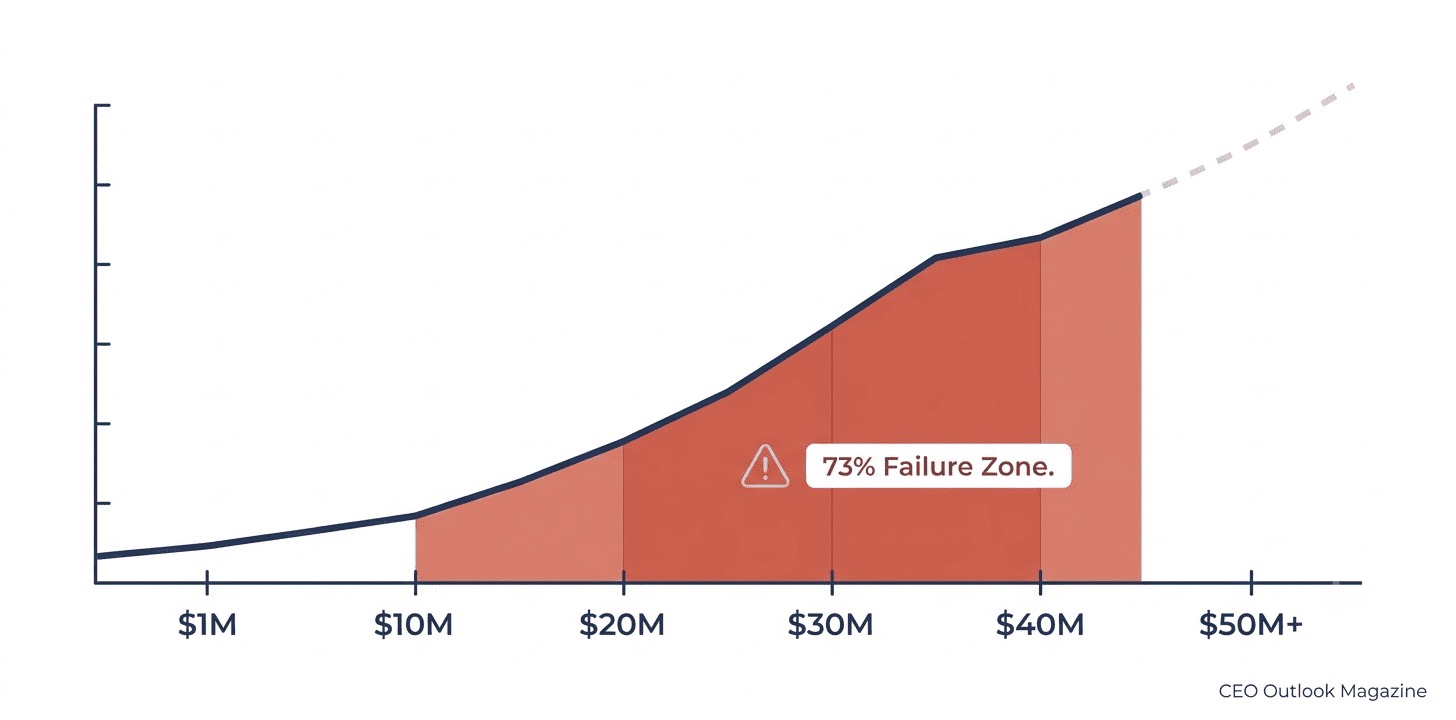
Allbirds went public in 2021 at a $4 billion valuation. By 2026, its assets sold for $39 million. Casper IPO'd at $12 a share and has traded below that ever since. Glossier, once valued at $2 billion, reportedly sought a buyer. These were not obscure startups or companies with weak products. They were among the most heavily funded and visible brands of their generation. The data is now clear: 73 percent of DTC brands fail between $10 million and $50 million in revenue. This is the point where growth begins to reveal what the business never built to support it.
The $10-50M Zone Where Growth Turns Into Collapse.
The reasons for this failure rate are consistent: inventory bloat, founder bottlenecks, and manual systems that cannot handle increased volume. The problem is rarely product-market fit or ineffective marketing. It is operational: inventory tracking, fulfillment capacity, and systems integration that were sufficient at small scale but quickly become inadequate as order volume grows. Most companies delay investment in these areas because the systems appear to work—until they do not.
What Actually Breaks First
Operational complexity does not scale linearly with growth. Each new sales channel or product line introduces new requirements for pricing, fulfillment, and customer service. Without unified systems, this often leads to overstock in one channel and stockouts in another. Cash flow issues follow a similar pattern: companies over-order inventory because sales forecasts and fulfillment data are disconnected, resulting in excess stock and tied-up capital. A sudden spike in demand, whether from a marketing campaign or seasonal event, can overwhelm fulfillment teams that were never resourced for that volume. The result is delayed shipments and reputational damage at the exact moment the business should be strengthening its position.
Why Success Itself Triggers the Breakdown
Success often triggers operational breakdowns, not failure. A funding round, viral campaign, or strong holiday season can create a demand spike that exposes underbuilt fulfilment infrastructure in real time. The typical response—over-ordering inventory to avoid future stockouts—often makes the problem worse. Stockouts cost retailers an estimated $1 trillion annually, and most customers buy elsewhere instead of waiting. Overcorrection leads to excess inventory, tying up capital and creating new cash flow pressures. The original scaling problem is replaced by a different, but equally damaging, operational risk.
The Ownership Paradox That Makes This Worse for DTC Specifically
Direct-to-consumer brands carry a structural risk that marketplace sellers avoid. When a third-party marketplace order is late or damaged, the platform absorbs most of the reputational impact. For DTC brands, the brand itself is accountable for every failure. Seventy-three percent of DTC brands report fulfillment problems, and 68 percent cite delivery delays as their top operational issue. Nearly all consumers say delivery experience affects loyalty. Free shipping increases this risk: last-mile delivery now accounts for over half of total shipping costs, up from 41 percent in 2018. Free shipping does not remove the cost; it shifts it from the customer to the brand, turning a variable expense into a fixed one and putting further pressure on margins.
This Isn't Just a Startup Problem
Large, established retailers encounter the same structural failures when growth outpaces infrastructure. Dollar General, for example, accumulated excess inventory during the pandemic without expanding warehouse capacity or improving receiving processes. The result was overstretched storage, rushed deliveries, safety issues, and product damage—much of it due to internal handling, not external theft. The lesson is consistent: infrastructure that is not scaled deliberately will break, regardless of company size or resources.
What This Means for Retail Leadership
Retailers and founders who manage rapid growth effectively involve operations in strategic planning from the start. Treating fulfillment as an afterthought, handed a forecast and expected to deliver, is a common failure point. Advance visibility into demand events allows for preparation, rather than reacting to overwhelmed teams in real time. Sustainable growth depends less on product quality or marketing success and more on early investment in operational infrastructure.
Is your operational infrastructure built to handle three times your current volume, or only what you have today? That question often determines whether growth is sustainable or exposes the business to unnecessary risk.