

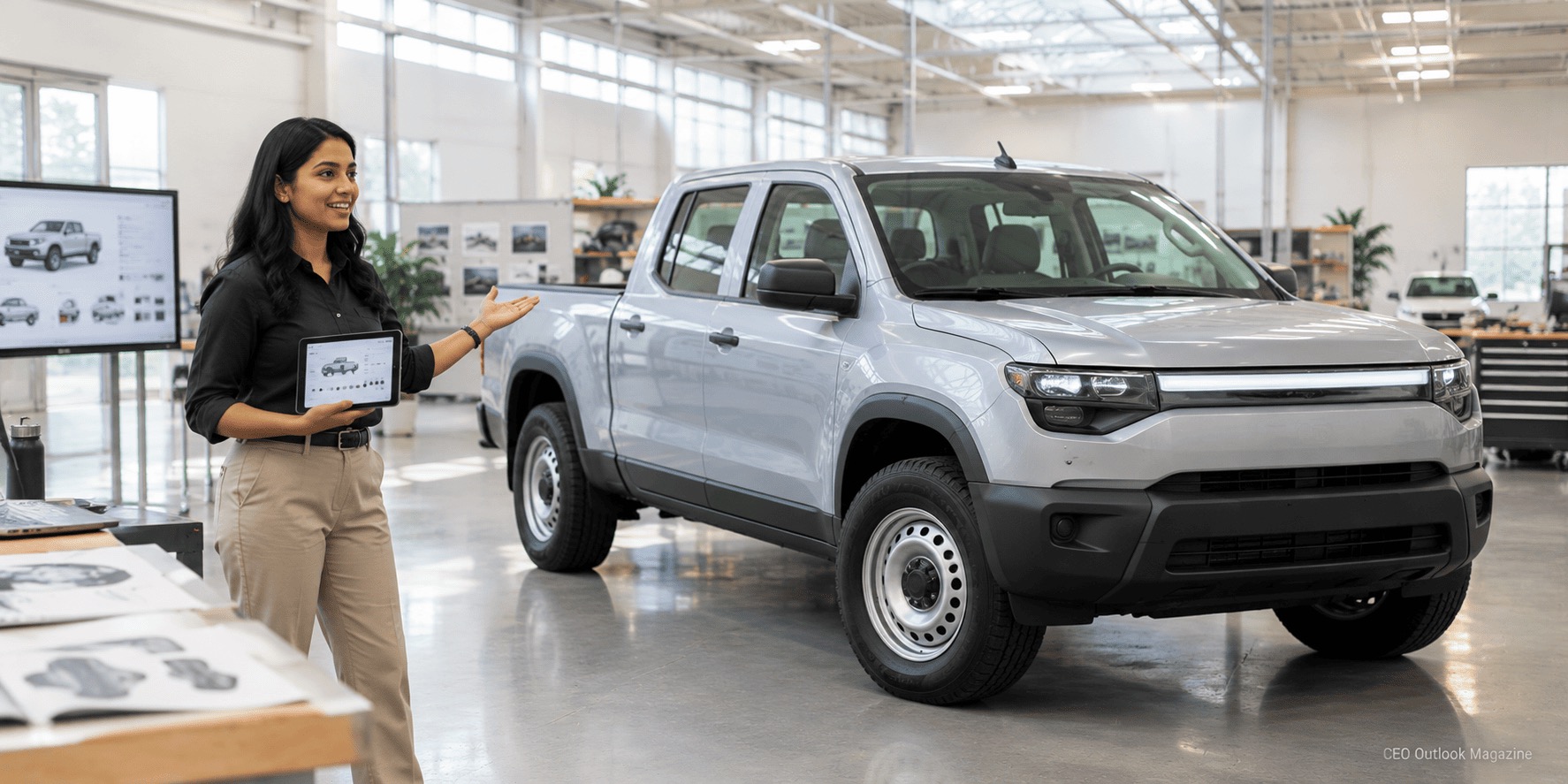
Slate Auto spent three years developing its product in Troy, Michigan, just miles from Ford and General Motors, before emerging in 2025 with $1.4 billion in funding and a plan to sell a bare-bones electric pickup. The company is not trying to compete with legacy automakers on features or technology. Instead, it aims to deliver a minimal product at the factory and let customers decide what to add later. This is the kind of business model shift that is structurally difficult for incumbents tied to decades of manufacturing habits.
The Startup That Built Itself in Ford's Backyard, in Secret
Slate Auto was founded in 2022 and spent three years developing its product in stealth, operating near Ford and General Motors before going public in April 2025. The leadership team brings experience from Amazon: co-founder Jeff Wilke was previously CEO of Amazon's consumer business, and CEO Peter Faricy, appointed in March 2026, was a vice president at Amazon Marketplace. Faricy points to a cost structure and business model that differ materially from those of established automakers.
The Bet: Sell Almost Nothing, Then Let Customers Add Everything
Slate's product strategy is to offer a base vehicle, the Blank Slate, with steel wheels and a stripped-down interior—no infotainment screen, speakers, or powered windows—at a starting price of $24,950. Buyers choose between a 150-mile or 240-mile battery at the factory. All other features, including accessories and a $5,000 kit to convert the two-door pickup into a five-seat SUV, are added after purchase and can be changed as customer needs evolve. The company is also limiting the product to a two-door, rear-wheel-drive configuration, with no four-door or all-wheel-drive options. This is a focused bet, not an attempt to serve every segment.
The Money Behind the Bet
Slate has raised $1.4 billion since 2022, including a $650 million Series C round in April 2026 led by TWG Global. Earlier investors include Jeff Bezos' family office, General Catalyst, and Slauson & Co. The company is investing $400 million in a Warsaw, Indiana manufacturing facility, targeting 150,000 units of annual capacity and more than 2,000 jobs. Faricy puts the break-even point at about 80,000 vehicles per year. Slate aims to be cash-flow positive by 2027, with first deliveries planned for late 2026.
The Incumbent It's Racing Head-to-Head Against
Slate's schedule puts it in direct competition with Ford, which is preparing to launch a compact, four-door electric pickup on its Universal EV Platform at a target price of $30,000 by the end of 2026. Ford is reworking its manufacturing approach to cut costs, while Slate is betting on minimalism and post-purchase customization. The outcome will test whether an incumbent's reinvention or a startup's clean-sheet design is more effective in the affordable EV segment.
Why This Bet Is Happening at Exactly the Wrong Moment, or the Right One
Slate is entering the market when EV demand is uneven. The loss of the federal $7,500 tax credit, two years of declining Tesla sales, and the production challenges Rivian and Lucid face all point to a difficult environment. Major automakers have scaled back their EV ambitions during this period. Slate is moving into the gap left by that retreat, betting that a lower-cost, stripped-down product with a different cost structure can succeed where higher-priced, feature-heavy EVs have struggled to achieve volume.
What This Means for Automotive Leadership
For industry leaders, Slate's approach is a test case in business model differentiation rather than feature competition. The startups most likely to outmanoeuvre incumbents are not always those with the latest technology, but those willing to make focused product bets—minimalism, post-purchase customisation, a single configuration—that are structurally hard for large-scale incumbents to copy quickly, even when targeting the same price point.
Most organizations evaluate startup competitors by their technology. The more important question is whether the underlying business model is fundamentally different. That distinction often matters more than the latest feature set.