

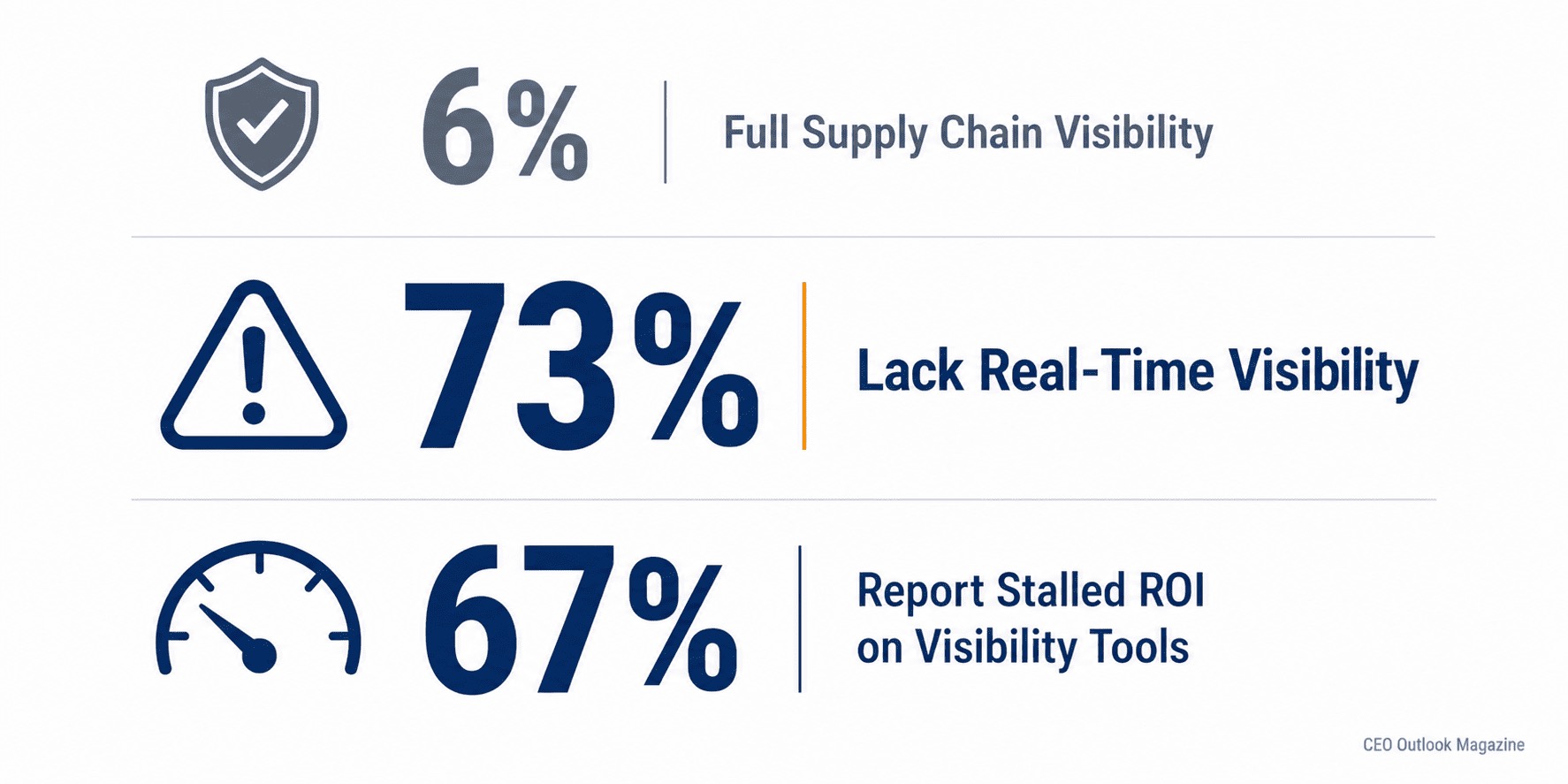
Six per cent of businesses report full visibility into their supply chains. Another independent survey found that 73 percent of supply chain leaders lack real-time visibility across their networks. The message is consistent: despite years of investment in dashboards, control towers and AI-driven platforms, most companies still cannot answer basic questions about inventory location or emerging risks.
The Numbers Behind the Visibility Gap
A clear gap exists between how supply chain technology is discussed and how it operates in practice. Executives often reference automation and AI, but many small and mid-sized businesses still depend on manual processes or disconnected systems for core sourcing decisions. Only about half of surveyed professionals feel confident they can respond to disruption over the next two years. The numbers—6 percent with full visibility, 73 percent lacking real-time visibility—point to the same conclusion: the reality has not caught up with the rhetoric.
Investment Alone Is Not Closing the Gap
The issue is not a lack of investment. Sixty-seven percent of enterprises report that increased spending on visibility tools has not delivered better returns. The main reason is persistent reliance on fragmented legacy systems. New platforms were supposed to replace or unify these systems, but in most cases, they have not. Companies continue to invest, but the tools are not integrated with the broader data infrastructure, so the promised benefits remain out of reach.
A Modern Version of the Spreadsheet Problem
Many organizations have not adopted too little technology, but too much of it in disconnected forms. The result is technology sprawl: overlapping platforms that promise visibility but deliver more complexity. In practice, this is not much different from relying on spreadsheets, since the tools do not communicate or provide a unified view. Meanwhile, just under half of surveyed organizations have moved from manual data management to AI-powered analytics. The rest still depend on fragmented, manually updated tracking for core supply chain decisions.
Technology Costs Fell. Organizational Barriers Remain.
Technology is no longer the main obstacle. IoT sensor costs have dropped by about 70 percent since 2018. Sixty percent of companies now use IoT for real-time tracking, and 45 percent use AI for predictive analytics. Cost is not the reason for the visibility gap. The real barriers are organizational: data literacy, cross-functional collaboration, and technology fluency. These skill gaps contribute to nearly two million unfilled roles across the industry. Solving them is more difficult than buying another software license.
What Companies Closing the Gap Achieve
Companies that have addressed the integration problem, rather than adding more disconnected tools, see stronger returns. Research shows that organizations with unified systems achieve over three times the return on generative AI investment compared to those still lagging. Top performers allocate up to a quarter of their budget to technology. The demand for real-time visibility is clear: nearly 90 percent of supply chain leaders rank it as their top investment priority. The difference is not desire or spending level, but whether investment has produced a single, reliable view of the supply chain instead of another isolated dashboard.
Implications for Supply Chain Leadership
For supply chain leaders, the lesson is clear: integration, not acquisition, is the real objective. Buying another visibility platform without addressing data fragmentation only adds to the complexity that undermines returns. The organizations seeing better results are not spending more, but spending more deliberately—on systems that unify supply chain data, not on isolated tools that cannot deliver visibility on their own.
Most organizations face a choice: invest in integration or continue adding to a disconnected stack. The evidence suggests that only the former delivers real visibility.