

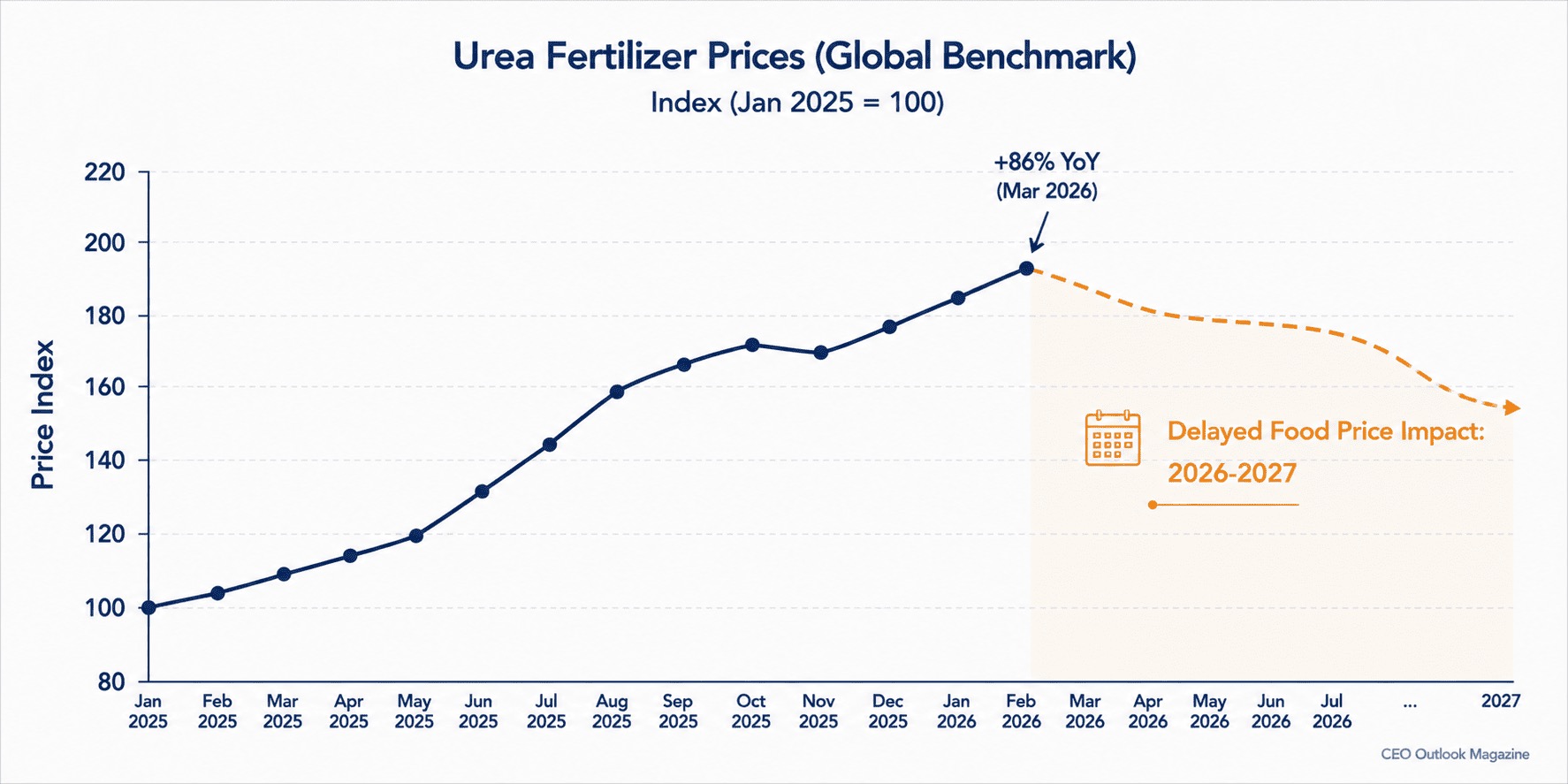
A third of global fertilizer trade depends on the Strait of Hormuz. By March 2026, urea prices had climbed 86 percent year over year, with most of that spike compressed into a single month as Middle East tensions escalated. This is not about lost farmland or failed crops. The breakdown is in logistics: the supply chain moving essential inputs from producers to farmers has faltered. That disruption is already forcing changes in planting decisions, with the eventual impact on food prices still unfolding.
The Shock Moving Through the System Right Now
The link between a shipping chokepoint in the Middle East and higher grocery bills is operational, not a policy failure. The World Bank ties the current fertilizer price shock directly to the concentration of trade through Hormuz, projecting a 31 percent price increase as a result. The sequence is predictable: higher fertilizer costs lead farmers to cut application rates, yields fall, and food prices rise with a lag. The International Grains Council reports that farmers are already planning to plant fewer acres and grain balances are tightening for the 2026-2027 season. This is a concrete, current signal that a distant shipping bottleneck is already altering global crop production.
Why This Isn't Primarily a Production Story Anymore
Academic research on food security increasingly identifies this exact mechanism as the primary channel through which Research now points to supply chain disruption, not direct production loss, as the main way global shocks translate into hunger. Armed conflict and pandemics rarely destroy crops outright; they disrupt the movement of food and the inputs required to grow it. The stakes are immediate: 363 million people face acute hunger in 2026, a figure rising in step with conflict and climate pressures. Heat waves and drought are straining both production and access, especially in developing and unstable regions. Damage in the field. Jon Davis, chief meteorologist for supply chain risk firm Everstream Analytics, identifies tropical cyclones, hurricanes, typhoons, and cyclones collectively as the single most serious disruptor to food logistics specifically. Extreme weather caused an estimated $50 billion in economic losses during 2025 alone, and Everstream's own tracking finds four of the five worst-loss years on record have occurred since 2017, evidence of a genuinely intensifying trend rather than isolated bad years. A less commonly discussed but genuinely significant mechanism involves inland waterways: drying rivers are severely disrupting food logistics, causing real delays and forced capacity cuts on transport routes many food supply chains depend on entirely apart from ocean shipping. In late November, three consecutive cyclones swept across South and Southeast Asia, triggering widespread flooding and landslides that caused severe loss of life alongside major disruption to the region's supply chain infrastructure, a concrete, current illustration of exactly this compounding risk.
The Climate-Yield Connection Is Now Dominant, Not Marginal
Peer-reviewed research shows climate now accounts for more than 60 percent of yield variability in major breadbasket regions. This is not a marginal factor. It outweighs agricultural practice, technology, or any other single variable typically cited in food security debates. The implication is clear: even flawless policy cannot offset a variable that already determines most yield outcomes in the regions feeding much of the world.
What the Supply Chain Response Actually Looks Like
Organizations that treat food security as a supply chain management problem, not just a policy issue, are using tools drawn from logistics risk management. Crop monitoring now integrates satellite imagery, weather data, soil sensors, IoT devices, and predictive modeling to spot stress or strength before harvest. When mid-season data signals trouble—drought, heat, disease, or logistics breakdowns—buyers with this visibility can secure alternative suppliers, diversify sourcing, or lock in contracts before prices spike. This lead time is the difference between managing risk and absorbing it. Everstream prescribes the same resilience measures now standard in freight and manufacturing: geographic diversification, higher inventory buffers, and logistics networks that can reroute quickly around weather disruptions. The same logic applies to food and the inputs that support it.
What This Means for Food, Agriculture, and Supply Chain Leadership
For leaders in food, agriculture, and logistics, the shift is clear: food security is now a supply chain problem as much as a policy one. Fertilizer shocks, cyclone disruptions, drying rivers, and climate-driven yield swings are operational risks that require operational solutions—real-time monitoring, geographic diversification, and logistics networks that can adapt quickly. Organizations that rely solely on policy are missing the real mechanism that determines whether food reaches people in 2026.
The question for leadership is straightforward: are you treating food security as a supply chain discipline, or as a policy issue? The answer will determine who manages risk—and who is left reacting to it.