

Solar and wind generation costs have fallen sharply, but storage technology has not kept pace. The main technical barrier to a fully decarbonized grid is no longer generation cost, but the lack of affordable, reliable storage that can bridge multi-day periods of low renewable output. A range of well-funded startups are pursuing different approaches to this problem, with no clear consensus on which technology will ultimately prevail.
The Piece Missing From the Clean Energy Success Story
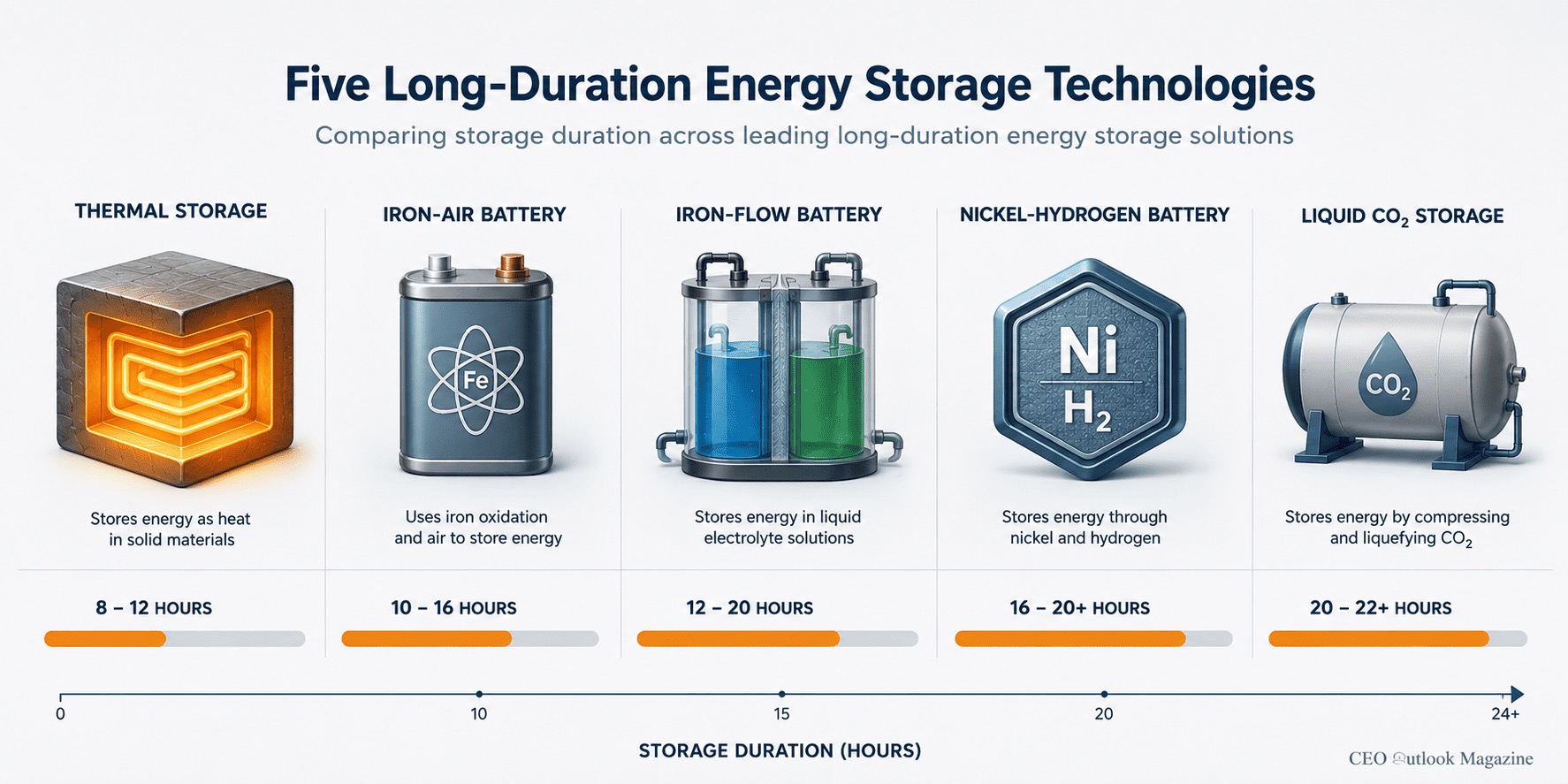
Lithium-ion batteries, which dominate current grid storage deployments, typically provide two to four hours of storage. Eight-hour systems are only now reaching commercial scale. This is sufficient for daily balancing, but does not address the more difficult challenge: maintaining grid reliability through several days of low renewable output without reverting to fossil fuel backup. Long-duration storage—generally defined as eight hours or more—has shifted from a research topic to a capital-intensive priority because it remains the missing link in the energy transition.
The $550 Million Bet on Glowing Carbon Blocks
Antora Energy, founded in 2020, has raised over US$850 million across its Series B and C rounds, with backing from G2 Venture Partners, Eclipse, and others. The company’s approach is to store renewable electricity as heat in carbon blocks, then convert that heat back to electricity or supply it directly for industrial use. The scale of recent investment suggests that thermal storage is now viewed as a credible alternative to conventional battery technologies, not just a research experiment.
The Iron-Based Alternatives Racing in Parallel
Form Energy is developing iron-based battery systems aimed at providing multi-day storage, a gap lithium-ion cannot fill. Its recent US$405 million Series F round included institutional investors such as Temasek and T. Rowe Price. ESS Inc is taking a different approach with iron-flow batteries that use iron, salt, and water as electrolytes. Backed by Honeywell, ESS claims its systems can operate for decades without capacity loss and can be deployed at scale within months. Both companies are targeting the operational requirements of utilities and large-scale users, where duration and reliability are critical.
The NASA Technology Now Powering City Grids
EnerVenue is adapting nickel-hydrogen battery chemistry, originally developed for NASA, for grid-scale storage. The company has raised over US$420 million to commercialize a system that utilities describe as durable and low-maintenance, with a lifespan measured in decades—significantly longer than typical lithium-ion systems.
Why Nobody's Betting on Just One Winner
Despite significant capital flowing into grid storage, there is little agreement on which technology will dominate. The ten largest startups account for a substantial share of sector funding, yet investor participation is fragmented, with few investors backing more than one major company. This is not confusion, but a rational response to uncertainty about which chemistry—thermal, iron-air, iron-flow, nickel-hydrogen, liquid CO2, sodium-ion—will prove most viable at grid scale. Investors are spreading risk across fundamentally different approaches rather than converging on a single solution.
The Urban Deployment Model Nobody Expected
Some startups are focusing less on battery chemistry and more on deployment strategy. NineDot Energy, with over US$650 million raised, is building community-scale storage across underused sites in the New York City area. Here, the main challenge is not battery cost, but securing sites, permits, and interconnection in dense urban grids where space and access are the limiting factors.
What This Means for Energy and Grid Leadership
For utility and grid infrastructure leadership, the practical implication of this genuinely diversified startup landscape is that no single technology bet is safe to rely on exclusively. The companies attracting the largest checks are pursuing meaningfully different technical paths because the long-duration storage problem remains unresolved at the required cost and scale. The largest investments are going to companies with fundamentally different technical approaches because the long-duration storage problem remains unresolved at the required cost and scale. Any organization planning long-term grid investments should monitor multiple solutions rather than assume the market has settled on a winner. Startups are racing to solve the energy transition's hardest technical problems.