

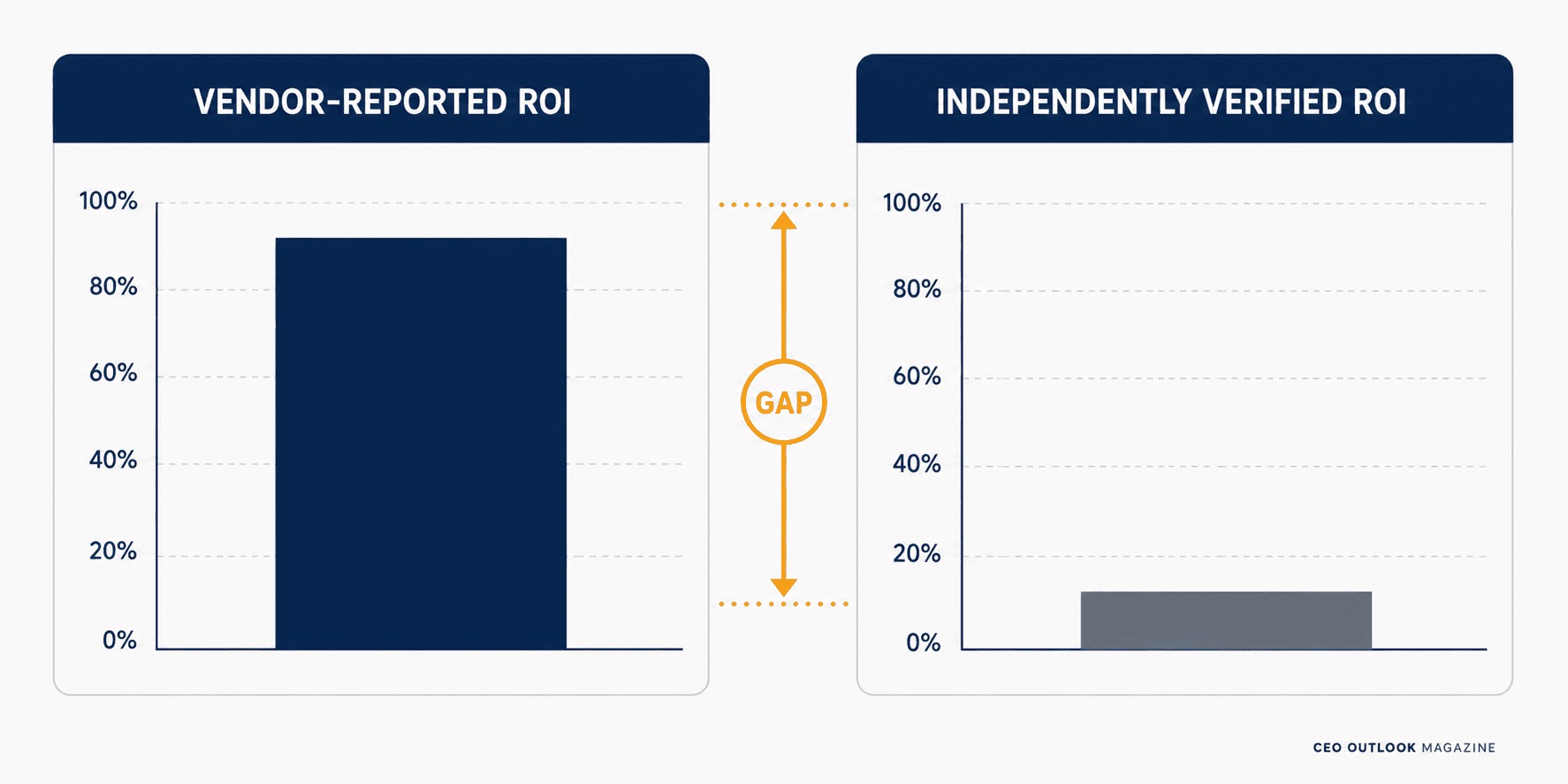
Vendor surveys claim 89 percent of companies using AI personalization see positive ROI, with payback in under a year. Yet PwC's 2026 CEO survey found 56 percent of chief executives saw no revenue growth or cost reduction from AI in the past year. Both sets of numbers refer to the same technology, in the same timeframe. The gap is not about dishonesty. Most retailers reporting positive AI ROI are not measuring it with enough rigor to know if the return is real.
The Two Sets of Numbers at Tn'tee
Most research funded or cited by vendors paints a positive picture: AI personalization is linked to double-digit conversion lifts, and nearly every retailer claims to have an AI plan. But when studies focus on actual financial outcomes, the numbers shift. PwC found only 12 percent of organizations achieved both revenue growth and cost reduction from AI. Broader research puts the share of companies seeing substantial AI ROI at scale closer to 5 percent, with another third reporting only partial returns. The gains are concentrated in specific functions like supply chain and finance, not spread evenly across the business.
Why the Gap Is So Wide
The disconnect is straightforward once measurement practices are examined. Only 24 percent of retailers have a credible framework for judging AI ROI, and just 18 percent say their AI systems are integrated enough to pull reliable data from across the business. Without both, any ROI figure is guesswork. When nearly all organizations claim an AI plan but only a fraction can measure results, most positive-ROI statistics reflect self-reported impressions or vendor benchmarks, not independently verified outcomes.
Where the Real Value Is Actually Concentrating
The same survey shows where retail AI investment is actually landing. Loss prevention is the leading use case, with grocers also focusing on inventory forecasting and workforce scheduling, and specialty retailers on recommendations and chatbots. These are defensive moves: using AI to prevent losses and operational failures, not to reinvent the retail model. That is not a criticism. Loss prevention is one of the few areas where the business case is clear and the results are easy to measure. The narrative of AI as a transformational revenue engine covers only a small fraction of real-world deployments.
The Governance Bottleneck Locking Away the Biggest Value
Most retailers are stuck at what researchers call Stage 2: pilots have shown AI can work, leadership is supportive, but scaling is blocked by clear gaps. Governance is the biggest barrier. Retailers score just 3.1 out of 10 on AI governance maturity, which prevents them from pursuing the highest-value use cases like dynamic pricing, personalized pricing, and AI-driven credit scoring. These account for up to 60 percent of potential AI value in retail. The irony is that the most valuable applications require governance capabilities most retailers lack, while the use cases they can safely deploy today—chatbots, basic recommendations, loss prevention—deliver only a modest share of the total value.
What Actually Separates the Useful From the Expensive
Retailers seeing real value from AI follow a consistent approach: they account for the full cost, including data infrastructure, ongoing operations, change management, and governance, not just the software license. They deploy in stages, proving unit economics on a first use case before scaling. They measure against hard financial outcomes—margin, shrinkage, verified conversion—not engagement metrics or vendor benchmarks that are easy to inflate and hard to audit. A number on a dashboard is not evidence of value unless it ties directly to a financial or operational result.
What This Means for Retail Leadership
For retail executives, the reality sits between vendor optimism and blanket skepticism. AI delivers measurable value in specific, well-defined applications—loss prevention is the clearest example—and falls short when deployed broadly without the governance and measurement needed to track results. Before any new AI investment, the question isn't whether AI is useful, but whether the organisation can prove it with the same rigour applied to any other capital project, instead of relying on vendor claims or internal optimism.
Can your organization independently verify its AI ROI, or is it relying on vendor benchmarks? The answer matters more than the next marketing headline.