

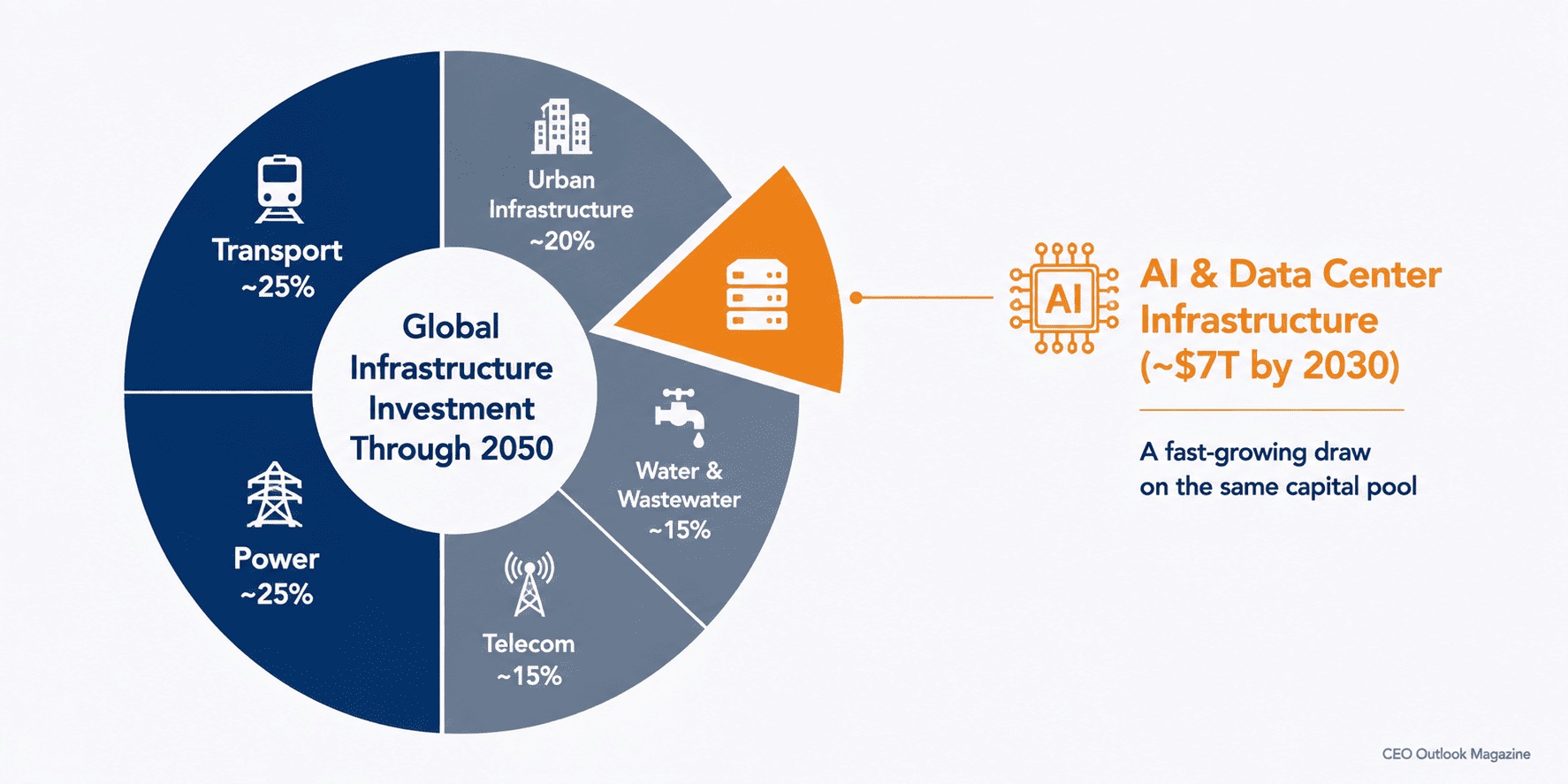
Global transportation infrastructure spending is set to reach $1.5 trillion in 2026 and approach $2.4 trillion by 2050. Transport and power together will absorb nearly half of the $151 trillion in global infrastructure investment projected through mid-century. Private capital is not in short supply: infrastructure funds have raised more in the first half of 2025 than in all of 2024, and $350 billion in dry powder is available. Yet the United States still faces a $684 billion roadway funding gap, even after $591 billion in recent investment. The gap between available capital and actual progress remains wide. The core question is not whether capital exists, but which transportation segments can credibly compete for it—and which cannot.
The Scale Nobody Disputes
Transportation and power will account for nearly half of the $151 trillion in global infrastructure investment projected through 2050. Annual spending will rise from $4.4 trillion in 2024 to $6.9 trillion by mid-century. The nature of this investment varies by region. Asia-Pacific will drive more than half of global infrastructure spending, and Africa will see the fastest growth, both focused on building new capacity. In contrast, Europe and North America face a cycle of renewal: aging transport, energy, and water systems require modernization just to maintain resilience and competitiveness. For these markets, the challenge is not expansion, but sustaining what already exists.
The Capital Is Genuinely There, Competing Harder Than Ever
Private capital availability for infrastructure broadly is not the constraint it once was. Infrastructure funds raised more than $115 billion in the first half of 2025 alone, compared to $102 billion for all of 2024, and private markets currently hold roughly $350 billion in dry powder ready to deploy. The genuine complication for transportation: private capital is no longer the main constraint for infrastructure investment. Infrastructure funds raised $115 billion in the first half of 2025, surpassing the total for all of 2024, and $350 billion in dry powder is available. The real challenge for transportation is competition: capital now faces higher-growth, higher-margin alternatives. Energy and power infrastructure alone will require $23 trillion through 2040, and data centers may need nearly $7 trillion by 2030 to meet AI demand. Transportation is no longer just competing with itself for capital. It is up against the fastest-growing infrastructure categories in the global economy.7-22 to 3.5 to 3.8 years in 2023-24, a genuine liquidity headwind that makes transportation infrastructure a less attractive destination relative to faster-turning alternatives. The US roadway example makes the underlying problem concrete: $591 billion in recent investment has still left a $684 billion funding gap largely unmoved, directly echoing the rail infrastructure gap and public transit fiscal cliffs this publication has already documented in detail this year. Capital deployed at scale does not automatically close gaps, particularly in a renewal-phase market carrying decades of accumulated deferred investment.
The Structural Answer Already Gaining Share
One structural change is making a difference, though unevenly: public-private partnerships now account for about 35 percent of global infrastructure funding, up from 32 percent. This shift reflects a broader recognition that traditional public funding alone is not enough. Transportation leaders are increasingly pursuing dedicated funding mechanisms and user-fee-backed sources, rather than relying on general appropriations. Waiting for a single public funding solution is no longer viable.
What This Means for Every Thread This Series Has Covered
Viewed together, the divergent paths across transportation sectors reveal a clear pattern. Public transit faces a structural funding crisis and must modernize within the limits of strained public funding. In contrast, Class I railroads like BNSF continue to invest billions from their own balance sheets, while short line and passenger rail segments still depend on federal grants. Aviation shows the same dynamic: sustainable aviation fuel adoption remains stalled because private capital is hesitant to fund production capacity at scale. At the same time, eVTOL air taxis have attracted billions because their commercial prospects are clearer. The lesson is consistent: capital moves quickly to segments with direct, near-term commercial returns, and much more slowly—or not at all—to those reliant on public funding under pressure.
What This Means for Transportation Leadership
For transportation leaders, the next five years will hinge less on the availability of global capital—which is ample—and more on whether their segment can compete for it. Success will depend on building public-private capital structures, securing dedicated funding mechanisms, and being realistic about which assets can attract private investment and which will remain tied to public funding already under strain.
The practical question for leadership is whether your transportation infrastructure strategy is positioned to rely on private capital, or whether it remains dependent on public funding already under pressure.