

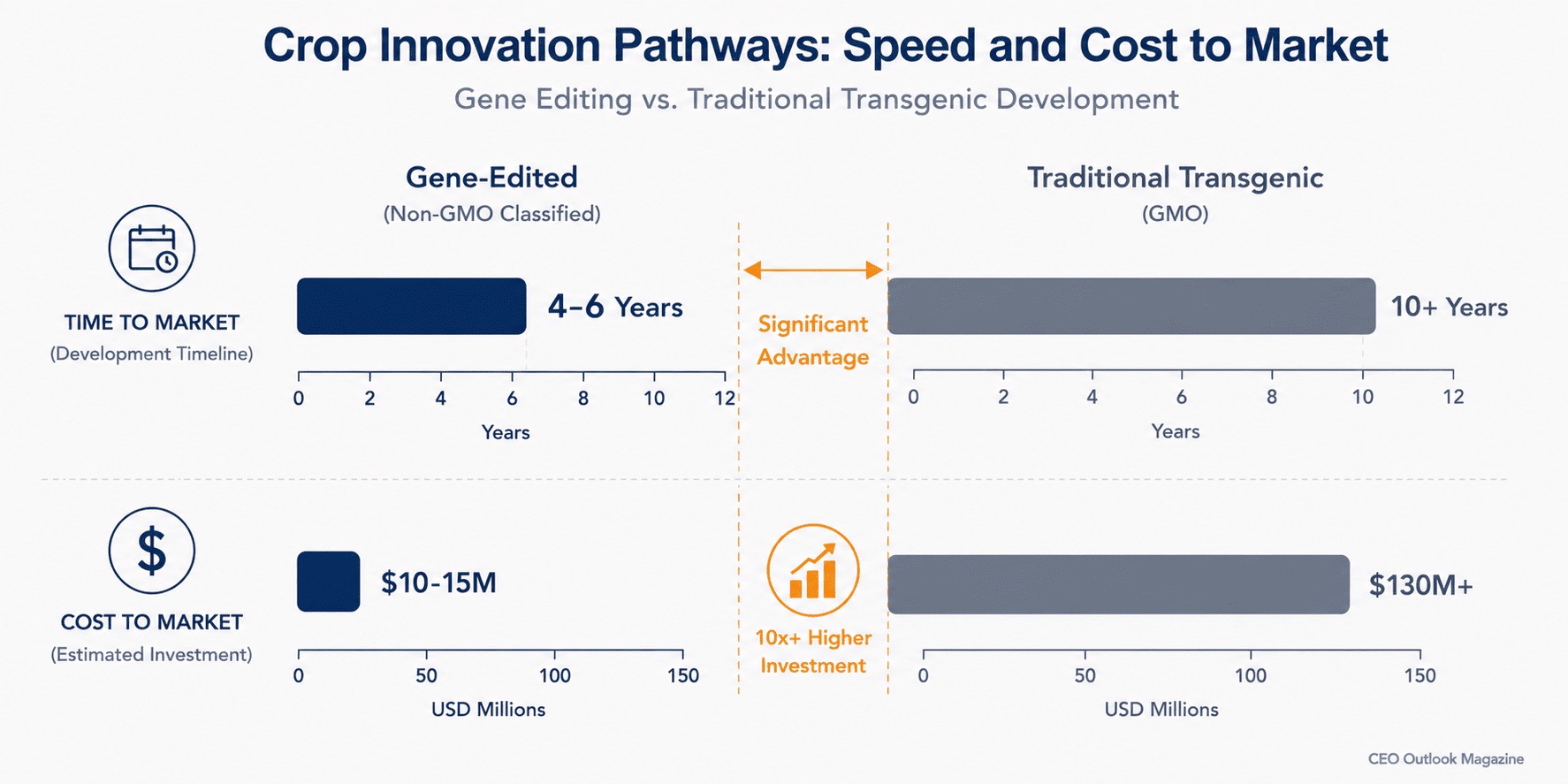
A gene-edited crop that is not classified as a genetically modified organism can reach the market in four to six years, with a development cost of $10 to $15 million. In contrast, a traditional transgenic trait, subject to full GMO regulatory review, often requires more than a decade and over $130 million to commercialize. The difference is not scientific, but regulatory. This is a clear example of a broader pattern: the technology is increasingly effective, but the ability to capture its value depends on regulatory clarity, verification systems, and access to capital—not on the underlying science.
The Question Connecting Every Thread in This Series
This pattern is consistent across agricultural technology. Precision agriculture tools deliver as promised, but adoption is divided by farm size due to cost, connectivity, and technology-fit—not doubts about effectiveness. Alternative proteins have proven viable in the lab, but the sector's correction was driven by manufacturing economics and regulatory fragmentation, not failed science. Institutional capital moved into regenerative agriculture only after verification infrastructure matured enough to provide credible evidence, while early-stage innovation capital declined. Gene-edited crops are now the latest and, over the next five years, likely the most consequential test of this dynamic.
The Regulatory Shift That Just Changed the Math
The European Union's approval of the New Genomic Techniques framework in 2026 removes a classification barrier that has limited one of the world's largest agricultural markets. Seed company KWS noted that the framework enables genome editing to move from research to product development and field trials, potentially accelerating the development of more resilient and resource-efficient crops. Cibus, an agricultural biotechnology company, described the framework as validation for its gene-editing approach, with the potential to speed deployment of disease-resistant, resource-efficient traits across Europe. This is not a minor regulatory change. It shifts the commercialization path from a $130 million, decade-long process to a $10 to $15 million, four-to-six-year timeline, at the scale of an entire continent.
What's Actually Being Built Right Now
Commercial applications are already moving forward through this new regulatory pathway. Tropic Bioscience, a UK biotechnology company, is using CRISPR-Cas gene editing to develop Cavendish bananas resistant to Tropical Race 4, a fungal disease that threatens global banana production. Field trials are underway in major growing regions, with commercial cultivation targeted for 2027 and harvests expected by 2028—a specific, near-term timeline. Separately, Belgian startup Rainbow Crops raised €9.7 million to build an AI-guided multiplex gene-editing platform aimed at improving complex traits like drought tolerance and heat resilience. This combines artificial intelligence, large-scale genome editing, and high-throughput phenotyping, bringing together data-driven agriculture and genetic engineering. The logic is straightforward: better information and tools can unlock more value from existing resources.
The Demand Baseline Making This Urgent
The demand this technology must address is clear. The FAO projects the global population will reach 9.7 billion by 2050. The World Bank estimates that meeting this demand will require a 60 percent increase in global food production, at a time when growers are already facing heat stress, water scarcity, new pests, and soil degradation. These pressures are converging with genetic technologies that can address drought tolerance, disease resistance, and nutrient-use efficiency—on a timeline short enough to matter within the next decade, not just for the next generation.
What This Means for Every Thread This Series Has Covered
Gene editing's regulatory-classification economics are not an isolated technology story. They are part of a broader pattern shaping the sector's next five years: verified data infrastructure is unlocking institutional capital for regenerative agriculture; regulatory clarity is determining which alternative protein categories reach commercial viability; connectivity and financing access are deciding which farms benefit from proven precision technology; and now, regulatory classification will determine whether promising genetic improvements reach the market in years or over a decade. Organizations and regions that treat regulatory infrastructure, verification systems, and financing access as core strategic variables—investing in them as deliberately as in the underlying technology—will be the ones to capture the productivity and resilience gains that are now within reach.
What This Means for Agriculture and Food Production Leadership
For leaders in agriculture and food production, the next five years will not hinge on whether the technology exists. In most cases, it already does. The real test will be whether regulatory clarity, verification infrastructure, and financing access keep pace with the science, and which organizations recognize that gap as a strategic priority.
Is your organization treating regulatory and verification infrastructure as a core priority, or assuming that proven science will automatically translate into commercial adoption? The distinction will determine who captures value in the next phase of agriculture and food production.