

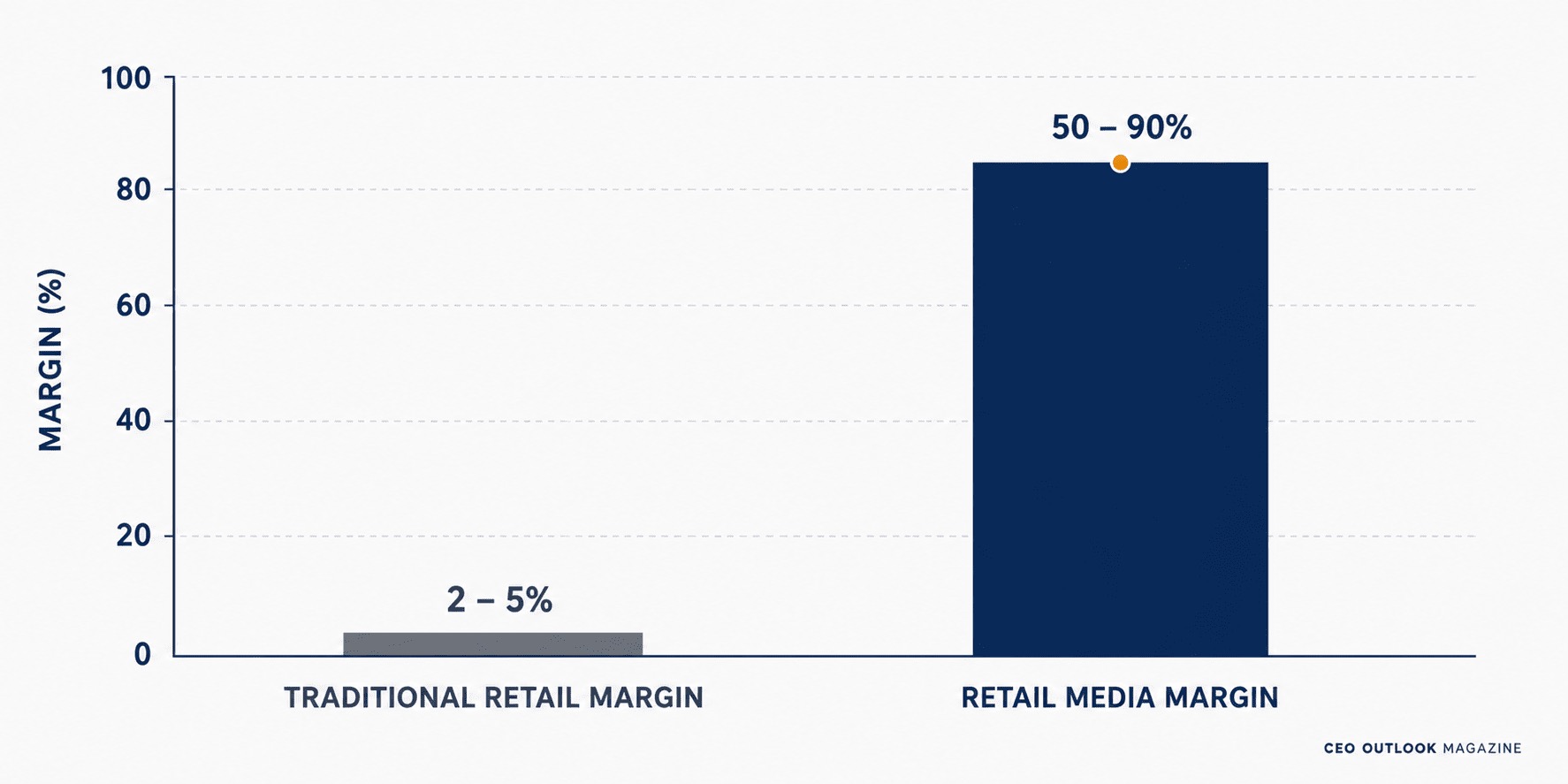
Traditional retail margins remain thin, typically between 2 and 5 percent. By contrast, retail media advertising margins often exceed 50 percent, and can reach as high as 70 to 90 percent on owned digital channels. This margin gap is now the central fact shaping retail strategy for the next five years. Bain projects only modest profit growth from merchandise sales through 2030. The pressures facing the sector—slowing e-commerce, rising acquisition costs, and eroding margins—all point to the same outcome: retail media is now the main profit driver. It is also the most direct test of whether retailers have actually learned the operational lessons that recent disruption has forced into view.
The Margin Math That's Reshaping Retail Strategy
The margin differential explains why retail media has moved from a marketing afterthought to a board-level priority in just a few years. Retailers with single-digit merchandise margins can generate far higher returns by monetizing customer attention and shopping data they already possess, without changing their core business model. Bain describes this as retail media entering a true performance era: what started as incremental revenue is now becoming the structural core of retail profit generation.
How Big This Has Actually Gotten
Estimates vary meaningfully across research firms, reflecting genuinely different methodologies, but the trend is clear. Global retail media spend was estimated at $174.9 billion in 2025 and is projected to reach $196.7 billion in 2026. Some forecasts put the market above $300 billion by 2030. Retail media is expected to surpass combined linear and connected TV ad spend in 2026, and may overtake social media advertising by 2028. The largest players are already operating at scale: Amazon Ads generated about $68 billion in 2025, Walmart Connect grew 27 percent to $6.4 billion, and Instacart Ads is approaching $1 billion annually, driven by grocery purchase data.r AI ROI skepticism this publication has documented elsewhere in retail. Average return on ad spend across the platforms independent tracker Skai monitors held at 6.1 times for five consecutive quarters through early 2025, a remarkable degree of measurement consistency for a channel this young. A 2026 survey of 166 advertisers found seven in ten brands reported meeting or exceeding their retail media performance goals. Unlike the broader AI ROI landscape, where this publication found only a quarter of retailers even possess a decent rubric for measuring return, retail media has built a genuine, verifiable measurement discipline around closed-loop attribution and first-party data, precisely the rigor most other retail technology investment still lacks.
The Complications Arriving as the Land Grab Ends
Retail media is not a frictionless growth story. Growth rates are slowing: WARC reports a deceleration from 13.7 percent in 2025 to 12.4 percent in 2026 and 11.6 percent in 2027. Meanwhile, operational complexity is increasing. Each retailer's media network operates as a separate walled garden, forcing brands to manage campaigns across multiple disconnected systems. Advertisers now run campaigns on an average of six different retail media networks, a figure likely to rise as more platforms launch. This fragmentation increases costs for advertisers and introduces the kind of complexity that has already strained other fast-growing retail operations.
Why This Is a Test of Everything This Series Has Argued
Retail media's success depends on capabilities that most retailers still lack. It requires accurate, verified first-party customer data, not the manipulated metrics often seen in customer satisfaction reporting. It also demands proprietary, well-governed AI infrastructure—something off-the-shelf vendor tools rarely provide. The buy-versus-build decision here deserves more scrutiny than most retail leaders apply. Finally, it requires scaling operational and data infrastructure ahead of demand, not scrambling to fix gaps after growth has already exposed them.
What This Means for Retail Leadership
The retailers most likely to capture outsized profit growth from retail media are not simply those with the largest customer bases. They are the ones that have already adopted operational discipline: using verified metrics instead of vanity numbers, measuring technology investments rigorously rather than relying on vendor claims, building proprietary infrastructure deliberately, and scaling operations ahead of growth. Retail media is not a separate opportunity. It is the clearest test of whether retailers have absorbed the lessons forced by recent industry disruption.
Retailers would not accept weak controls or untested assumptions in their core profit centers. The same discipline should apply to retail media. If your organization is approaching this with real rigor, I am interested in your perspective. Contact the editorial team if you have operating insights to share.