

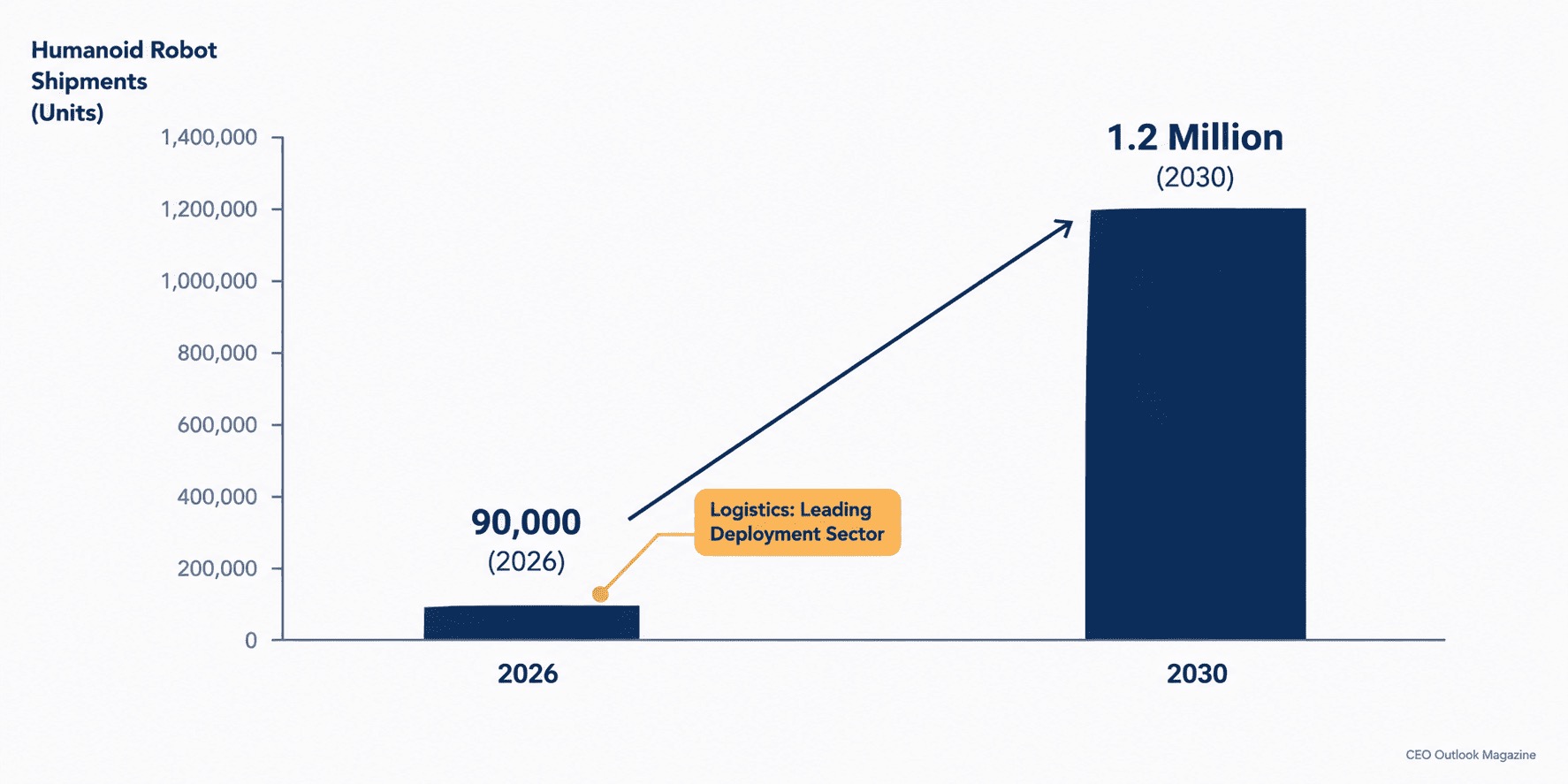
Logistics and warehousing are now the largest commercial sector for humanoid robot deployment, outpacing semiconductor manufacturing and food service. Bank of America projects around 90,000 humanoid robot shipments globally in 2026, rising to 1.2 million by 2030. The same issues that have challenged logistics and supply chain leaders—overstated automation ROI, real workforce displacement, and the persistent gap between vendor demonstrations and proven production deployments—are set to resurface at greater scale and speed over the next five years.
The Wave Already Reshaping the Warehouse
This is not a distant or speculative trend. Industry data already puts logistics and warehousing deployments at about 41,000 units, ahead of semiconductor manufacturing at 22,500. Bank of America’s forecast—from 90,000 shipments this year to 1.2 million by 2030—and Morgan Stanley’s more aggressive projection of a $5 trillion addressable market with up to one billion humanoids by 2050, point to a structural shift already underway. This is happening within the same five-year window that most logistics leaders are using for capital planning.
The Real Deployment vs the Demo
It is becoming easier to separate real progress from hype. Agility Robotics’ Digit has moved over 100,000 totes in a commercial deployment at GXO Logistics—a defined task in a live production environment with measurable operating cycles. This is the kind of verifiable milestone that marks actual deployment, not a staged demo. Figure AI reached a notable point in June 2026, operating more robots than human employees, but both the company and independent analysts see this as a signal of production ramp-up, not evidence of broad labor replacement. Logistics leaders should apply the same evaluation standard that robotics researchers now recommend: distinguish between a demonstration, a pilot, and a sustained paid deployment. Demand independent data on intervention rates, downtime, and total cost, not just vendor videos or self-reported performance.
Why This Directly Extends the ROI Skepticism Already Documented in This Beat
Warehouse automation ROI timelines are often much longer than vendor marketing suggests. Fully integrated systems typically require four to seven years to pay back, not the 18 months often promised. Humanoid robotics faces an even wider gap. Most valuation models rely on 2028 to 2030 performance assumptions, not current revenue, so the financial case remains largely unproven. Logistics leaders considering humanoid robotics over the next five years should use the same discipline applied to conventional automation: model full life-cycle costs, assume conservative benefit ramp-up, and treat any payback timeline as suspect unless it has been demonstrated in a comparable production setting.
The Constraint Nobody's Solved Yet
McKinsey’s assessment identified the robotics supply chain—not demand or software capability—as the most overlooked constraint in modelling humanoid robots. This is a structural bottleneck similar to the component supply in automotive manufacturing. Humanoid robots are not a simple add-on to existing warehouse automation. Industry analysis expects logistics adoption to be moderated by direct competition with autonomous mobile robots, automated guided vehicles, and robotic arms already in use. Leaders will need to make real capital allocation decisions between competing automation approaches, not just add humanoid robots to an existing strategy.
What This Means for the Workforce Question Already Raised in This Beat
Because logistics and warehousing are the leading sectors for humanoid robotics deployment, workforce displacement will accelerate beyond what fixed automation alone would have caused. Organizations that manage this transition responsibly will build real internal redeployment and reskilling pathways into their automation plans from the start, not announce upskilling programs only after layoffs and public scrutiny force the issue. The pattern of reactive workforce messaging has already undermined trust in automation initiatives.
What This Means for Logistics and Supply Chain Leadership
No single technology will solve logistics and supply chain’s persistent problems in the next five years. The real test will be whether leadership applies evidentiary discipline: verified visibility instead of fragmented spreadsheets, honest ROI timelines instead of vendor promises, accuracy over speed, and real workforce transition planning instead of reactive messaging. The organizations that succeed will not be those making the fastest announcements about humanoid robotics. They will be the ones demanding independent verification, full life-cycle cost accounting, and disciplined workforce planning—the same factors that have consistently separated real transformation from expensive disappointment.
The question for leadership is whether the same evidentiary rigor applied to warehouse automation and AI forecasting is now being used to evaluate humanoid robotics investment. The next five years will test whether organizations can separate real progress from hype and make disciplined decisions as the technology landscape shifts.