

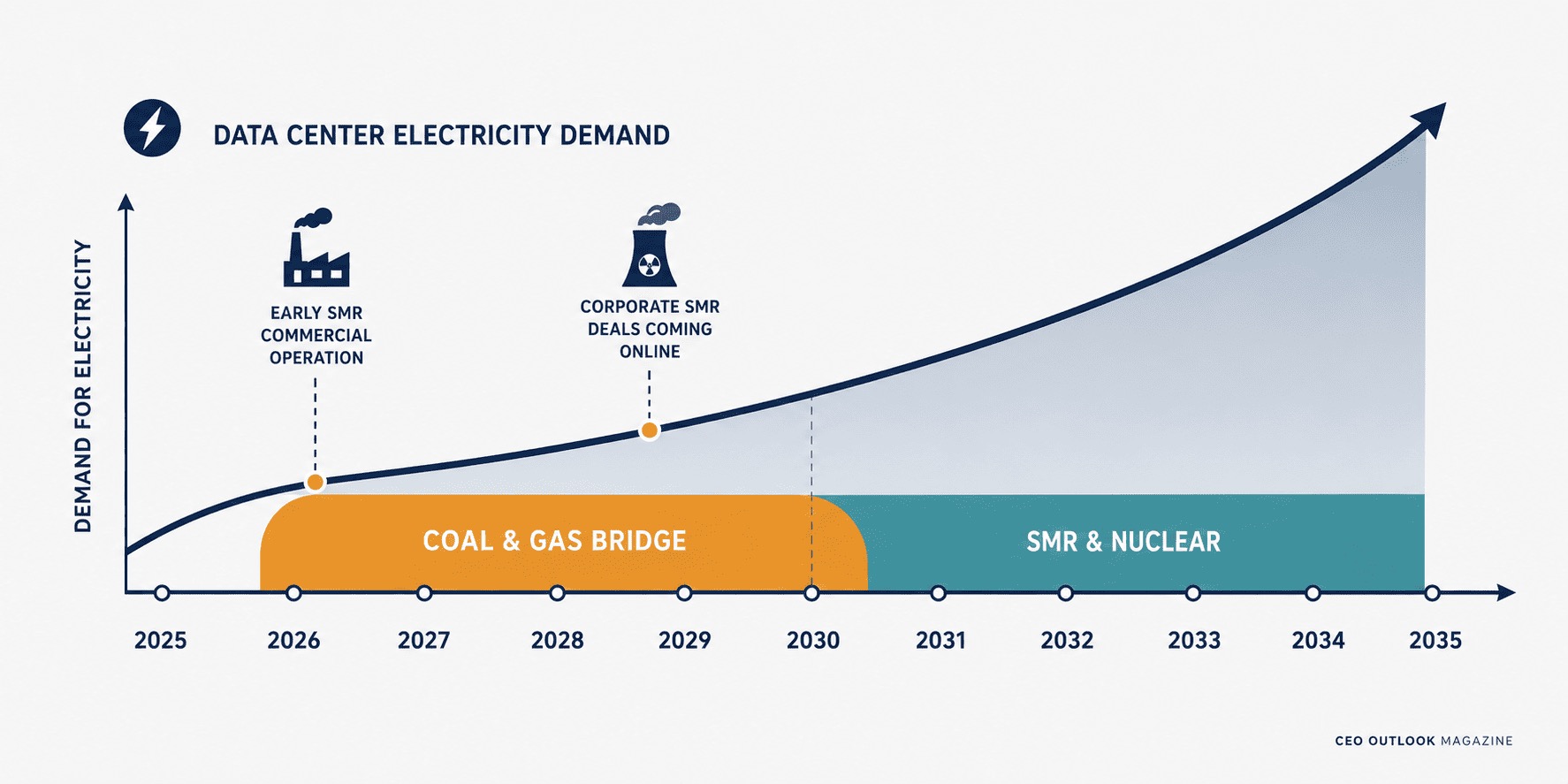
Global data center electricity demand is on track to double between 2025 and 2030, rising from 485 to 950 terawatt-hours. Small modular nuclear reactors, the only credible low-emissions technology at this scale, will not be available in meaningful volume before 2030. In the interim, the International Energy Agency projects that natural gas and coal will supply over 40 percent of the incremental demand. The reality is clear: the next five years will depend on fossil fuels, not because of policy failure, but because the alternatives are not ready at the required scale.
The Number Reshaping Every Other Story in This Series
AI's electricity demand is now a central fact, not a projection. The IEA expects global power demand to grow at more than 3.5 percent annually through 2030, outpacing overall energy demand by a wide margin. This growth is driving the storage gap, intensifying energy security concerns, and shifting the burden of grid investment. AI is not just another factor in the energy story; it is the primary driver shaping the sector's next phase.
The Bridge Fuel Nobody Wanted to Admit They're Relying On
The IEA's analysis quantifies the security-versus-emissions trade-off now embedded in national policy. As data center demand rises through 2030, natural gas and coal will supply most of the new load, both by running existing plants harder and by adding new capacity. The result: carbon emissions from data center electricity are projected to peak at 320 million tonnes around 2030, then decline only slightly to 300 million tonnes by 2035. This is not a worst-case scenario, but the central forecast. The extension of coal and gas is not an outlier; it is the expected outcome when AI-driven demand exceeds the pace of clean energy deployment.
The Technology Meant to Fix This Isn't Ready Yet
Small modular reactors are the most credible solution to the current gap, providing round-the-clock baseload power without the intermittency of renewables or the storage limitations that remain unresolved. Corporate investment is significant: Google, Microsoft, and Amazon have each committed to large-scale SMR projects, and total industry financing now exceeds 20 gigawatts. The constraint is not capital, but time. According to the IEA, SMRs will not contribute meaningfully before 2030. The near-term gap will be filled by fossil generation, regardless of current investment levels.
The Country Racing Ahead vs the Country Restarting Old Plants
Nuclear expansion is moving at different speeds in major markets, with long-term implications for competitiveness. China leads, approving 10 new units worth $27 billion and set to become the largest nuclear power market by 2030. Its Linglong One will be the first commercial onshore small modular reactor, operational in 2026. The United States expects only modest growth—about 7 percent, or 7 gigawatts—mainly from restarts and upgrades, not new builds. Globally, over 70 gigawatts of new nuclear capacity are under construction, the highest in thirty years. By 2030, renewables and nuclear together are projected to supply half of global electricity, up from 42 percent today.
The Supply Chain Risk Nobody's Pricing Into the Nuclear Bet
Nuclear's resurgence brings its own supply chain risk. Uranium demand is set to nearly double over the next two decades, but supply is projected to fall after 2030, raising the risk of a structural deficit in the fuel required for new plants. Nuclear projects also face slow regulatory approvals, cost overruns, and political uncertainty. If these risks materialize, the timeline for nuclear deployment could slip further than current forecasts suggest.
What This Means for Energy Leadership
For energy leaders, the next five years are neither a clean energy success story nor a sign of transition failure. The data points to a defined, near-term reliance on fossil fuels, driven by AI demand outstripping nuclear's timeline. Any real shift after 2030 will depend on resolving uranium supply constraints that are not yet reflected in most strategies. Organizations that plan for either a seamless transition or indefinite fossil reliance are missing the actual operating reality.
Most five-year energy strategies do not fully account for the near-term fossil-fuel bridge or the nuclear supply-chain risks that follow. These are not theoretical issues; they are now central to operating reality.