

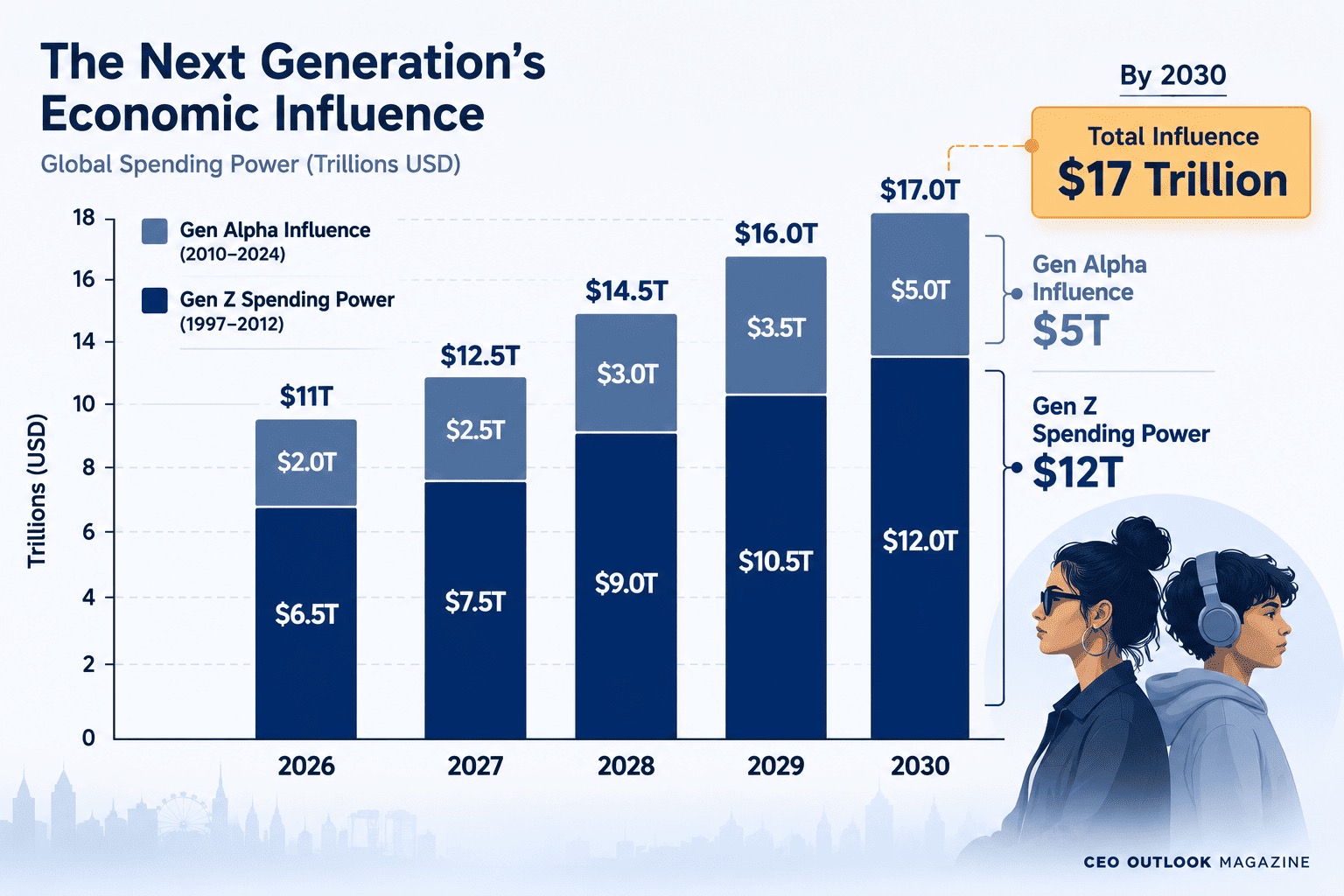
Nearly half of children between six and twelve have already interacted with AI-driven technology before most have ever made an independent purchase. Gen Z's spending power is projected to reach $12 trillion by 2030. Gen Alpha will influence more than $5 trillion in household spending by then, with an intergenerational wealth transfer exceeding $100 trillion arriving behind them by 2048. Every structural tension this publication has documented across consumer and entertainment this year- the collapse of manufactured trust, the flooding of AI-generated content, the exhaustion of generic loyalty mechanics- converges on a single fact: the generation about to command this money was raised specifically inside the systems this year's reporting found are becoming hostile to inauthenticity.
The Money Arriving Behind This Shift
The scale of capital moving toward younger consumers is not a distant projection. Beyond Gen Z's $12 trillion trajectory, Gen Alpha's economic footprint is expected to approach $5.46 trillion by 2029, already nearing the combined spending power of millennials and Gen Z, with roughly 2.5 million new Gen Alpha consumers born every week. Underneath both figures sits the largest intergenerational wealth transfer in history: an estimated $100 to $124 trillion moving from older generations to their heirs by 2048. This is not simply a demographic curiosity for marketing decks. It represents the capital base consumer and entertainment strategy will compete for over the next five years.
Why This Generation Doesn't Just Want Authenticity — It Was Raised to Detect Its Absence
Gen Alpha is the first cohort to grow up entirely within algorithmic systems shaping what they see, prefer, and consider from early childhood, establishing expectations around personalization and relevance before independent purchasing decisions even begin. This matters directly for the AI content and brand authenticity concerns this publication has already documented at length. A generation raised inside algorithmic discovery has also grown up watching, as one industry analysis puts it, every brand promise sustainability and inclusivity, and has already learned which ones actually delivered. This generation doesn't need to be taught to distrust manufactured signals. It is a generation for whom verification is the default operating mode, arriving at exactly the moment this publication has found peer reviews outranking brand messaging, AI-generated content actively eroding trust, and loyalty programs failing to produce genuine engagement despite record enrollment.
The Physical Reversal Nobody Predicted
A genuinely counterintuitive finding complicates the assumption that younger consumers want more digital, more automated, more frictionless commerce. Sixty-one percent of Gen Z now prefers discovering new products in-store, a direct reversal of the digital-native assumption that has shaped retail and brand strategy for a decade, and one that extends directly from this publication's earlier finding that e-commerce's growth advantage over physical retail has largely evaporated. For Gen Alpha, the shift runs even deeper structurally: commerce is collapsing into community and identity rather than remaining a separate, purely transactional activity, with shopping increasingly functioning as an act of social expression validated through peers and creators rather than a discrete decision made in response to an advertisement. Brands built around broadcasting a message to a broad, passive audience are structurally mismatched with a generation that expects to discover products inside the communities it already belongs to.
The Honest Caution Even the Data Providers Are Issuing
An important complication deserves equal weight, and it comes directly from the research firms producing these generational forecasts. NielsenIQ's own analysis explicitly cautions that the biggest shift in consumer spending is not generational at all, but behavioural, warning brands against relying on demographic targeting alone and instead focusing on when a given consumer, of any age, prioritises premium experience versus pure value. Gen Z's own spending behavior underscores this volatility directly. After expecting to increase holiday spending by 37 percent in 2024, the same cohort planned a 23 percent cut heading into 2025, and current purchase frequency growth for Gen Z trails older generations by two to three times despite its far larger projected lifetime spending power. A generation with enormous eventual spending power is not the same as a generation whose current behavior can be reliably predicted from age alone.
What This Means for Every Thread This Series Has Covered
Read against this generational backdrop, nearly every theme this publication has tracked across consumer and entertainment this year gains new urgency. Loyalty programs built on generic, interchangeable points mechanics are converging with a consumer base raised to spot manufactured engagement at a glance. AI content flooding streaming and social platforms is converging with a generation that has interacted with algorithmic systems since early childhood and expects genuine personalization, not volume-driven slop. Brand strategy divorced from genuine product truth is converging with what may be the most verification-native generation in consumer history. And niche, deliberately specific brand positioning, the strategy this publication found driving outsized growth for founders willing to build for a narrow audience first- aligns naturally with a generation that discovers products through community and identity rather than broad, undifferentiated mass marketing.
What This Means for Consumer and Entertainment Leadership
The leaders positioned to capture the disproportionate spending power arriving over the next five years are not simply the ones with the most sophisticated generational targeting data. They are the ones who have already internalized this year's harder lesson: that manufactured signals, whether AI-generated content, gamed loyalty metrics, or brand positioning untethered from genuine product truth, are becoming both easier to detect and more costly to deploy, precisely as the generation inheriting the next several decades of spending power arrives already fluent in spotting the difference.
Is your organization building consumer strategy around genuine verified substance, or generational targeting alone? CEO Outlook Magazine wants to hear your perspective — share your view with our editorial team, and subscribe to our newsletter for ongoing coverage of the forces shaping consumer and entertainment's next five years.