

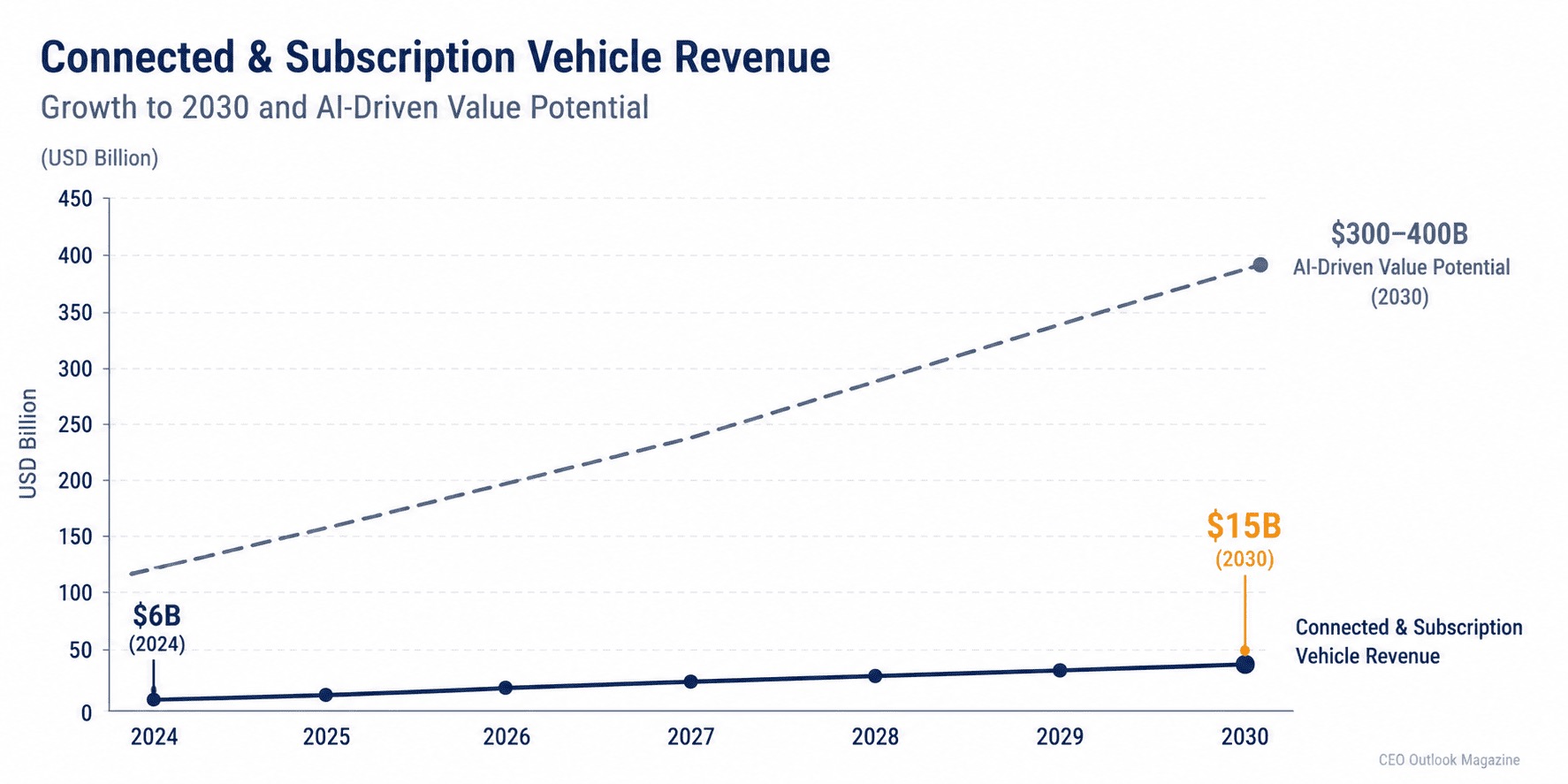
Selling a physical car typically yields a margin between 4 and 10 percent. Software and recurring digital services offer far less, and the industry has noticed. Connected and subscription service revenue is projected to grow from roughly $6 billion in 2024 to $15 billion by 2030, while McKinsey estimates software and digital features could represent $50 billion or more in annual industry revenue by that same year, with AI-driven personalization and connected services potentially contributing $300 to $400 billion in broader value. Nearly every structural pressure this publication has documented across automotive this year, from compressed development cycles to strained chip supply to unresolved autonomous vehicle trust, exists in service of this single, defining shift: the industry is racing to convert the car from a one-time sale into a continuous, monetizable software platform.
The Shift That Explains Every Other Story in This Series
The scale of this transition is now measurable in real capital and real market reaction, not merely projected. The global software-defined vehicle market is estimated at $447.55 billion in 2026, projected to reach $1.7 trillion by 2035. That figure captures both hardware and software, but the underlying logic is consistent across every estimate: automakers are converting vehicles from products sold once into platforms that generate revenue throughout their entire operational life. This is precisely why the development-cycle compression this publication documented at Nissan, and the manufacturing reinvention underway at Ford, matter beyond simple cost reduction. A vehicle built to support years of over-the-air feature updates and subscription revenue requires fundamentally different architecture than one designed to be sold and forgotten.
The Companies Already Cashing In, and How
Concrete examples of this model generating real revenue are no longer speculative. General Motors bundles baseline safety and connectivity features free for up to eight years on new 2025-and-later models, specifically designed to convert 30 to 40 percent of trial users into paid Super Cruise subscribers once that free period ends, a funnel investors rewarded directly, driving GM's stock up 8.8 percent in a single day following disclosure of its software margin growth. Tesla has taken a more aggressive approach, removing basic lane-keeping functionality from new vehicles entirely and eliminating the lump-sum purchase option for Full Self-Driving, forcing new buyers toward a $99 monthly subscription as the sole path to hands-free navigation. Both approaches generate recurring, predictable cash flow that Wall Street has shown it will reward decisively.
Why Some Companies Are Built for This, and Others Are Retrofitting
This capability gap directly extends the development-speed divide this publication has already documented. Companies including Tesla, Rivian, and Chinese manufacturers Nio, Xpeng, and Li Auto are furthest along the software-defined path largely because they designed their computing architecture from scratch specifically to support it, the same structural advantage that lets them compress vehicle development timelines to a fraction of legacy competitors' schedules. Legacy automakers are pursuing genuine, substantial catch-up efforts: BMW's upcoming Neue Klasse platform, launching in 2026, moves to a centralized zonal computing architecture built around an in-house, cloud-native operating system, while Volvo has achieved full-stack software control, joining only Tesla and Rivian among automakers capable of writing code from the silicon layer up through the customer-facing application. Stellantis has set an explicit target of €20 billion in annual software-related revenue by 2030. The pattern is consistent: the companies that built software-native architecture from the beginning are capturing this shift fastest, while legacy manufacturers race to retrofit decades of accumulated hardware-first engineering culture onto a fundamentally different business model.
The Compute Demand This Creates, Compounding an Already Strained Supply Chain
This transition adds direct, compounding pressure to the semiconductor supply chain vulnerability this publication has already documented in detail. Modern AI-native vehicle computing, exemplified by NVIDIA's DRIVE Thor system-on-chip delivering 2,000 tera-operations per second compared to the 10 to 30 TOPS of previous-generation automotive chips, represents a genuinely non-incremental leap in the advanced semiconductor capacity vehicles now require. That demand competes directly for the same advanced-node manufacturing capacity already being pulled toward AI data centers, meaning the software-defined vehicle transition is not simply a revenue opportunity sitting alongside the chip supply crisis. It is actively intensifying it, adding automotive-specific demand for exactly the category of chip capacity already documented as structurally under strain.
The Trust Risk This Shift Is Quietly Creating
The software-defined vehicle transition also introduces a genuinely new trust dimension, distinct from but layered directly on top of the autonomous vehicle safety trust deficit this publication has already examined. Removing previously standard features and requiring a subscription to restore them, as Tesla has done with basic lane-keeping, creates a different category of consumer skepticism than safety concerns alone: not simply "is this technology safe," but "is this a fair deal." Automakers that treat this transition purely as a monetization opportunity, without genuine attention to how customers perceive fairness in what they are being asked to pay for repeatedly, risk compounding an already fragile trust relationship rather than building the durable customer connection that recurring revenue models genuinely depend on to succeed long term.
What This Means for Automotive Leadership
The next five years in automotive will be won or lost less by who builds the best individual vehicle and more by who successfully executes the full chain of capabilities this publication has documented across the year: development speed fast enough to compete with software-native rivals, supply chain resilience robust enough to secure the advanced compute this transition demands, and genuine customer trust durable enough to sustain a recurring revenue relationship rather than a single transactional sale. Automakers still measuring success primarily by units sold, rather than by the software-driven revenue relationship that follows each sale, are optimizing for the business model the industry is actively leaving behind.
Most automakers now face a fundamental question: are they building vehicles as one-time products, or as the start of a recurring software revenue relationship? The answer will determine which companies adapt to the industry's new economics and which remain anchored to a model the market is leaving behind.