

When three major dictionaries independently named 'slop' their word of the year in 2025, it signaled a shift. AI-generated content is no longer a marginal issue for media platforms. It has become a recognized business problem with direct operational and financial consequences.
The Word That Made It Official
'Slop' was chosen to reflect the unease with the volume of low-effort, algorithmically generated content now saturating digital platforms. The data shows many creators overestimate how easily AI-generated content escapes detection. In reality, much of it is more easily identified as artificial than its producers expect, which undermines the logic of scaling up production through automation.
The Real Harm Isn't Aesthetic — It's Economic
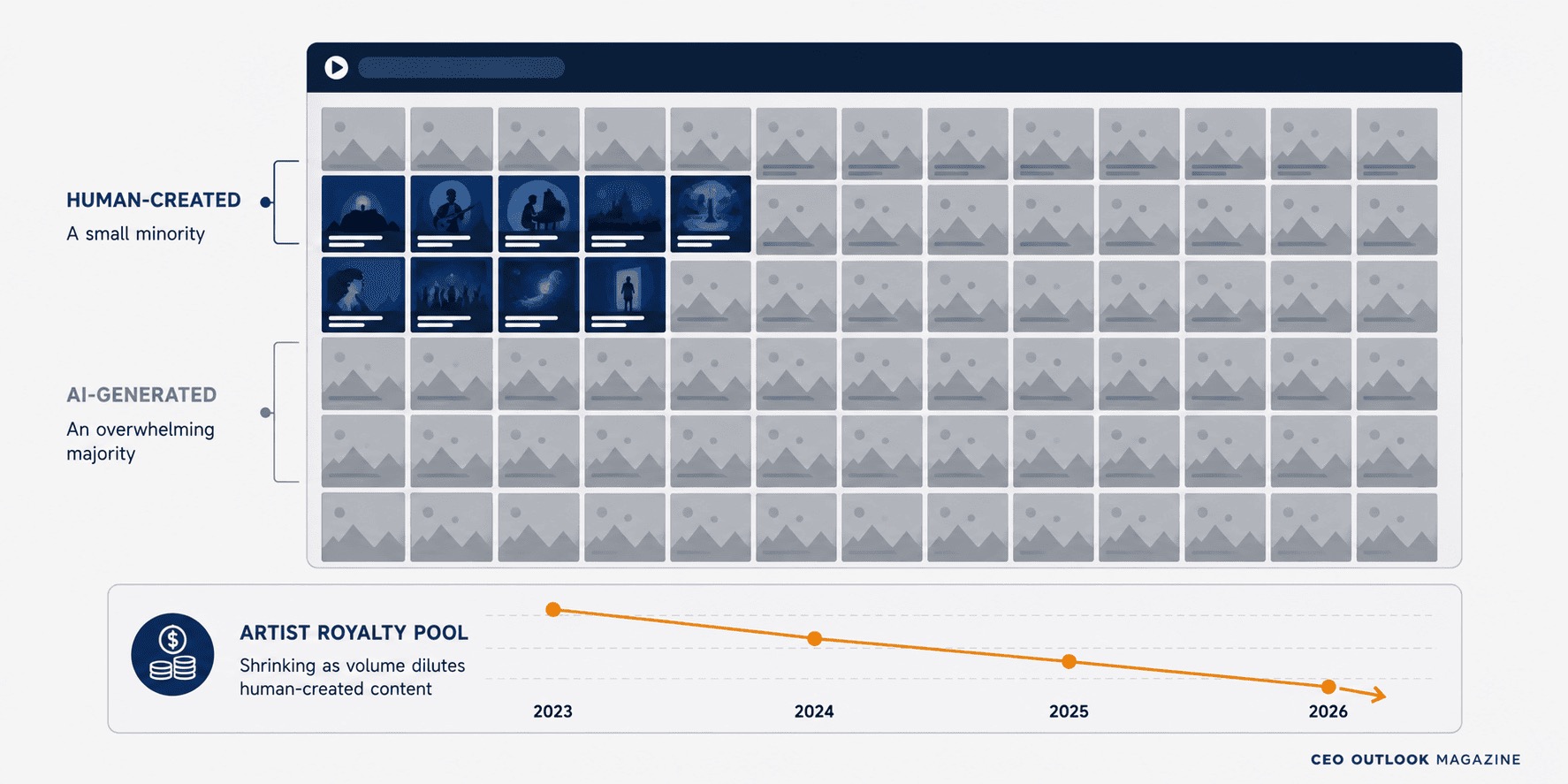
The most consequential problem with AI content flooding entertainment platforms is not that some of it looks or sounds cheap. Volume itself functions as a direct economic weapon against human creators. The core problem with AI-generated content flooding entertainment platforms is economic, not aesthetic. High volumes of AI content dilute royalty pools and reduce compensation for human creators. Artist groups have accused AI music platforms of flooding streaming services with tracks that draw from the same royalty pool as the human artists whose work trained the models. The Recording Industry Association of America has sued AI music generators over alleged mass copyright infringement, a legal dispute that will shape how the industry treats AI training data. In video, low-budget, AI-generated films are now produced to fill ad-supported streaming catalogs and search results, often using generic plots that mimic popular franchises. The logic is familiar: content designed to fill space, not to be chosen by viewers. Or substantially AI-generated, and critically, those labeled tracks are not eligible for royalty payments at all, a direct financial disincentive rather than a cosmetic disclosure requirement. Spotify introduced a new Artist Profile Protection feature specifically letting artists review releases before they go live on the platform, a direct response to AI-generated content repeatedly landing on the wrong artist pages, a problem the platform itself acknowledged had worsened as AI tracks became easier to produce at scale.
The Real Fight Happening in Hollywood
Organized labor has delivered the most significant structural response so far. SAG-AFTRA's 2026 TV/Theatrical Agreement now requires producers to disclose any plans to use synthetic performers and to justify their use. Synthetic actors are permitted only if producers can show they provide significant additional value beyond what a human performer or their digital replica could offer. The controversy over Tilly Norwood, a fully AI-generated performer, highlighted how quickly this issue has become immediate. Since studios can, organized labour has taken the most significant structural action so far. SAG-AFTRA's 2026 agreement requires producers to disclose and justify any use of synthetic performers. Synthetic actors are allowed only if producers can show they provide significant value beyond what a human performer or their digital replica could offer. The controversy over Tilly Norwood, a fully AI-generated performer, showed how quickly this issue became urgent. Since studios cannot be fully prevented from using synthetic performers, SAG-AFTRA is considering a studio tax that would require productions to pay a royalty into a union fund when synthetic actors are used. Union representatives acknowledge this is an imperfect but practical solution. Studios leaning too heavily on AI-generated volume risk alienating the exact audience their content strategy depends on, even before accounting for the copyright and labor consequences already working through courts and contract negotiations.
What This Means for Media Leadership
For media and entertainment leaders, AI content is no longer just a production efficiency issue. It is now an economic, legal, and trust liability, with measurable consequences in royalty structures, union contracts, and consumer behavior. Organizations that require real disclosure, build structural protections for human creators, and treat labeling as a financial mechanism rather than a symbolic gesture are better positioned to use AI as a production tool without incurring unnecessary reputational or legal risk.
Is your organization treating AI content transparency as a genuine structural commitment, or a symbolic disclosure? CEO Outlook Magazine wants to hear your perspective. The question for leadership is whether AI content transparency is treated as a structural commitment or just a symbolic disclosure. The distinction will determine which organizations can manage the risks and which will be exposed as the industry evolves.