

The US shipped 22.37 billion parcels in 2024, but revenue growth did not keep pace, reaching $203.2 billion. That gap is not a rounding error. It reflects real and growing margin pressure, even as parcel volume continues to rise. Global last-mile delivery is projected to expand from $184.2 billion in 2025 to $277.76 billion by 2030. The headline numbers look strong, but the underlying economics are less reassuring. Many businesses are losing money on a significant share of deliveries, and those losses are rarely visible in standard reporting.
The Gap Hiding Inside the Growth Story
Market-size projections track transaction volume, not profitability, and the two have been moving in opposite directions. Nearly 84 percent of e-commerce businesses report higher last-mile delivery costs over the past year, with some seeing increases up to 90 percent. US delivery costs rose an average of 12 percent between 2024 and 2025. When market growth runs at 8 to 9 percent annually but per-delivery costs rise faster, profitability does not scale with volume. The headline growth and the margin reality are now fundamentally disconnected.
What Businesses Actually Charge vs What Delivery Actually Costs
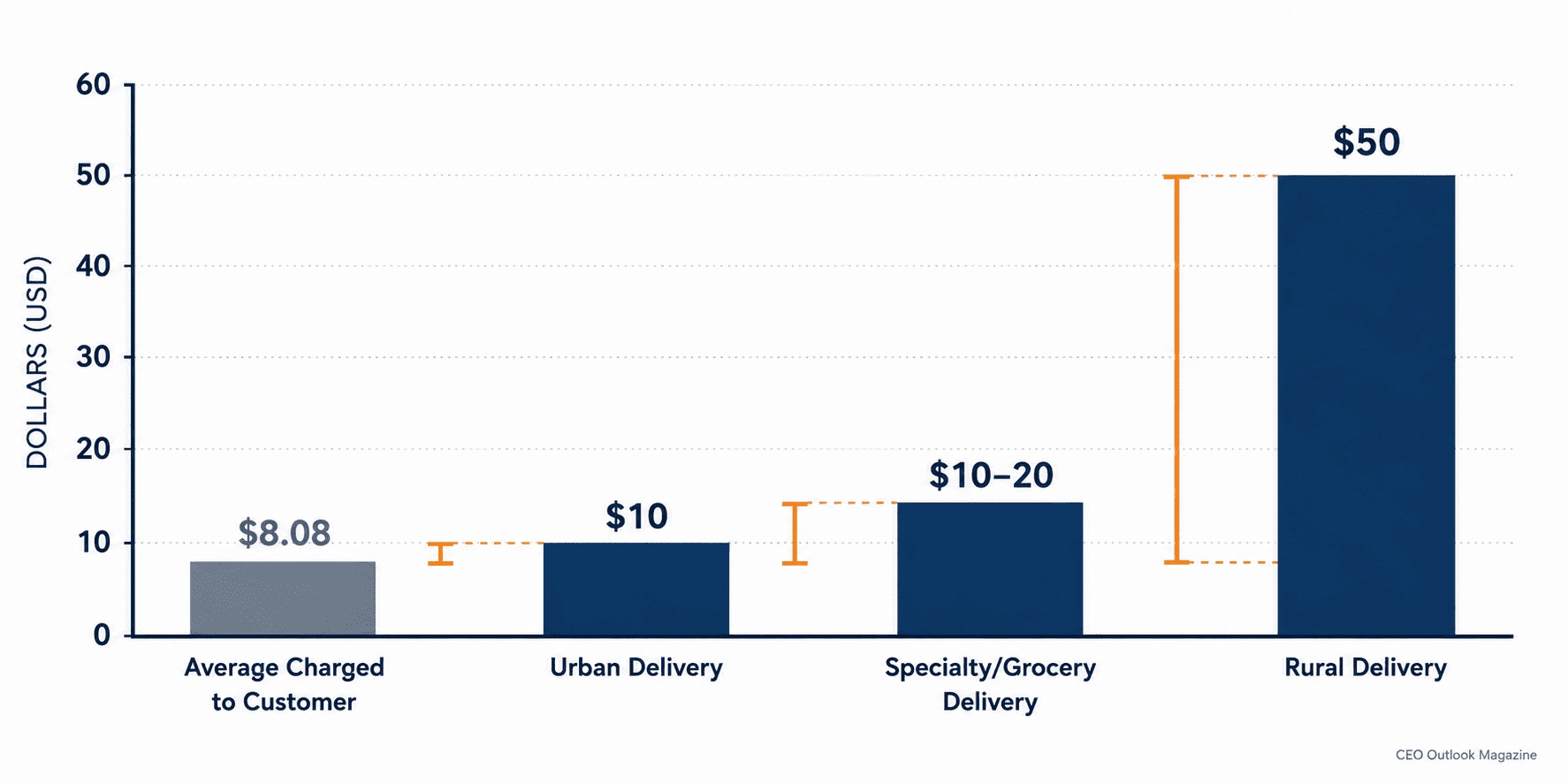
The pricing math makes the margin gap clear. Consumers pay an average of $8.08 for delivery. Actual costs vary: urban deliveries average $10 per package, rural deliveries can reach $50, and temperature-controlled grocery deliveries run $10 to $20. The difference between what businesses charge and what delivery actually costs is often absorbed directly by the business, especially for rural and specialty deliveries. That shortfall comes straight out of margin.
The Order That's Losing Money and Nobody Notices
Margin erosion is often hidden at the transaction level, which makes it easy to overlook. Take a $25 home-improvement item shipped with premium next-day delivery because it was the only available option at checkout. Delivery costs $18. Add packaging, labor, and overhead, and the retailer loses money on the order. The negative contribution margin is buried in what appears to be a routine sale. Multiply this across hundreds or thousands of similar orders, and a pattern that looks like a one-off mistake becomes a structural drain on profitability. Last-mile delivery now costs more than warehousing or long-haul freight. Unless actively managed, these costs rise every year.
The Sticker Price Isn't the Real Price
The base delivery rate businesses use for cost estimates is often misleading. UPS and FedEx residential surcharges alone run $5.30 to $5.65 per package in 2026. Fuel surcharges, dimensional weight fees, extended area fees, and peak season charges can add another 30 to 50 percent above the base rate. A shipment that appears competitively priced at the base rate often costs much more once the final invoice arrives. This gap undermines cost planning that relies on headline carrier pricing instead of fully loaded delivery cost. Failed deliveries add to the problem, costing retailers an average of $17.20 per failed order, or about $197,730 annually for businesses with meaningful scale.
What Actually Protects Margin
Last-mile delivery is not inherently unprofitable. The businesses that protect margin as volume grows use a consistent set of tactics. AI-driven route optimization has delivered cost reductions of about 20 percent in practice. Micro-fulfillment hubs closer to customers can cut last-mile distance by 30 to 50 percent, reducing costs by 35 to 40 percent in dense urban areas. Hybrid fleets that combine owned drivers with gig and crowdsourced capacity provide the flexibility to handle demand spikes without overbuilding fixed infrastructure. None of these measures happen automatically as volume increases. Each requires deliberate investment and active management. That discipline separates businesses whose last-mile growth produces real profit from those subsidizing growth with shrinking margins.
What This Means for Logistics and Retail Leadership
For logistics and retail finance leaders, the lesson is clear: top-line last-mile growth, whether measured by parcel volume or market size, does not guarantee healthy unit economics. Businesses that benefit from last-mile growth measure contribution margin at the order level, account for full delivery costs (including surcharges), and invest in routing and fulfilment infrastructure to keep per-delivery costs aligned with what customers pay. Celebrating rising parcel volume without verifying profitability is measuring growth in the wrong dimension. Margin at the individual order level? CEO Outlook Magazine wants to hear your perspective — share your view with our editorial team, and subscribe to our newsletter for more coverage on the real economics of logistics and supply chain performance.