

In late August 2025, the United States ended its $800 de minimis exemption for imported goods. Within days, postal operators across Germany, Denmark, Sweden, Italy, and later France and Austria suspended US-bound shipments entirely, unable to resolve the customs uncertainty the change created. A peacetime suspension of transatlantic postal flows makes the case for freight network resilience more plainly than any hypothetical scenario could. For any shipper whose network could add or switch carriers within days, the disruption was manageable. For any shipper that treated each carrier relationship as a separate, slow-to-build integration project, it wasn't.
The Diversification Wave That Already Happened, and the One That's Just Starting
Between 2020 and 2024, shippers responded to congestion by spreading import volume across a wider range of gateway ports, moving away from heavy dependence on Southern California toward Savannah, Houston, Vancouver, and Prince Rupert. That first wave of diversification is now largely complete, and industry leadership has explicitly identified where the real work has shifted. As Erin Brenner, Maersk's US Head of First Mile and Depot, put it directly in June 2026, the first wave of supply chain diversification was about the ports. The next wave is about everything that happens after them. Inland network resilience- the ability of a shipper's post-port logistics network to absorb disruption across rail, drayage, warehousing, and final delivery- has become the capability actually separating resilient supply chains from vulnerable ones, precisely because chassis shortages, rail car constraints, and warehouse backlogs have repeatedly turned successfully diversified port arrivals into costly downstream bottlenecks anyway.
The Event That Made This Concrete, Not Theoretical
The de minimis-driven postal suspension illustrates exactly why this inland and carrier-level resilience matters more than port selection alone. A shipper's ability to respond was not determined by which port their goods entered through. It depended on whether their broader carrier network could absorb a sudden, total loss of an entire shipping channel without stopping operations. A network that could add or switch to an alternative carrier within days kept shipping through the disruption. A network where every carrier relationship required its own lengthy integration process waited, watching goods pile up with no functional alternative route available.
Why This Isn't Actually a Trade-Off Against Cost
Treating resilience and cost as opposing priorities misses what the data actually shows. Sixty-five percent of shippers surveyed would fully commit to an alternative carrier strategy if it cut parcel costs by 30 percent. Early adopters have already reached that threshold. One case study found that strategic inventory positioning and carrier optimization reduced total carrier costs by 34 percent. The implication is clear: investing in freight resilience is not always a premium for insurance against disruption. In practice, diversification and cost reduction often go hand in hand. A fragmented, single-carrier-dependent network is frequently both the most expensive and the most fragile option, not just the riskiest.
The Three-Part Framework Freight Leaders Are Actually Building
Industry leaders have moved past searching for a single fix and are building resilience around three core elements. First, diversification: blending contract freight with on-demand alternatives, including regional fleets and owner-operators, instead of relying on a handful of large national carriers. Second, visibility and speed: giving operational teams the authority and tools to reroute shipments within hours when disruption strikes, rather than losing critical time to multi-layered approvals. Third, stronger carrier relationships: building partnerships based on transparent pricing, reliable communication, and faster payments. These relationships become decisive when capacity tightens and carriers choose which shippers to serve first.
The Geography of Redundancy
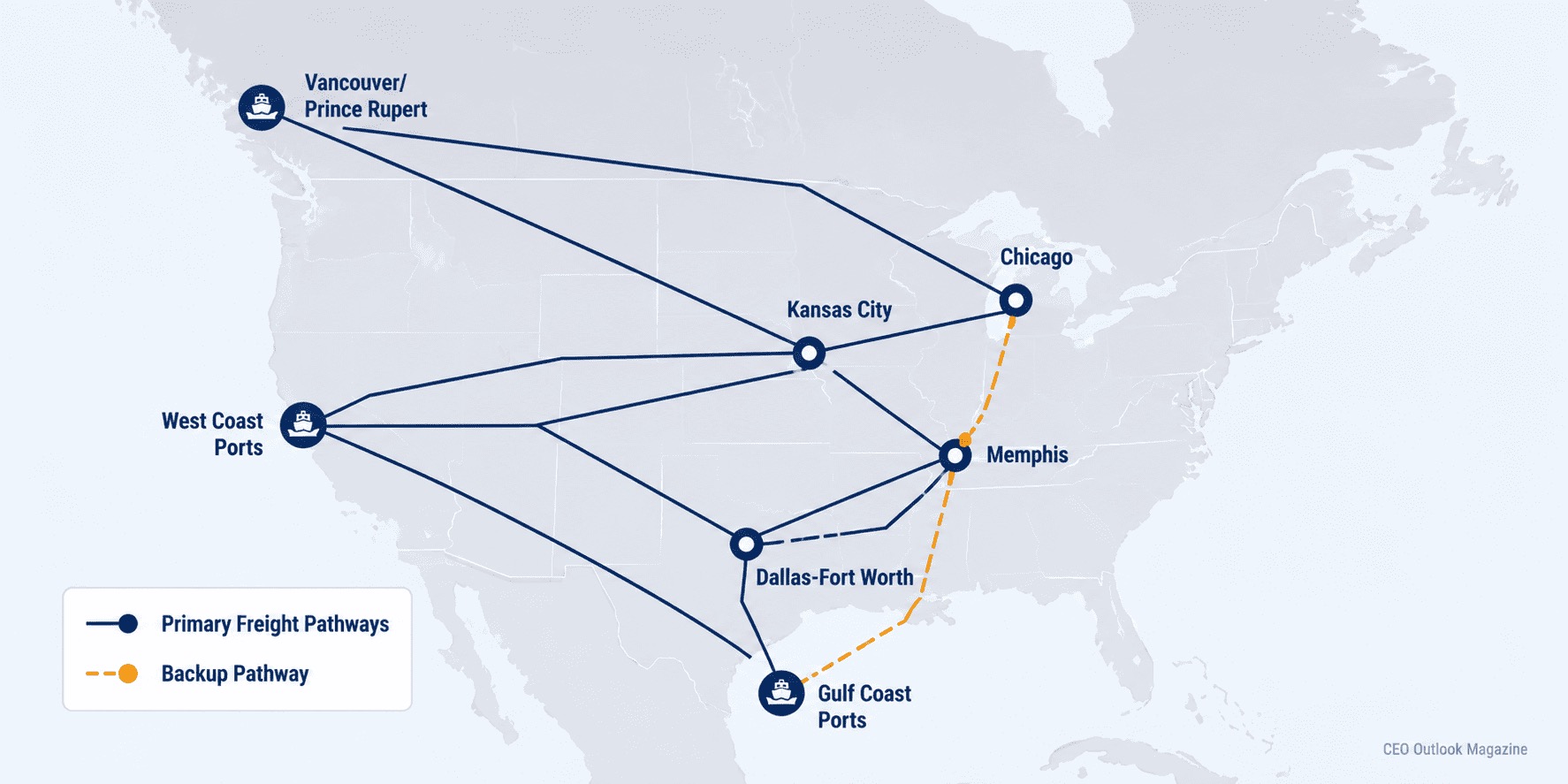
This focus on resilience is now shaping how shippers design their geographic routing. More organizations are building redundant import pathways instead of relying on a single dominant route. They are pairing Mexico with Asia, Canada with the US Gulf Coast, and adopting dual-port entry models to avoid overdependence on any one region or corridor. Inland, Memphis, Dallas-Fort Worth, Kansas City, and Chicago still anchor US freight, but the shift is in how shippers now treat these hubs: as strategic infrastructure designed for multimodal flexibility and inventory positioning, not just as default pass-through points.
What This Means for Logistics and Supply Chain Leadership
For logistics leaders, the shift is clear: freight network resilience is not a box checked when ports were diversified. The real competitive edge now lies inland, in carrier relationships, rail capacity, and warehousing—the factors that determine whether goods actually reach their destination after clearing the port. The ability to add or switch carriers within days, not months, is now essential. Organizations still focused only on cost per shipment, without considering how quickly their network can absorb a real shock, are optimizing for the wrong outcome given recent experience.
The question for leadership is straightforward: can your freight network add or switch carriers within days, or does each relationship still require a lengthy integration? The answer will determine how your organization weathers the next disruption.