

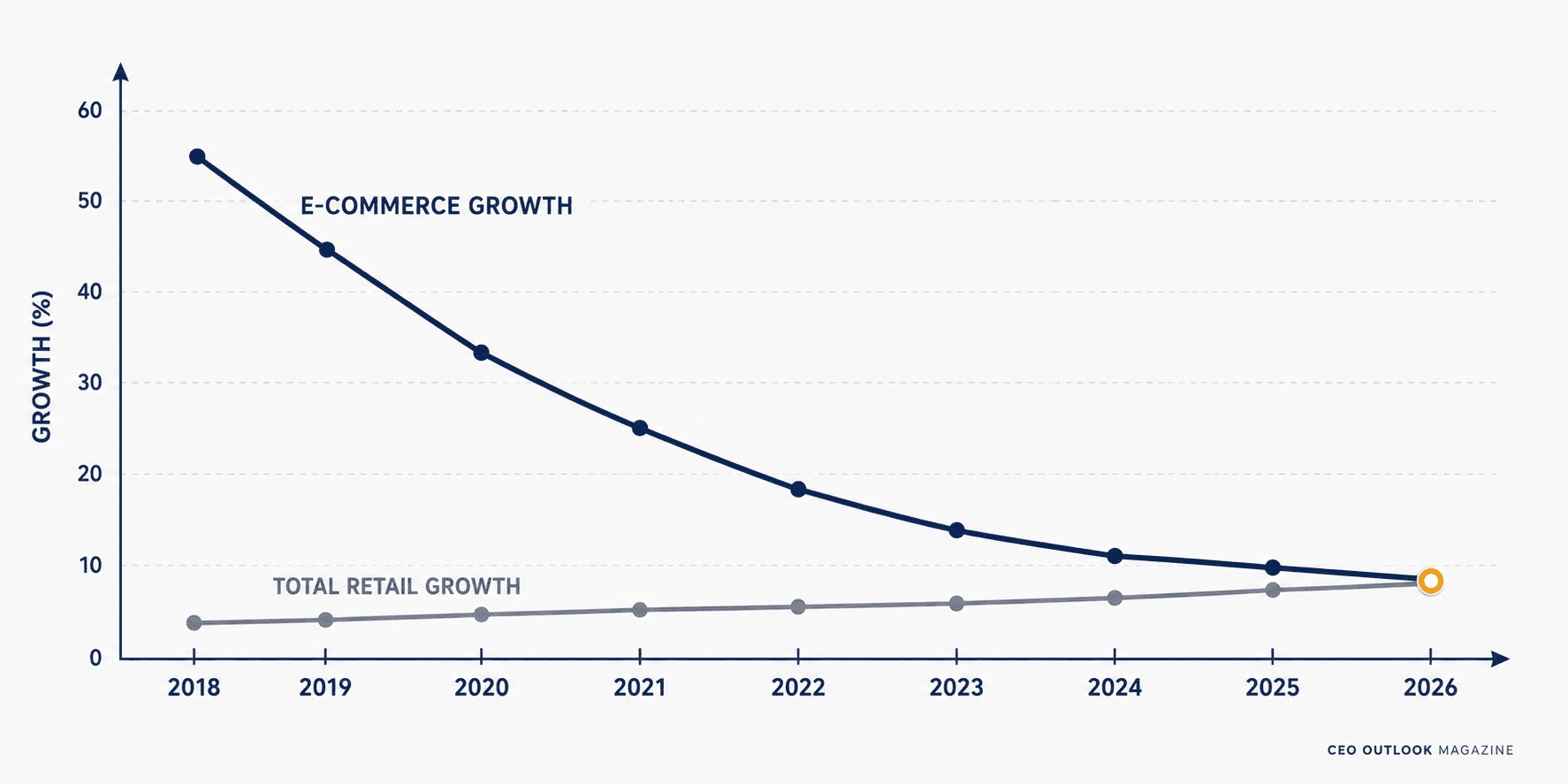
E-commerce's share of US retail sales increased from 16.2 percent to 16.4 percent over the past year, according to Federal Reserve data. For a channel that previously drove retail strategy with sustained double-digit growth, a 0.2 percentage point annual gain signals a structural shift. Yet many retailers continue to plan strategy, budgets, and headcount as if the old growth rates remain in effect.
The Gap That Used to Do All the Growth
For years, e-commerce's growth far outpaced total retail, effectively serving as the industry's default growth engine. When e-commerce expanded annually at 30 percent while total retail grew at 4 percent, it was simply keeping pace and gaining share. That dynamic has changed. E-commerce growth has slowed to about 5.1 percent annually, while total retail remains in the 3 to percent range. The gap has narrowed, and growth of 10 to 15 percper cent reflects actual share gains from competitors, not just participation in a rapidly expanding channel. Sustaining that level of growth is significantly more difficult and costly.
The Ceiling Nobody Wants to Admit
Many retail strategies continue to overestimate e-commerce's addressable market. Physical stores still account for 84 percent of US retail spending, not just due to categories like gas stations or restaurants. In apparel, physical stores handle more than 60 percent of sales, particularly in mass and value segments. Home improvement and furniture remain predominantly offline. Even Amazon has recognized these limits, closing Amazon Go and redirecting focus to Whole Foods. The traditional model built on price and speed is no longer sufficient.
Why Strategy Hasn't Caught Up to the Numbers
There is a clear disconnect between current growth data and retail leadership expectations. In a recent survey of nearly 500 retail, commercial real estate, and CPG professionals, about 70 percent still expect e-commerce to outpace physical stores, despite the narrowing growth-rate gap. Consumer behavior also challenges digital-first assumptions: 55 percent of consumers identify in-store shopping as a key discovery channel, and 54 percent believe that role is increasing. Strategies that treat physical retail as a declining legacy channel are increasingly misaligned with both the data and consumer sentiment.
The Growth That's Left Isn't Evenly Distributed
The limited e-commerce growth that remains is increasingly concentrated among higher-income consumers. Recent analysis shows that 2025's e-commerce gains are driven largely by the top 10 percent of income earners, whose spending has benefited from rising asset values, while wages for most consumers have stagnated or declined. For retailers relying on broad-based, mass-market e-commerce expansion, this concentration poses a significant risk. The headline growth figures mask the reality that many brands serving mainstream consumers may be experiencing far less online growth than national averages suggest.
The New Complication Retailers Are Reacting to Fast, While Missing the Bigger One
Ironically, retail leadership is moving with genuine urgency on a different, more novel disruption while still catching up on the growth-rate convergence. Retail leadership is responding quickly to new disruptions, particularly the rise of AI-driven referral traffic. For some retailers, AI platforms now account for 15 to 20 percent of total referrals, and AI-referred purchase conversions rose sharply in late 2025. Deloitte projects that AI shopping agents could handle up to 25 percent of global e-commerce transactions by 2030. Most retail executives expect generative AI to weaken brand loyalty as purchasing decisions shift to AI intermediaries. While retailers are investing to address these changes, few are revisiting the more fundamental assumption that e-commerce will continue to outpace physical retail at historical rates—achieving roughly US$7.41 trillion in 2026 with global penetration climbing to 21.8 percent of total retail sales. The US-specific flattening documented here reflects a maturing, developed market reaching a more stable equilibrium between channels, not a global retreat from digital commerce. For retail leadership operating in mature markets like the US, the practical implication is direct: capital allocation, real estate strategy, and growth targets built around the assumption that e-commerce will keep outgrowing physical retail by a wide margin are increasingly based on an outdated model. The organizations already treating physical and digital as genuinely complementary, rather than one in structural decline and one in perpetual ascendance, are the ones positioned to actually capture the growth that remains.
Many organizations are still operating as if the e-commerce tailwind remains strong, despite clear evidence to the contrary. Senior leaders should reassess whether their growth strategies reflect current realities, not outdated assumptions.