

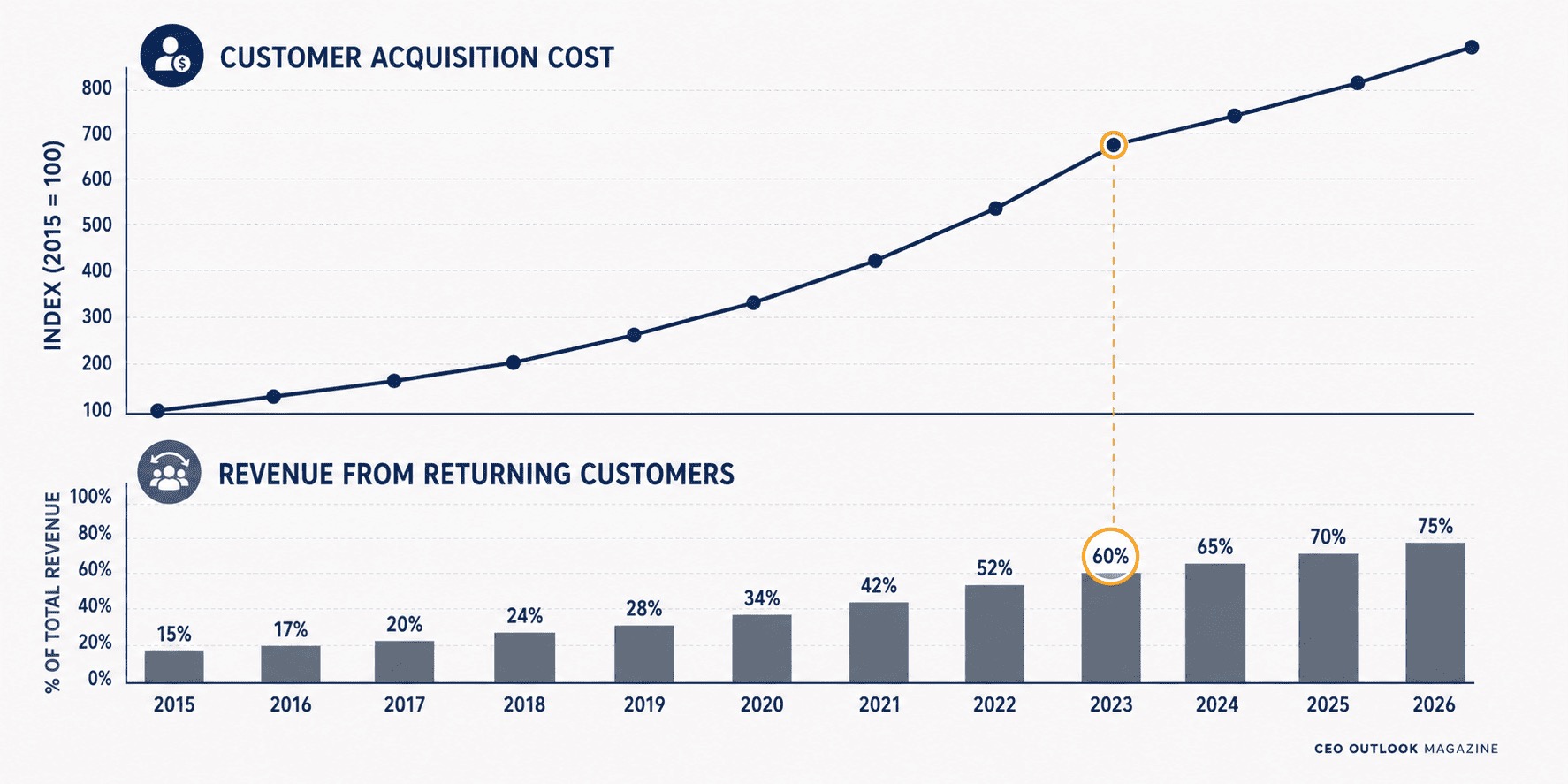
In 2015, DTC brands could acquire customers through Facebook ads at a fraction of today's cost, with targeting precise enough to build a business on paid acquisition alone. That equation no longer works. Customer acquisition costs have increased 40 to 60 percent since 2023, and up to 80 percent since 2021, driven by structural changes that are unlikely to reverse. Brands still operating on the 2018 playbook are learning, often expensively, that the underlying assumptions have changed.
The Economics Behind Early DTC No Longer Apply
The original DTC model depended on paid acquisition that was both inexpensive and precise. That changed with Apple's iOS 14 privacy updates, which reduced targeting accuracy, and with increased competition that has steadily pushed CPMs higher. Platform saturation now means most categories have far more brands competing for the same attention than five years ago. Median blended customer acquisition costs are now between US$60 and US$120 per new customer, and continue to rise 12 to 18 percent annually. These increases are not cyclical. Regulatory privacy changes, platform saturation, and rising ad competition are now permanent features of the landscape. DTC brands must build their models around these realities, not wait for conditions to improve.
A Case Study in Paid Acquisition Limits
Glossier's trajectory shows what happens when a brand relies too heavily on paid acquisition as it scales. As the company grew, its marketing mix shifted toward paid channels, and marketing costs rose accordingly. Paid acquisition that works at small scale, targeting a narrow and responsive audience, becomes less efficient as a brand moves into broader, more expensive segments. What looked like a growth engine at US$10 million in revenue can become a structural drag at US$100 million, because the acquisition economics were never sustainable at scale.
Where DTC Profitability Actually Comes From
The more important shift is that DTC profitability now depends on retention, not acquisition. Sixty percent of DTC revenue comes from returning customers, not new ones. The economic engine has moved from the top of the funnel to keeping customers over time. The growth of the subscription economy, from US$492 billion in 2024 to a projected US$1.5 trillion by 2033, reflects this change. Brands are increasingly building their models around recurring revenue, not one-time transactions funded by costly paid acquisition.
The New Playbook: Community, Not Just Targeting
Brands that are adapting have changed what they optimize for in paid channels. Instead of focusing on the lowest cost per first purchase, the more effective approach is to acquire genuinely engaged community members who are likely to stay and generate lifetime value over time. User-generated content from existing customers now outperforms studio-produced ads, and lookalike targeting based on high-value community members delivers better results than broad interest targeting. Brands with real community infrastructure—ambassador programs, online communities, referral systems—see repeat purchase rates 40 to 60 percent higher than those without. These community members also act as an unpaid acquisition channel through word of mouth.
Why 'Direct' Now Means Multi-Channel
A clear sign of how the DTC model has changed is that many successful brands no longer sell exclusively direct. Physical retail, including pop-ups, now serves as a low-cost acquisition channel, letting customers interact with products before buying online. Brands operating across three or more integrated channels—paid, owned, community, and physical—generate nearly triple the revenue of those relying on a single channel. The reality is that many brands now succeeding under the DTC label have become omnichannel businesses that started direct, rather than proving that pure direct-to-consumer distribution was ever a sustainable long-term model.
Implications for Brand and Retail Leadership
For leaders evaluating DTC strategy, the acquisition-led growth model that defined the category's early years is structurally finished, not just temporarily out of favor. Today's successful businesses have rebuilt their economics around retention, community, and multi-channel presence, not cheap paid acquisition. Brands still measuring success by first-purchase acquisition cost, instead of lifetime value across channels, are optimizing for a growth engine that no longer exists.
Many organizations still build DTC strategy around acquisition-led growth, even as the economics have shifted toward retention and community. The practical question is whether leadership has recognized this shift and adjusted accordingly.