

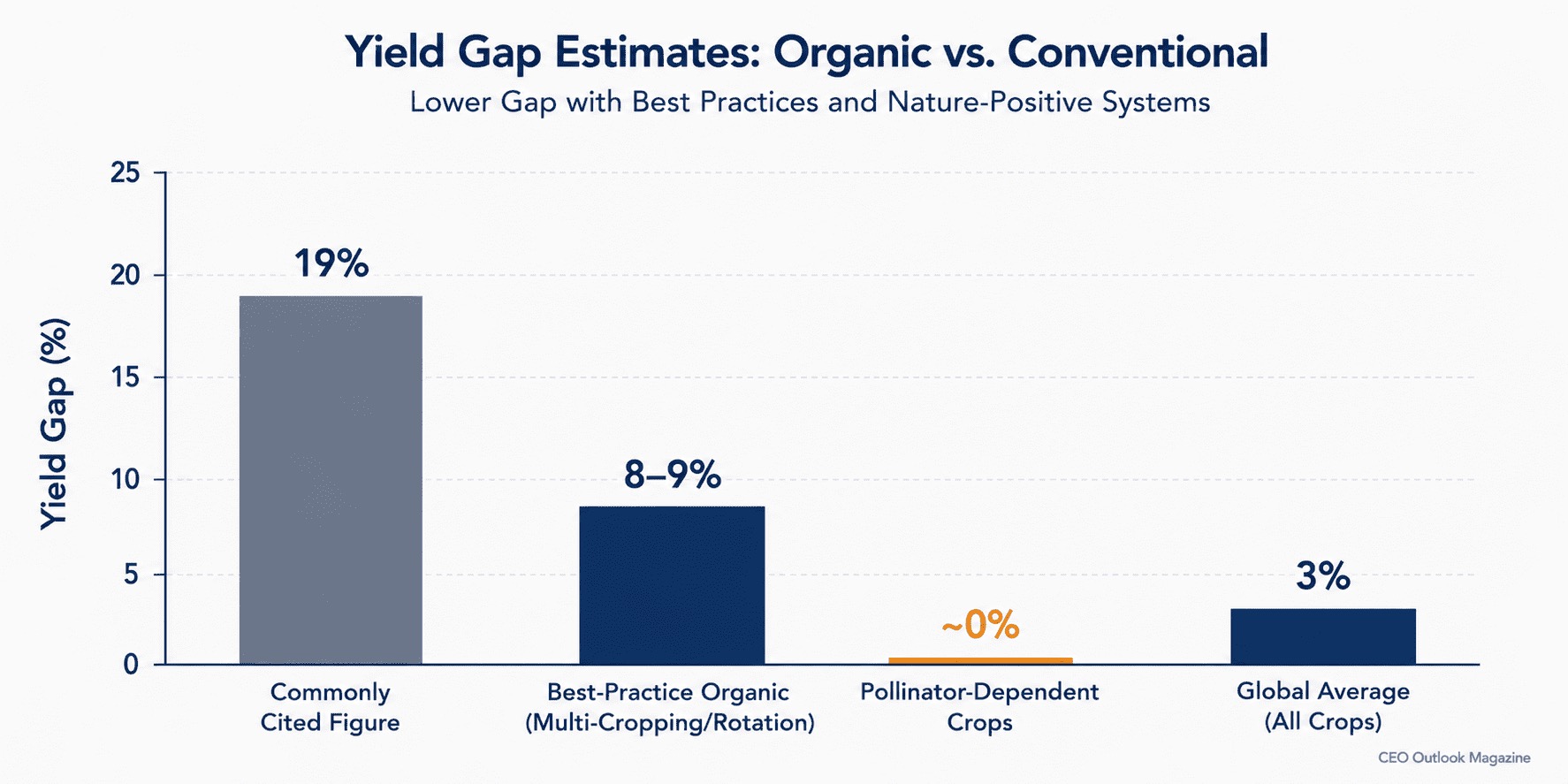
The widely cited 19 percent yield gap between organic and conventional farming has shaped the debate for years, reinforcing the idea that sustainability comes at a steep productivity cost. But the most comprehensive meta-analysis to date, covering 115 studies and over 1,000 observations, puts the gap closer to 8 to 9 percent when best organic practices are applied. The real figure is likely smaller, given the documented bias in much of the research toward conventional methods. The trade-off exists, but it is smaller, more dependent on crop and practice, and more open to improvement than the headline number suggests.
Why the Standard Yield Gap Number Is Outdated
The University of California, Berkeley meta-analysis used more rigorous methods than earlier studies and found the organic yield gap narrows significantly when farmers adopt proven practices like multi-cropping and crop rotation. These approaches improve soil health, reduce pests and disease, and make water use more efficient. The study’s authors point out that the remaining gap is surprisingly small, especially given the historic underinvestment in organic research and seed development compared to conventional agriculture. The literature also shows a clear bias in favor of conventional methods, suggesting the true gap is likely smaller than even these updated estimates.
Yield Gaps Vary by Crop
A recent study adds a critical point: the yield gap between organic and conventional farming is not consistent across crops. Reviewing 1,372 records from 199 studies and 61 crop species, researchers found the gap shrinks as crops become more dependent on pollinators, and can disappear entirely for those with moderate to high pollinator reliance. The reason is straightforward. Organic farming tends to preserve insect populations and improve soil, which strengthens pollination. For crops where pollination limits yield, better pollination can offset the typical organic yield penalty. This result held up across climate zones and crop types, and after adjusting for publication bias. For a significant share of global crops, organic methods may not just be more sustainable, but also more productive.
Is the Yield Gap a Research Problem?
The most important shift in perspective is this: the remaining yield gap may be the result of decades of underinvestment, not a hard biological limit. Conventional agriculture has received far more research funding and seed development than organic methods. The practices that already narrow the gap, like multi-cropping and crop rotation, show that targeted research and organic-specific breeding can deliver real gains. The yield gap should not be treated as a fixed cost of sustainability, but as a problem that investment can solve.
The Overlooked Trade-Off: Yield Reliability
Yield reliability is an underappreciated part of the trade-off. A meta-analysis of 193 studies and nearly 2,900 comparisons found that organic farming has about 15 percent lower year-to-year yield stability than conventional methods. In other words, organic yields are less predictable, even when average output is similar. For farmers and buyers, this matters as much as average yield. Importantly, this volatility is specific to organic systems. No-tillage or conservation agriculture, for example, reduces average yields by about 5.7 percent, but does not show a significant difference in yield stability compared to conventional tillage. Sustainable farming is not a single risk profile. Organic and conservation methods present different trade-offs, and treating them as interchangeable misses important operational realities.
Biodiversity Gains and Yield Costs: The Real Numbers
Where trade-offs remain, the numbers are clear. A 2022 meta-analysis found organic farming increases biodiversity by 23 percent, at a similar cost in yield. This is a real and measurable exchange. The relationship is not uniform, though. Biodiversity gains are linked to yield loss mainly for microbes and plants, but not for other groups. Some ecological benefits from organic practices come without a matching yield penalty.
Implications for Agricultural Decision-Makers
For agriculture and food production leadership evaluating sustainable farming investment, the honest lesson from current research is that the yield trade-off is real, considerably smaller than the commonly cited figure, highly dependent on crop selection and specific farming method, and partly a function of research investment gaps that continued agronomic funding could actively close. Organizations making sourcing or investment decisions based on the older, larger yield-gap figure, or treating organic and conservation agriculture as interchangeable in their ri For leaders evaluating sustainable farming investments, the evidence is clear: the yield trade-off is real, but smaller than the standard figure suggests. It varies by crop and method and partly reflects research funding gaps that can be addressed. Organizations relying on outdated yield-gap numbers, or treating organic and conservation agriculture as equivalent in risk, are not working from an accurate view of the production costs involved.