

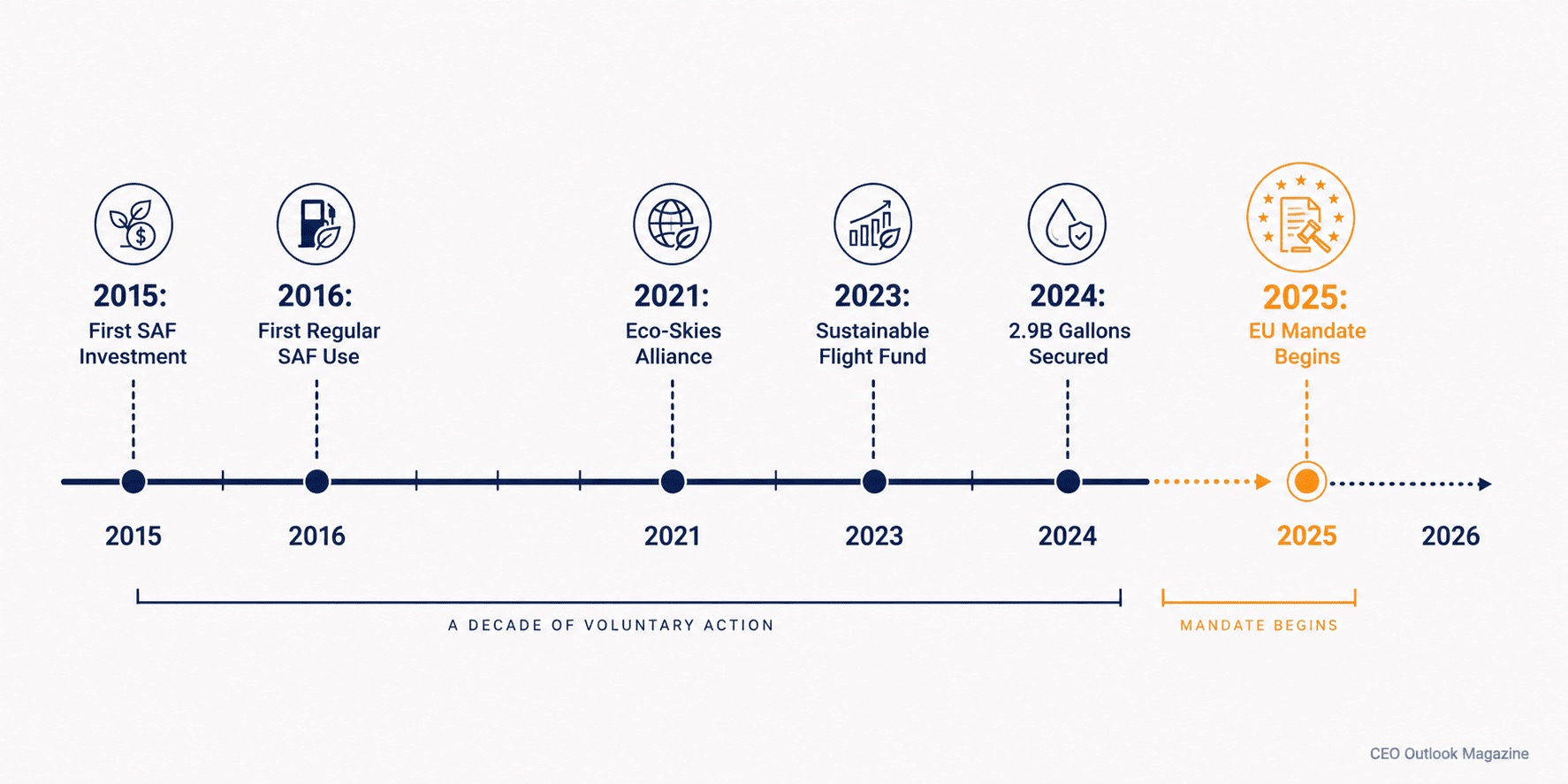
United Airlines began investing in sustainable aviation fuel in 2015. By 2016, it was the first airline to use SAF in regular commercial operations. The European Union’s ReFuelEU mandate, which takes effect in 2025, will create the first real regulatory demand for the fuel. United’s decision to commit capital nearly a decade before any mandate raises a practical question: why would a publicly traded airline absorb the cost and risk of an unproven, higher-priced fuel before regulation forced its hand? The answer offers a rare example of climate strategy driven by operating judgment rather than compliance.
The Bet That Predates the Pressure by a Decade
United’s SEC filings show a steady, long-term approach rather than a late-stage compliance move. After its initial SAF investment in 2015, the company set up a corporate venture arm focused on sustainable aviation technology and built its investment and procurement strategy over several years, well before any regulatory requirement in its main markets.
The Real, Dated Milestones That Built the Position
United’s SAF strategy is marked by specific, dated milestones. In 2021, it launched the Eco-Skies Alliance, allowing corporate partners to share the cost premium of SAF, and established United Airlines Ventures as a dedicated investment arm. In 2022, United signed a purchase agreement with Neste for up to 52.5 million gallons of SAF, the first international deal of its kind by a US airline. In 2023, it created the UAV Sustainable Flight Fund with over $100 million from United and partners including Air Canada, Boeing, GE Aerospace, JPMorgan Chase, and Honeywell. The fund nearly doubled as more partners joined. By 2024, United became the first airline to purchase SAF for use at Chicago O’Hare, contracting with two suppliers.
The Scale This Voluntary Bet Actually Reached
Industry data puts United’s SAF commitment in context. BloombergNEF reports United has secured 2.9 billion gallons of SAF through offtake agreements and direct investment, a volume that outpaces competitors by a wide margin. For comparison, Delta Air Lines has a seven-year agreement with Gevo for 385 million gallons, and American Airlines has a ten-year deal with Aemetis for 350 million gallons. Both are significant, but neither approaches United’s scale.
Why This Was Genuinely Voluntary, Not Regulatory Compliance
The timing of United’s investment is the strongest evidence this was a strategic decision, not early compliance. From 2021 to 2024, most European airlines still benefited from free EU Emissions Trading System allowances, which reduced the financial incentive to adopt SAF. The real regulatory pressure only begins in 2025, when the EU’s ReFuelEU mandate requires a 2 percent SAF blend, and intensifies in 2026 with the end of free ETS allowances. United’s core investments, starting in 2015, came well before these changes.
The Next Bet: Skipping the Feedstock Problem Entirely
United’s latest SAF investment targets a different constraint: feedstock supply. The airline invested in Twelve, a company developing power-to-liquid SAF technology that uses carbon dioxide, water, and renewable electricity instead of limited feedstocks like used cooking oil or animal fats. Studies indicate power-to-liquid fuels could reduce aviation emissions by up to 90 percent, depending on the electricity source. Twelve recently raised $83 million and is building its first commercial facility in Washington. United positions this as a direct emissions reduction strategy, in contrast to the offset-heavy approaches still common in the industry.
The Honest Scale of What's Still Left
United’s disclosures make clear how far the industry still has to go. The airline’s 2025 Corporate Impact Report notes global SAF production was about 634 million gallons, compared to nearly 107 billion gallons of conventional jet fuel consumed worldwide. The gap is significant. United’s SAF can cost up to five times more than conventional fuel, a premium the airline has absorbed for years to help build a market that still depends on further infrastructure and policy support to reach meaningful scale. Airline and Aviation Leadership
For airline executives weighing when to invest in sustainability, United’s approach is instructive. The company built market position, supplier relationships, and technology options years before regulatory pressure arrived, rather than waiting for mandates to force urgent procurement. Whether this early move delivers lasting competitive advantage as new mandates reshape industry costs is still uncertain. What is clear is that United acted well before regulation required it.
Most organizations face a choice: invest in sustainability ahead of regulation, or wait until mandates force the issue. The difference in timing can determine whether a company shapes the market or reacts to it.