

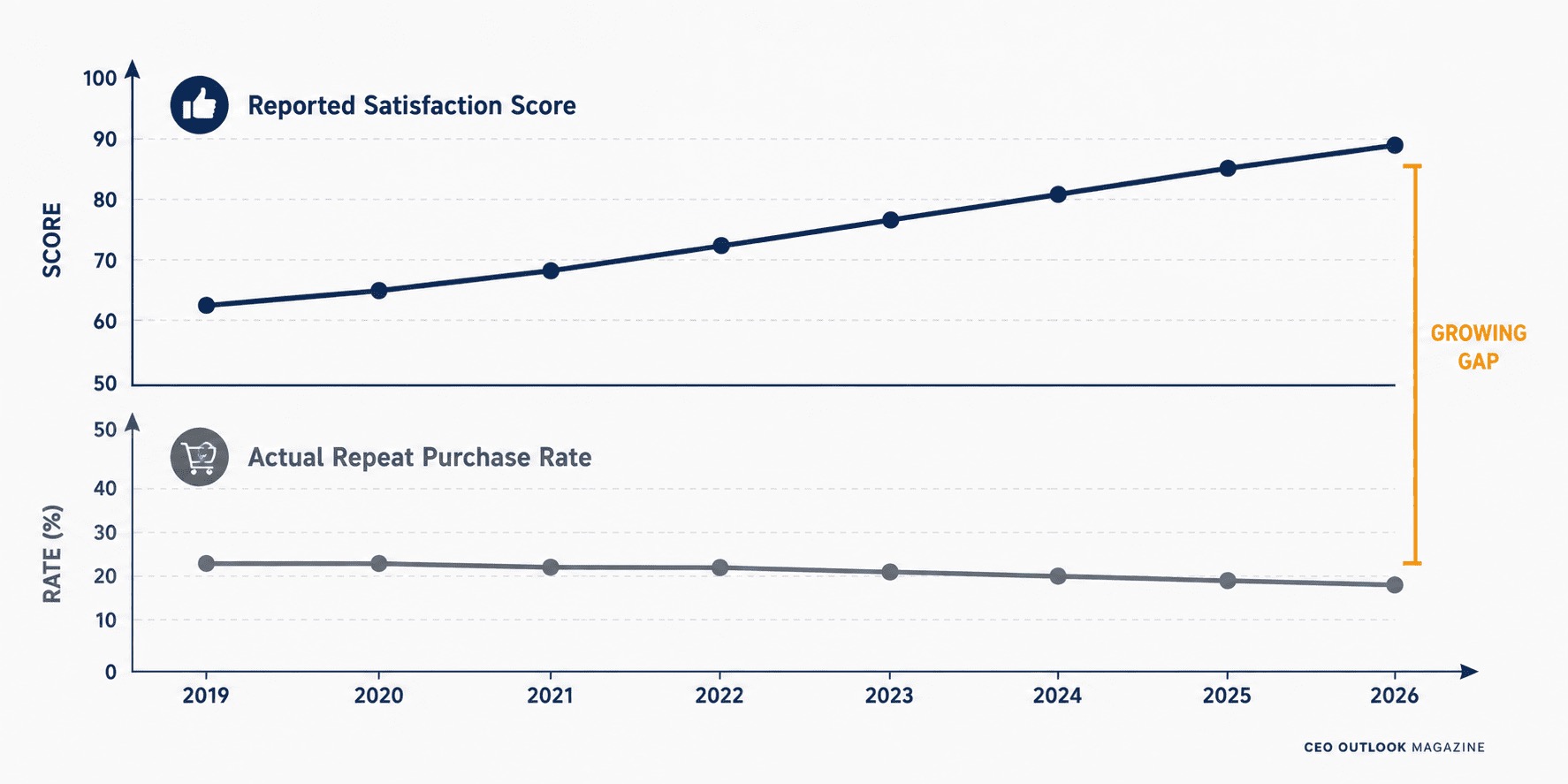
A customer can rate a purchase five stars and never return. That reality calls into question the foundation of how most retailers measure customer experience. Survey gaming—the manipulation of feedback data to inflate scores—has become a systemic issue, not just the work of a few outliers.
The Number Every Retailer Reports and Few Actually Trust
The incentive to report strong customer satisfaction scores is direct and significant. Bain & Company finds that sector leaders on customer satisfaction or Net Promoter Score grow revenue twice as fast as competitors. Gartner reports that organizations linking satisfaction data to financial outcomes are 29 percent more likely to secure ongoing CX budgets. These incentives exist regardless of whether the underlying customer experience is improving. Forrester's data shows the gap is widening: average customer experience effectiveness dropped to 64 percent in 2024, indicating that many organizations are investing in CX without reliable evidence that those investments are working.
How the Gaming Actually Happens
Ipsos research defines survey gaming as the manipulation of feedback collection by employees or internal stakeholders to inflate performance scores. The tactics are often routine rather than fraudulent. Employees asking for five-star ratings at the point of interaction is common. When compensation is tied to satisfaction scores, teams predictably find ways to boost the number, often by surveying only satisfied customers and excluding likely detractors. Survey timing and frequency also distort results. Surveys sent immediately after a positive outcome, or so often that only the most engaged or frustrated customers respond, end up measuring the survey process more than the actual customer relationship.
The Flaw That Doesn't Even Require Cheating
Not all metric distortion is intentional. Non-response bias can inflate scores even without manipulation. As response rates fall and the sample becomes less representative, a rising satisfaction score based on a shrinking group is less reliable than a flat score from a broader base. Another flaw is in the scoring itself. Customers who are merely 'satisfied' defect at higher rates than those who are 'very satisfied,' but standard CSAT scoring treats both as equally positive, masking real churn risk inside a superficially healthy number.
The Metric Retailers Should Actually Be Watching
In retail, the metric that predicts revenue is not satisfaction scores but repeat purchase behavior. A five-star rating from a customer who never returns creates no lasting value. If CSAT scores are strong but reorder rates are flat or declining, the disconnect is a signal to investigate, not to celebrate. Treating high satisfaction scores as evidence of loyalty, without validating against actual repeat behavior, is how retailers get blindsided by churn their dashboards never flagged.
What Actually Fixes This
The solution is not to abandon CSAT or NPS. Both can be useful diagnostics if collected with discipline. Most retailers have not made the necessary changes. Surveys should use a deliberate sampling strategy to reach a statistically representative subset, not every interaction. Saturation surveying lowers response rates and introduces selection bias. Compensation tied directly to satisfaction scores should be reconsidered or at least verified against independent behavioural data, since any metric linked to pay will be managed toward the number, not necessarily the outcome. Quantitative scores should be paired with open-ended feedback and direct review of support tickets or call transcripts, since leadership assumptions about customer complaints often diverge from what detractors actually say. Above all, satisfaction data must be routinely validated against repeat purchase rates and customer lifetime value, not treated as a standalone measure of loyalty.
What This Means for Retail Leadership
Boards and investors should scrutinize not just the satisfaction score, but how it was collected. Surveys sent only to satisfied customers, timed after a resolved complaint, and tied to compensation will reliably produce high scores, regardless of whether customer relationships are improving. The retailers gaining real advantage from customer experience are not those with the highest NPS, but those whose satisfaction data aligns with repeat purchase and retention. That alignment, not the headline score, is the only evidence the metric is measuring something real.
Most organizations treat customer satisfaction data as a statistic, rarely as behaviour you can trust to predict actual repeat purchase behaviour. That gap is where risk accumulates, and where leadership attention should be focused.