

Indonesia controls over 40 percent of global nickel reserves. China owns about 75 percent of the refineries processing that nickel. But ownership alone does not determine leverage. Those refineries operate on Indonesian territory, under Indonesian law. As a result, China's position in battery-grade nickel depends on decisions made in Jakarta, not Beijing. In the current geopolitics of critical minerals, leverage rests with whoever controls the jurisdiction, not just the asset.
The Old Playbook Doesn't Work Anymore
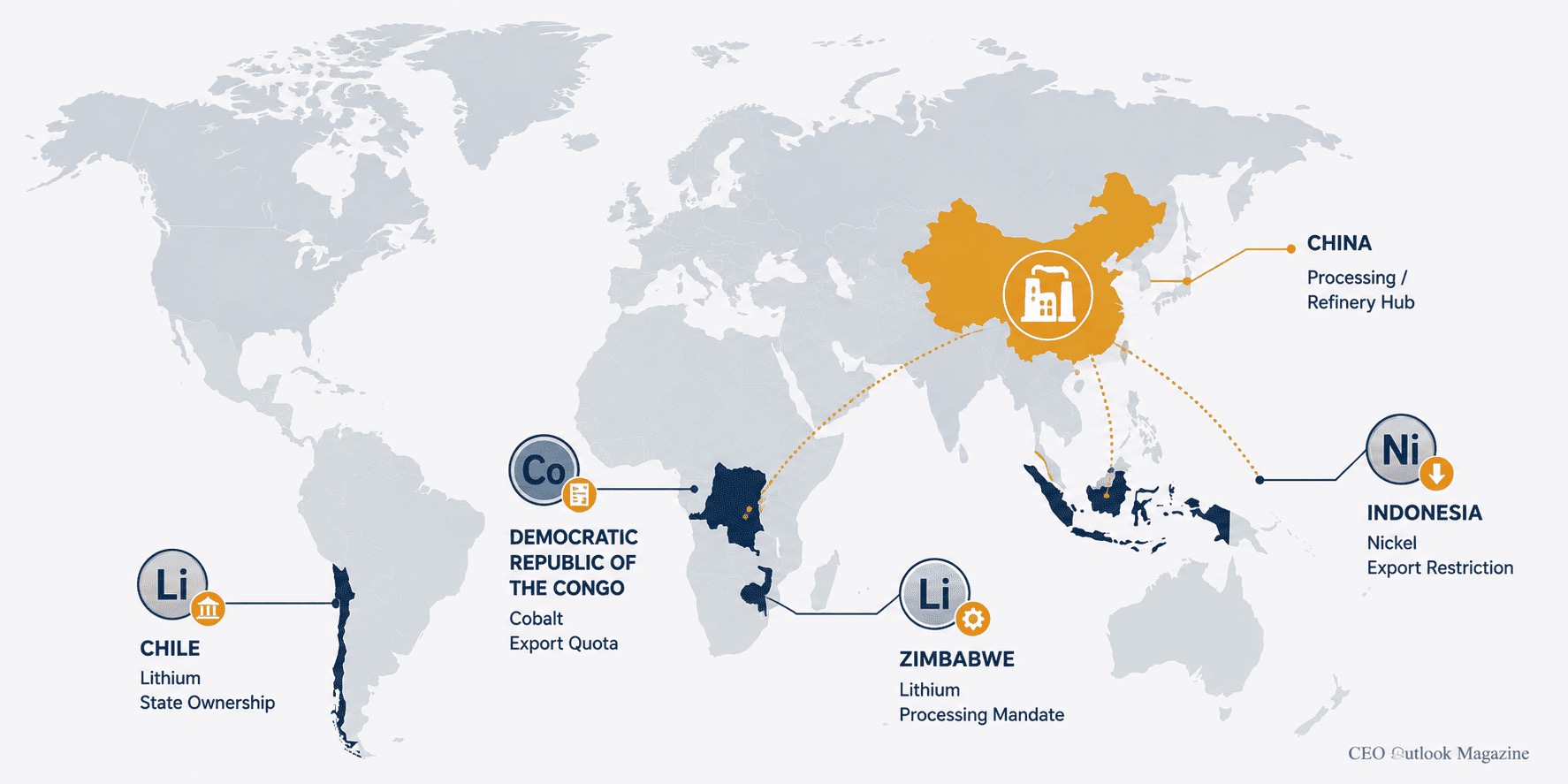
Resource nationalism in critical minerals has outgrown the old playbook of higher royalties and windfall taxes. Now, governments are using export controls, production quotas, mandatory local processing, and direct state ownership. These moves have turned critical minerals from a standard mining business into a live geopolitical contest. This is not a standoff between two rivals. Over the past two years, China, the Democratic Republic of the Congo, Vietnam, Indonesia, Chile, and the European Union have each used these tools in their own way, reshaping supply chains and adding legal risks that didn't exist in earlier commodities.
"Processing Is the New Mining"
The key lesson is simple: owning the little without the ability to refine it. Indonesia saw this early. Its nickel export ban, once controversial, has pulled in billions for local processing and set a model other countries are now copying. Jakarta proved that keeping the refining step at home turns raw resources into real leverage.
The Quota Squeeze Tightening in Real Time
Other producer countries are moving just as quickly, and the changes are happening now, not years from now. The Democratic Republic of the Congo, which supplies over 60 percent of the world's cobalt, banned exports in February 2025, then replaced the ban with strict quotas that will cut exports in half for 2026 and 2027. Indonesia has lowered its nickel mining quota for 2026 by about a third and switched from three-year to one-year quota approvals, giving itself more control over supply. Zimbabwe has banned raw lithium exports and now requires domestic processing by February 2026. That policy has already convinced Chinese investors like Huayou Cobalt and Sinomine to spend hundreds of millions building local plants instead of shipping ore out.
The Irony Inside China's Own Dominance
What is new now is that this same dynamic is starting to limit China's own supply chain. Chinese companies control about 75 percent of Indonesia's nickel refining and are on track to process most of the world's cobalt by 2030. But those plants sit in Indonesia and the Congo, under local rules and restrictions. The resource nationalism that once worked in China's favor now puts its investments at risk, just like everyone else's.
The New OPEC That Isn't Actually an OPEC
Some analysts call this a new OPEC, but the comparison only goes so far. There is no single bloc or coordinated cartel. Instead, countries like Indonesia, the DRC, Chile, Vietnam, and Zambia are each making their own moves—nickel, cobalt, lithium, rare earths, copper—often without talking to each other. The result is cartel-like leverage over supply chains, but without the need for formal coordination.
What Winning This Actually Requires
The practical response from import-dependent powers has been to accept tightening terms from producer nations whileImport-dependent countries grudgingly are accepting tougher terms from producers and moving quickly to sign bilateral deals—like the US-DRC cobalt partnership and the EU-Namibia lithium pact—instead of relying on open markets or WTO rules that have little teeth against national resource policy. Investors are forming direct partnerships with producer governments, a setup that favors big, well-funded companies that can handle the complexity. Smaller mining firms are being pushed out unless they bring hard-to-copy processing technology. The next decade will belong to those who can manage the tension between owning the mine and running the refinery. In this context, the strategic map has genuinely changed shape. It is no longer sufficient to secure a mining offtake agreement or a processing partnership independently. Durable supply security now requires navigating both layers simultaneously, understanding not just who owns a deposit, but which government ultimately controls the jurisdiction where processing happens, and how quickly that government's own resource-nationalist calculus might shift.
Is your organization mapping critical mineral supply risk across both extraction and processing jurisdictions, or treating ownership of one as sufficient security? CEO Outlook Magazine wants to hear your perspective — share your view with our editorial team, and subscribe to our newsletter for more coverage on the geopolitics reshaping global energy and resource strategy.