

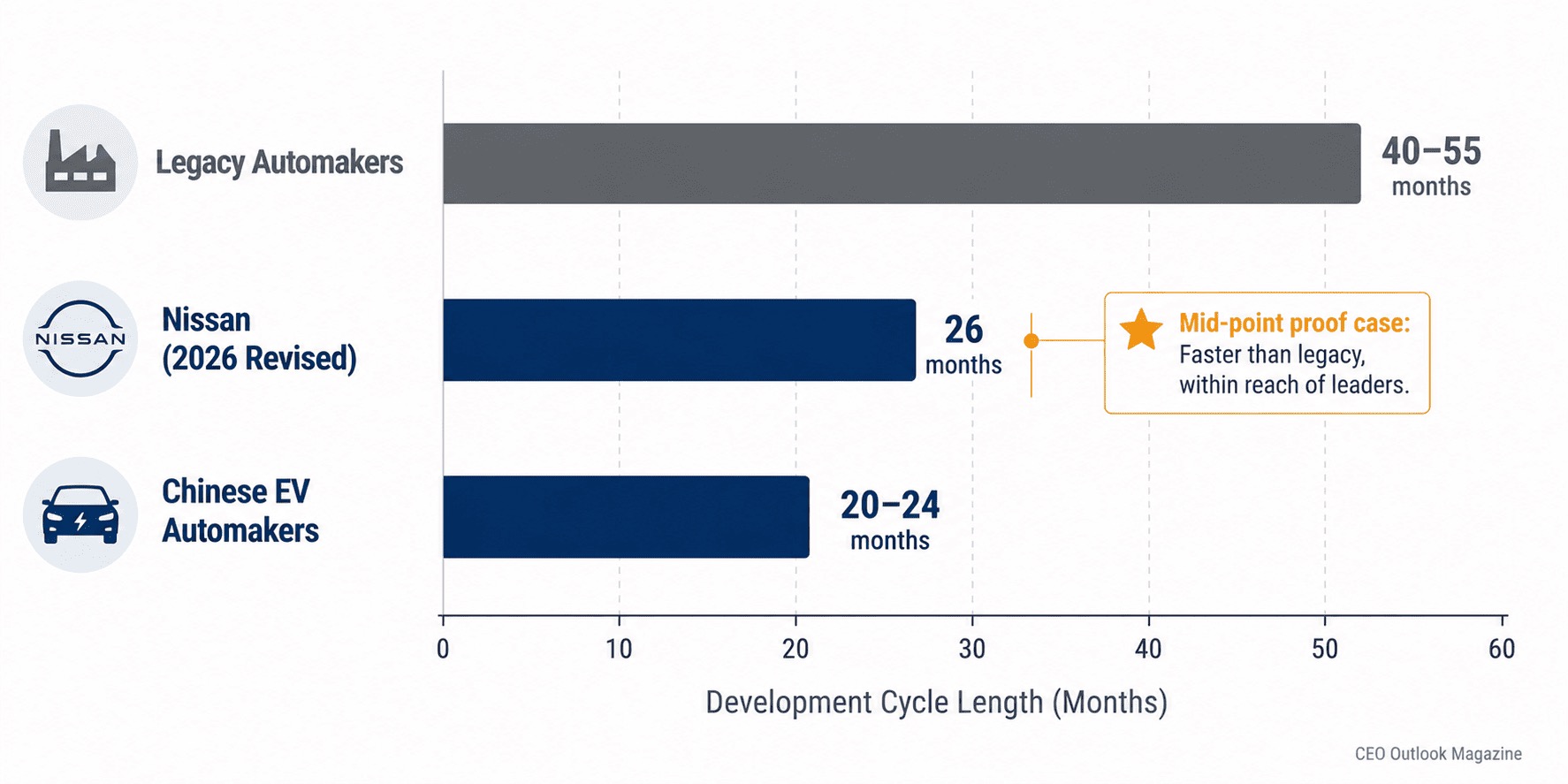
Legacy automakers still require 40 to 55 months to bring a new vehicle from concept to market. Chinese EV-focused manufacturers now do it in 20 to 24 months. The difference is not just a statistic; it is a structural problem that recent tariff shocks and shifting consumer demand have exposed more quickly than most product planning cycles can accommodate. The events of 2026 have made the consequences of this gap, and the risks of overreacting to it, impossible to ignore.
The Gap Measured in Months
This mismatch is not hypothetical. McKinsey research shows Chinese EV-focused automakers developing vehicles in about 24 months, while legacy competitors remain on 40 to 50 month cycles. That speed gap is now colliding with rapid shifts in consumer demand. As tariffs drive up prices, US buyers are already trading down or delaying purchases, while more affordable models from automakers are still at least a year from market. The industry is facing a demand signal that moves in months, but a product pipeline that moves in years.
The Company Proving the Gap Can Close
Nissan offered the clearest recent proof that the development cycle gap is not fixed. In June 2026, the company announced it had reduced its vehicle development timeline from 55 to 26 months, citing lessons from its China operations and AI-driven iteration models used by Chinese automakers. The process has already produced the next-generation Skyline, due for release in winter 2026, and Nissan plans to extend this approach to 90 percent of its projects this fiscal year. This legacy automaker shows that development speed is a strategic decision, not an unchangeable industry constraint. The Real Risk
Closing the development gap too quickly comes with real costs. Chinese automakers launched an average of 3.6 new models per day between January and May 2026, according to BYD's executive vice president. Industry executives warn this pace is achieved by skipping essential steps like design and production verification, putting unproven vehicles in the hands of consumers. The financial impact is clear: China's auto manufacturing profit margin fell to 3.4 percent, the lowest in five years. Analysts attribute the surge in launches not to demand growth, which has plateaued, but to defensive moves in a zero-sum market. At these margins, there is little room for error, and the current pace is widely seen as unsustainable.
Why Faster Isn't Automatically Better
There is a real trade-off here. Western brands are targeting two-year development cycles, but the average American vehicle remains in production for five to six years before a significant update. Durable, reliable models still attract buyers because of their track record. Toyota's Land Cruiser J70, in production for over four decades, is a clear example: reliability remains a competitive advantage. Compressing development timelines risks undermining that advantage if verification is sacrificed for speed. This is not just a technical issue. Consumer skepticism about rapid technology deployment is already high, especially in autonomous and connected vehicles. Accelerating development without maintaining quality will only deepen that trust gap.
The Company Standing Still While the Gap Widens
Some automakers are not responding to this pressure, and the results are visible. Global light vehicle production is expected to stay flat in 2026. The year is already being called a 'launch desert,' especially for the Detroit 3, whose product cadence is slow compared to OEMs investing in faster pipelines. Chinese brands now hold 71 percent of their domestic market, a record high. The Detroit 3 have lost 16 points of global market share over two decades, about one point per year. The decline is steady, not sudden, but it continues as the development speed gap remains unaddressed.
What This Means for Automotive Leadership
The lesson for automotive leaders is not to match China's pace at any cost, nor to ignore development speed altogether. Nissan's example shows that significant cycle compression is possible without abandoning verification. At the same time, the reliability issues emerging in China show the risk of prioritizing speed above all else. The strongest position will belong to automakers who close the development gap deliberately, moving fast enough to meet shifting demand, but not at the expense of the reliability that underpins consumer trust.
Is your organization's product development timeline built to respond to consumer demand shifts within a year, or still operating on a multi-year planning horizon? CEO Outlook Magazine wants to hear your perspective — share your view with our editorial team, and subscribe to our newsletter for more coverage on the strategic pressures reshaping the automotive industry.