

Eighteen US states now allow fully driverless commercial operation. No comprehensive federal law still governs how autonomous vehicles are built, tested, or certified anywhere in the country. That gap, a real, functioning commercial industry operating without a unifying national rulebook, is the clearest illustration of a regulatory problem that extends well beyond the United States, spanning three genuinely different governance philosophies across the world's major AV markets, each shaping which companies can deploy where and how fast.
The Patchwork Inside a Single Country
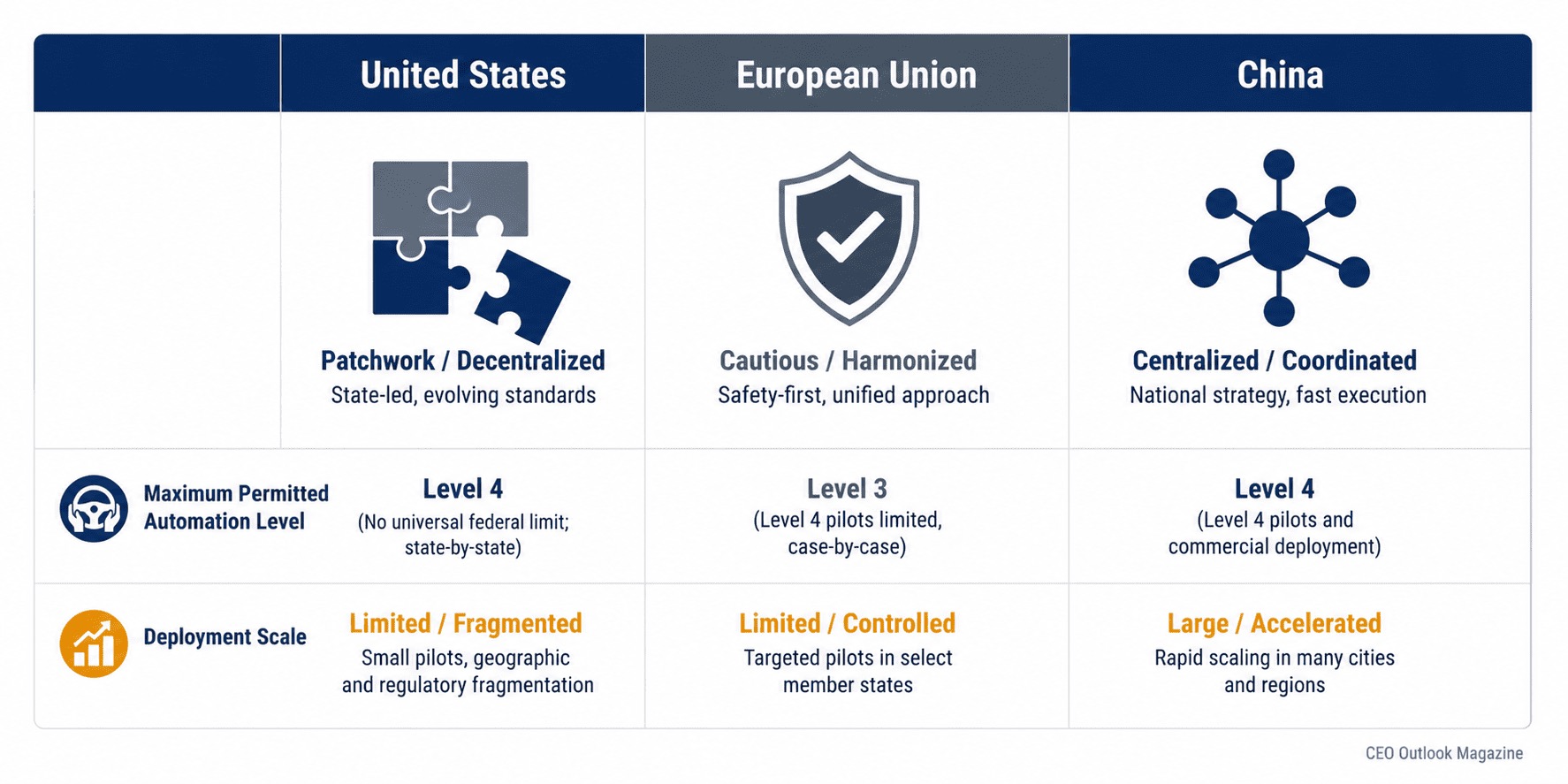
The United States regulates autonomous vehicles through a decentralized model: individual states set their own testing and deployment rules, with federal guidance operating alongside them rather than superseding them. California, home to more robotaxis than anywhere else in the country, has proposed a genuinely comprehensive testing and permitting process. Other states have taken the opposite approach, allowing any vehicle legal under federal standards to operate with no additional state-level barrier. For a company trying to scale a robotaxi fleet or a commercial trucking operation across state lines, this means navigating meaningfully different legal requirements depending on which state a vehicle happens to be operating in, a genuine operational complexity layered on top of the underlying technical challenge of building the vehicles themselves.
The Fix That's Finally Arriving, Slowly
Federal regulators have acknowledged this problem directly, and 2026 brought the most significant movement toward addressing it in years. On July 30 and 31, 2026, the National Highway Traffic Safety Administration and the Department of Transportation unveiled a coordinated set of actions described as the most significant recalibration of federal AV oversight to date, including the first-ever commercial exemption granted for robotaxis and a streamlined exemption process for future deployments. NHTSA also announced a partnership with the SAE Industry Technologies Consortia to fund a three-year, $5 million research initiative called ASCEND, explicitly aimed at developing the first genuine national AV performance standards and eventually eliminating the current patchwork. Separately, proposed federal legislation known as the SELF DRIVE Act would establish direct federal authority and preemption over state AV laws, requiring manufacturers to submit formal safety cases demonstrating their vehicles operate safely. Both developments represent genuine progress. Neither has actually resolved the patchwork yet: the national standards initiative runs on a three-year research timeline, and the SELF DRIVE Act remains pending legislation rather than enacted law.
Three Countries, Three Completely Different Philosophies
The regulatory divergence compounds considerably once the lens widens beyond the United States. Comparative research published in 2026 characterizes the US as pursuing a decentralized model that has, genuinely, fostered rapid testing and commercial deployment, even as it creates the operational uncertainty described above. The European Union has pursued the opposite philosophy entirely, enforcing a harmonized, safety-first framework under regulations including EU 2019/2144 and EU 2022/1426, emphasizing structured validation within tightly defined operational domains before deployment is permitted at all. The EU has historically struggled with its own internal patchwork, as individual member states like Germany and France moved faster than others, and it is now targeting a unified certification system by 2026 to 2027 specifically to let AVs certified in one country operate seamlessly across the entire bloc. China has taken a third, distinct path, using a centralized regulatory hierarchy that integrates national standards with coordinated local pilot programs, approving Level 4 autonomous operation across more than 40 cities, backed by strong government subsidies, infrastructure investment, and mandatory domestic data localization requirements. As one comparative analysis summarized it, the US currently leads on commercial deployment, China advances through coordinated state-directed effort, and the EU's caution is widely perceived within the industry as a genuine barrier to adoption speed.
What This Divergence Actually Does to Companies
This is not an abstract policy debate. It directly determines which companies can operate where, and how quickly. Tesla continues facing genuine regulatory hurdles for its Full Self-Driving technology in Europe and in parts of the US specifically because of this divergence. At the same time, Waymo has expanded successfully precisely by concentrating operations in US cities with the most favorable state-level regulatory environments. Baidu Apollo and Pony.ai operate robotaxi fleets at genuinely massive scale in China, benefiting directly from the coordinated national deployment framework described above. Mercedes-Benz and BMW, by contrast, have deliberately taken a more conservative approach in Europe, focusing on Level 3 systems rather than pushing toward full Level 4 autonomy, a strategic choice shaped directly by the EU's more cautious regulatory posture rather than by any technical limitation on their part.
The Gap Even the Most Advanced Jurisdiction Hasn't Closed
Even within the United States, the jurisdiction with the most active commercial AV deployment globally, a significant regulatory gap remains genuinely unresolved: no single federal law comprehensively governs how autonomous vehicle sensor data, including LiDAR and camera feeds, is collected, stored, or shared. That absence of clear legal guidance creates real, ongoing privacy and liability uncertainty, and it has not meaningfully slowed commercial deployment, meaning companies are scaling operations faster than the legal framework governing what data they collect and how it can be used.
What This Means for Automotive and Technology Leadership
For companies operating or planning to operate autonomous vehicles across multiple markets, the practical implication is that regulatory strategy now belongs alongside technology development as a genuine core competency, not a compliance afterthought handled once a vehicle is ready to deploy. The most successful companies in this space are not simply the ones with the best technology. They are the ones that have correctly matched their deployment strategy to the specific regulatory philosophy of each market they operate in, recognizing that the rules genuinely differ by design, not by oversight, across the world's major autonomous vehicle markets.
Is your organization's autonomous vehicle strategy accounting for genuinely different regulatory philosophies across markets, or applying a single global approach? CEO Outlook Magazine wants to hear your perspective — share your view with our editorial team, and subscribe to our newsletter for more coverage on the regulatory forces shaping autonomous vehicle deployment worldwide.