

For thirty years, automotive supply chains prioritized cost above all else. Single sourcing, just-in-time delivery, and global supplier networks became standard practice to reduce expenses at the margin. That model is now being reworked. Resilience and proximity are taking precedence over pure efficiency, and the financial impact is no longer theoretical. Companies are making substantial, visible capital commitments to support this shift.
Three Decades of Logic Getting Dismantled
Recent industry research confirms that the supply chain architecture built on single sourcing, just-in-time delivery, and global networks is being replaced. The new focus is on resilience, visibility, and geographic proximity, not just cost. This is a direct response to three major disruptions: the pandemic-era chip shortage, renewed geopolitical disputes over semiconductor supply, and ongoing volatility in demand between electric and hybrid powertrains. Each event exposed vulnerabilities that the old model could not absorb, and supply chain planning remains unsettled as a result.
What Resilience Actually Costs, in Real Dollars
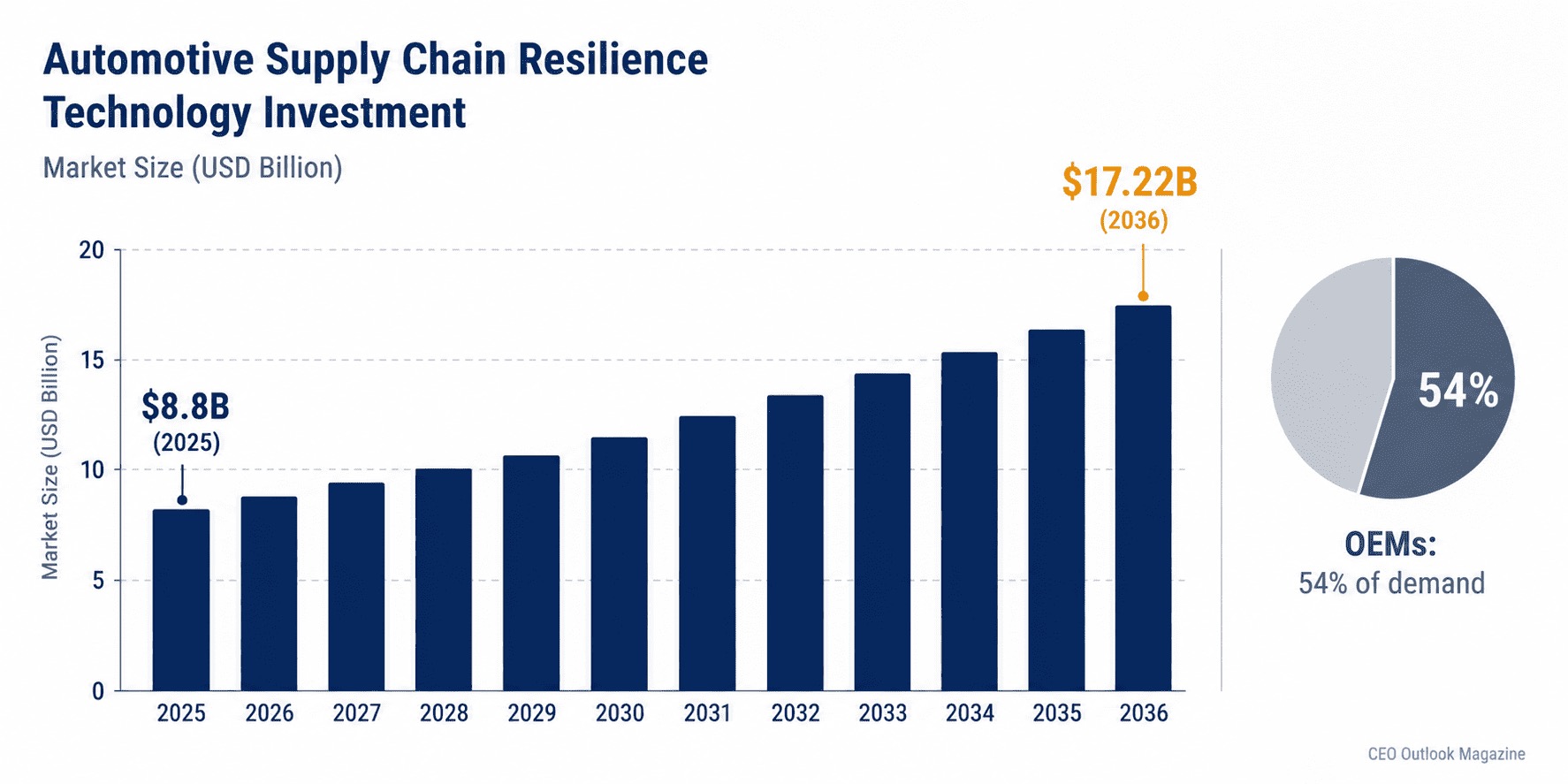
The scale of investment in supply chain resilience is now clear. The market for risk-monitoring software, visibility platforms, and digital twin simulation tools reached $8.8 billion in 2025 and is projected to double by 2036. OEMs account for more than half of this spending, which reflects the reality that automakers bear the full cost of production stoppages. Software and cloud-based solutions make up the majority of these investments, with digital twin technology in particular enabling companies to model disruption scenarios in advance rather than respond after the fact.
The Smarter Version of Stockpiling
The industry has moved past the blunt approach of increasing inventory across the board. Leading supply chain strategies now apply just-in-time protocols to low-risk, readily available parts, while reserving buffer stock for high-risk, hard-to-replace components. This targeted approach matters: indiscriminate stockpiling ties up working capital unnecessarily, while focused buffers protect against real disruption without undermining cash flow.
The New Financial Burden Nobody Priced In
The most overlooked financial impact is not just higher inventory costs, but a structural increase in supply chain complexity. The transition to electric vehicles has not followed the expected path. Instead of a rapid shift to battery-electric platforms, automakers are extending the life of hybrid and internal combustion models due to affordability and infrastructure constraints. The result is a dual-supply-chain challenge: companies must now support two fundamentally different powertrain architectures at the same time. This is not a short-term transition cost, but a lasting expansion of working capital exposure that earlier resilience planning did not fully anticipate.
Where the Capital Is Actually Flowing
The capital shift is already visible. Volkswagen is nearshoring vehicle and parts supply chains in response to recent volatility. Ford is reducing reliance on overseas suppliers to build a more resilient, local supply base. Across the sector, procurement leaders are moving away from lowest-cost sourcing toward reliability and flexibility, a trend accelerated by tariff policy uncertainty that delayed strategic decisions through much of 2025. The expansion of Chinese manufacturing facilities in Europe and North America is emerging as the next area of competition and will influence where capital investment flows in the years ahead.
What This Means for Automotive Finance and Supply Chain Leadership
For finance and supply chain leaders, resilience investment now demands the same discipline as any major capital allocation. This means rigorously determining which components require buffer stock, accurately accounting for the increased working capital tied up in supporting both combustion and electric supply chains, and investing in the visibility and simulation tools needed to anticipate future disruptions. Companies that treat recent shocks as isolated events, rather than signs of a more volatile environment, risk being unprepared for what comes next.
Many organizations still spread resilience investment evenly, rather than focusing on areas of real risk. The difference is not academic. In a more volatile environment, allocate capital where it actually protects the business.