

Toyota halted new orders for certain hybrid SUVs in early 2026, citing component shortages. Honda projects a $960 million hit to operating profit this fiscal year due to ongoing semiconductor constraints. These developments come well after most of the industry considered the 2021-2022 chip crisis resolved. The belief that semiconductor shortages were a one-off, pandemic-driven event has not held up. The events of 2026 show the underlying problem remains unresolved.
The Assumption That Turned Out to Be Wrong
The 2021-2024 chip shortage cost the global auto industry an estimated $500 billion. Most treated it as a temporary result of pandemic-driven demand swings and fragile just-in-time supply chains, expecting normal production to resolve the issue. That view overlooked a deeper vulnerability: concentrated supplier dependence and minimal inventories were never addressed. The system was not truly tested again until a separate geopolitical dispute exposed the same weakness.
The Dispute That Proved Nothing Was Actually Fixed
In September 2025, the Dutch government intervened in Nexperia's Netherlands operations over concerns about Chinese ownership and potential relocation. China responded by halting exports from Nexperia's Dongguan facility, its largest packaging and testing site. Nexperia supplies essential legacy components—transistors, diodes, MOSFETs—used in core automotive systems, with about 40 percent market share in its segment and 60 percent of revenue from automotive customers. The disruption hit Volvo, Volkswagen, and Honda's European operations hardest, while Nissan reduced output at several Japanese plants. Lead times extended by six to eight weeks. Exports resumed in late October, but only with payment in yuan, adding new logistical complications. A formal hearing on alleged mismanagement remains scheduled for January 2026, underscoring that the dispute is not resolved.
Why the Same Vulnerability Is Still Wide Open
The issue is not Nexperia's failure, but the industry's reliance on certified automotive-grade semiconductors. Meeting AEC-Q100 and Q101 standards means switching suppliers takes months, even in the best case. A disruption at a single supplier can affect the industry long after the initial shock. Automakers have reverted to pandemic-era tactics: building up inventories and slowing production to avoid shutdowns. This is a clear sign that the structural weaknesses identified in 2021 remain unaddressed.
The New, Structural Threat That Has No Resolution Date
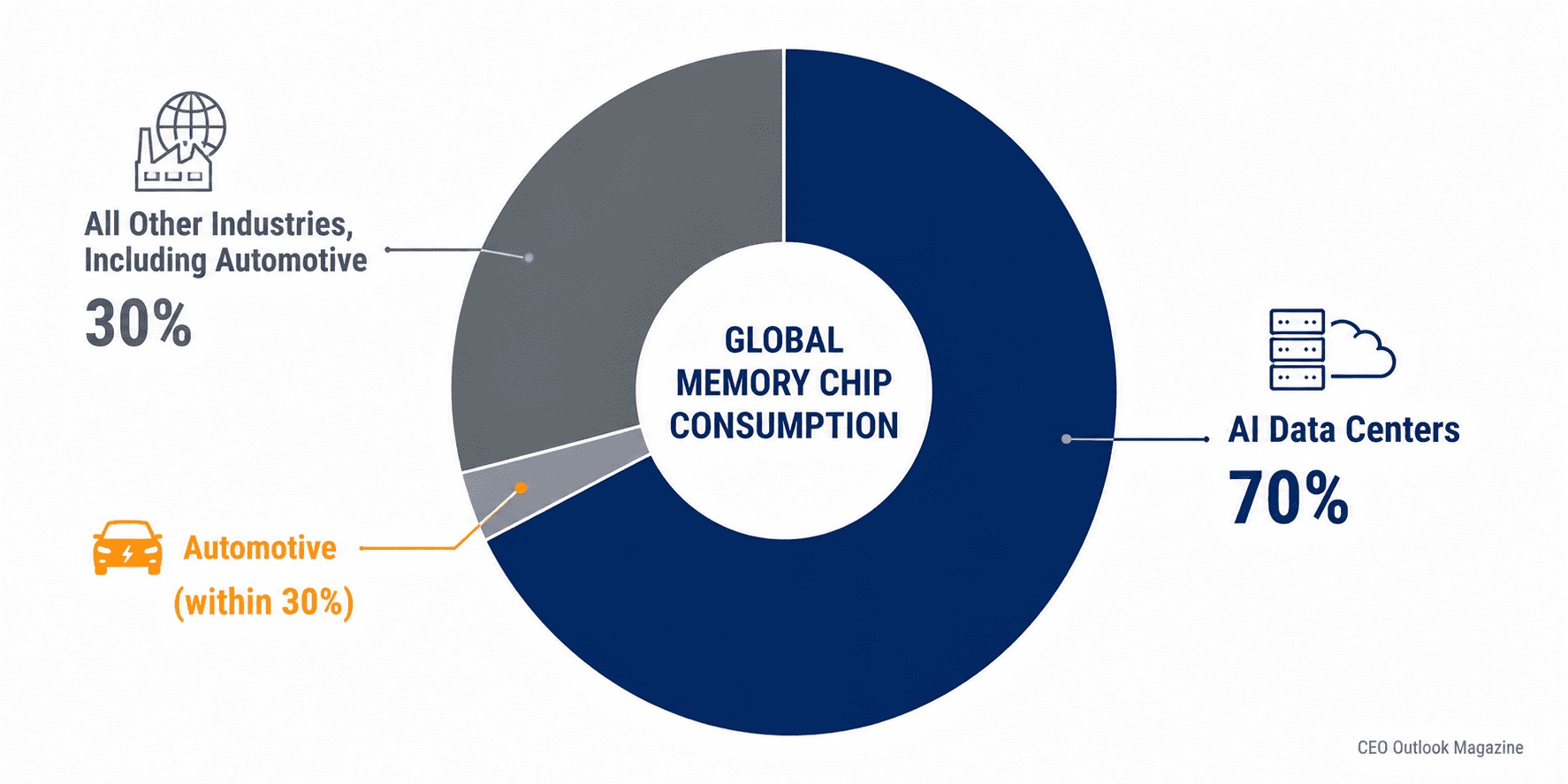
Beyond recurring geopolitical risk, the industry now faces a structural shift in semiconductor demand. By 2026, AI data centers are expected to consume 70 percent of all memory chips, directly competing with automotive orders for manufacturing capacity. About 95 percent of chips in vehicles are older, lower-margin types—the same category foundries are deprioritizing as they invest in advanced AI chips. S&P Global Mobility has warned this could create real shortages in legacy-node capacity. Unlike the 2021 crisis, which eased as capacity caught up, this risk has no clear endpoint. Toyota, Nissan, and Honda responded by forming a joint venture in 2024 to develop advanced semiconductors and strengthen their negotiating position with foundries. A similar risk is emerging in automotive DRAM, with potential shortages starting in early 2026 as memory makers shift to AI-focused products. The legacy DRAM market is consolidating, and availability increasingly depends on price. OEMs and suppliers now need to treat memory sourcing as a strategic decision, not a routine purchase.
The Fix That's Also Concentrating the Risk
The main industry response to legacy-node shortages is to rely on Chinese foundries, which account for nearly 70 percent of new mature-node capacity in 2026. This approach increases dependence on the same geopolitical chokepoint that caused the Nexperia disruption. Building diversified, resilient supply chains remains expensive and slow, requiring months to qualify new sources. Many automakers deferred these investments after 2021, assuming the crisis was over.
What This Means for Automotive Supply Chain Leadership
The lesson for automotive leaders in 2026 is clear: the chip shortage was never solved, only paused. The industry now faces both recurring geopolitical risk from concentrated legacy-node suppliers and a new, structural competition for manufacturing capacity from AI. Treating semiconductor supply as a background issue, rather than an ongoing strategic risk, leaves automakers exposed to further disruption—just as recent events have shown.
Many organizations still treat semiconductor supply chain resilience as a problem solved in 2022, rather than an ongoing strategic priority. The evidence suggests this is a mistake.