

Sixty-eight percent of fast-growing businesses regret at least one major software purchase. Thirty-five percent of enterprise teams have already replaced a major SaaS tool with custom-built software in 2026. Enterprise subscription costs are rising as much as 25 percent per year, turning what was once a predictable expense into what many now call a 'SaaS tax.' Despite the scale of these shifts, most organizations still treat the buy-versusmostld decision as routine, rather than the strategic risk it has become.
Theorganisationsdy Talkmaket
Dissatisfaction with purchased software is not minor. Beyond the 68 percent reporting regret, 31 percent have replaced software because costs exceeded expectations. As SaaS pricing outpaces inflation, more teams are reverting to custom builds. Buying software is not inherently a mistake. The real problem is that too many of these decisions are made on speed or convenience, not with the discipline applied to other major capital allocations. The result is a pattern of short-term fixes that rarely serve the organization's long-term interests.
The Question That Actually Decides This
The most practical question for retail leaders is whether the software in question is a commodity or a source of competitive advantage. Payroll, email, standard accounting, and core CRM systems are commodities. Vendors in these categories have invested more engineering time than any retailer can justify, and trying to out-build a mature, widely adopted platform in these areas is rarely a good use of internal resources. Building or customizing makes sense only when the software is central to how the business competes—where proprietary data, differentiated pricing, or unique workflows cannot be replicated by off-the-shelf platforms without forcing the organization to fit someone else's model.
The Option Most Retail Leaders Forget Exists
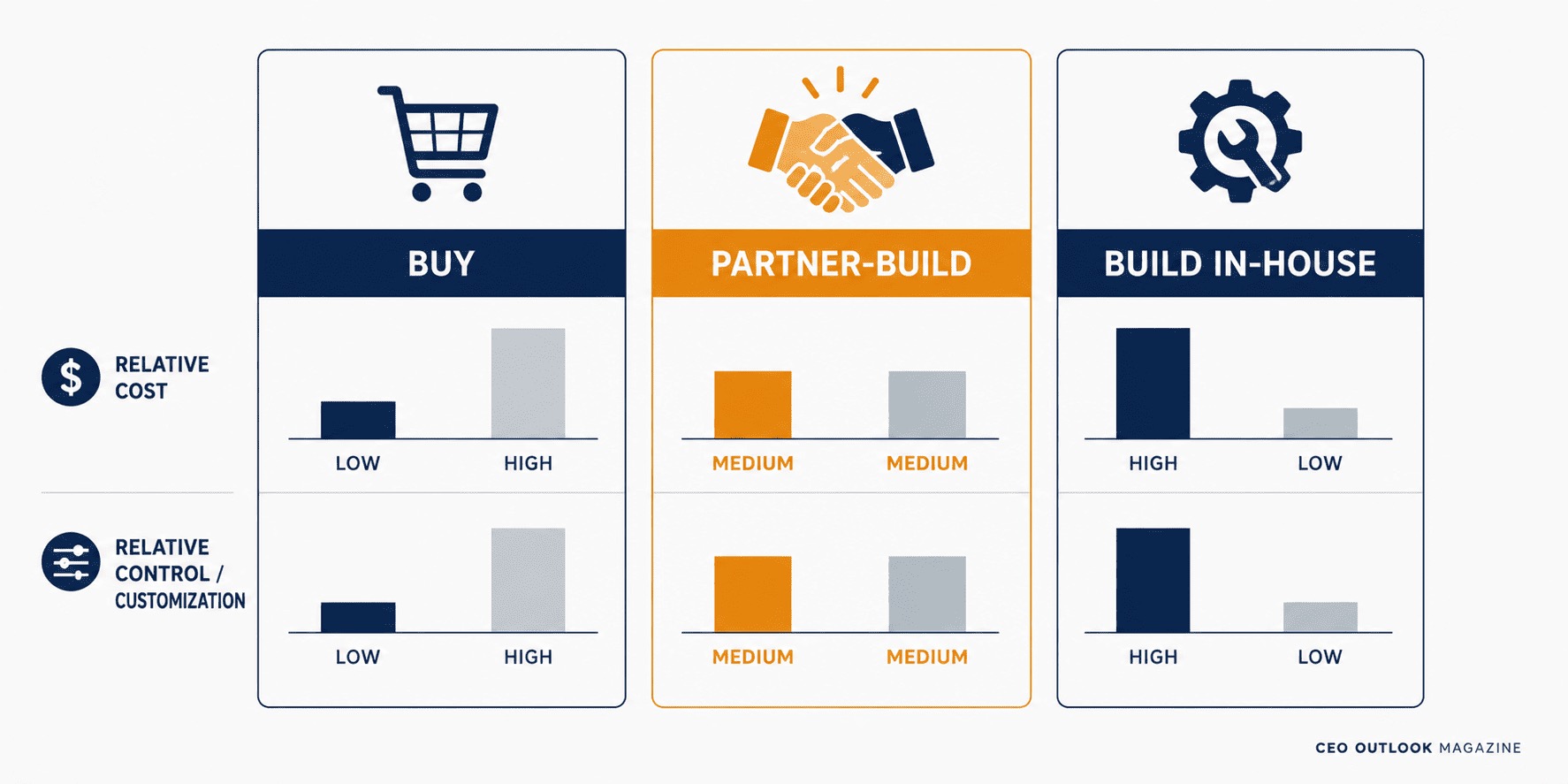
Many retail leaders treat the decision as a binary: build everything in-house or buy off the shelf. In reality, a third option—partner-building with an external engineering firm—often fits mid-market retailers best. This approach allows organizations to own proprietary software without the overhead of a permanent internal engineering team. For retailers in the US$50 million to US$500 million range, the economics can be more rational than either extreme. Partner firms typically charge US$100 to US$300 per hour, and a significant build can reach six or seven figures. That cost, while substantial, is often less than the long-term expense of maintaining a full in-house team or the disruption of replacing the wrong platform within eighteen months, a scenario that is more common than most admit.
The Hidden Cost Both Sides Underestimate
Neither buying nor building is a one-time decision. Both come with ongoing costs that are often ignored in the initial business case. Purchased software brings vendor lock-in risk—proprietary data formats, custom integrations, and long-term contracts can make switching expensive and disruptive. This risk should be evaluated before signing, not discovered during a costly migration. Custom-built software has its own ongoing tax: maintenance typically runs 10 to 20 percent of the original build cost each year. If the organization cannot sustain that commitment, the software quickly becomes a liability. A disciplined decision requires calculating total cost of ownership over at least five years for both options, not just comparing upfront prices.
Why This Decision Is Getting More Consequential, Not Less
The buy-versus-build line in retail is shifting because AI value is now concentrating in specific areas. This publication has already documented that retail's highest-value AI use cases, dynamic pricing, personalized pricing, and buy-now-pay-later credit scoring, rThe buy-versus-build calculus in retail is shifting as AI value concentrates in a few high-impact areas. Dynamic pricing, personalized offers, and buy-now-pay-later credit scoring now account for a large share of potential AI value, but these use cases demand governance and data control that most off-the-shelf solutions cannot provide. Commodity features like basic recommendations or chatbots are now widely available and cheap. The real differentiators increasingly require proprietary data and disciplined governance, which pushes more organisations toward building or partner-building, even if they have historically preferred to buy. Retailers still defaulting to whichever option looks fastest in a vendor pitch meeting are increasingly the ones showing up in next year's purchase-regret statistics, as the technology categories worth building around determine who wins.
Too many organizations still treat retail technology as a commodity purchase, rather than distinguishing which systems actually drive competitive advantage. That distinction is now central to leadership in the sector.