

For years, maritime shipping’s emissions challenge was seen mainly as a fuel and technology issue, with the industry waiting for cleaner propulsion and alternative fuels to reach scale. By 2026, the problem shifted: compliance is now the immediate concern. Multiple regulatory regimes have landed at once, each with its own emissions accounting, each imposing financial penalties, and none coordinated with the others.
2026: The Year Regulatory Deadlines Collided
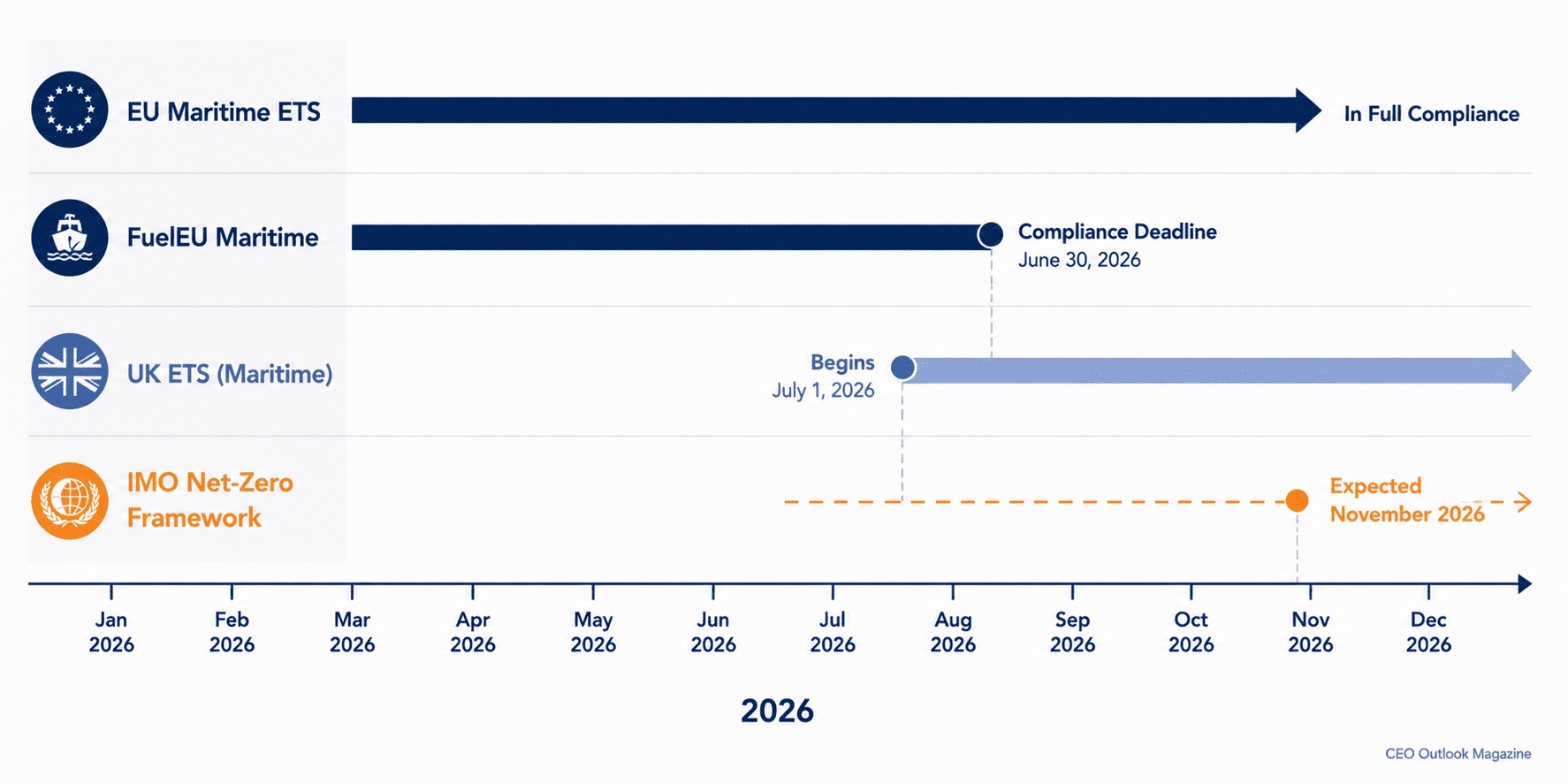
2026 marks the point where maritime emissions regulation becomes a commercial constraint, not a gradual transition. The EU’s Maritime Emissions Trading System now requires full compliance, ending its two-year phase-in. FuelEU Maritime completes its first compliance cycle, with reporting and penalties due in the first half of the year. The UK’s maritime Emissions Trading System launches in July. The IMO has also expanded Emission Control Areas to the Canadian Arctic and Norwegian Sea. These deadlines did not arrive in sequence. They converged within a single year, creating a real compliance bottleneck for operators exposed to multiple jurisdictions.
The Global Framework That Keeps Almost Arriving
The International Maritime Organization’s Net-Zero Framework sits above these regional rules. It is the first attempt to combine mandatory emissions limits with global greenhouse gas pricing for an entire sector. The framework was approved in principle in April 2025, but formal adoption was postponed and is now expected in late 2026. The proposed carbon price is around $100 per tonne of CO2-equivalent for emissions above the compliance target, a level that would materially affect shipping economics. Unlike the EU’s flat carbon levy, the IMO framework uses a two-tier target. Vessels meeting both targets pay no carbon price under IMO rules. The mechanism is more conditional than the “global carbon tax” label suggests.
The Compliance Problem Companies Face Even Before the Global Rules Arrive
The IMO’s delays do not give shipping companies a compliance reprieve. The EU ETS, FuelEU Maritime, and the UK ETS all remain in force, regardless of the IMO’s timeline. When the IMO framework eventually arrives, companies will face overlapping regimes. The same vessel and voyage could be subject to both, but the systems use different emissions boundaries. The EU prices emissions on a tank-to-wake basis, counting only what is burned on board. The IMO uses a well-to-wake approach, including upstream fuel production. Reconciling these fundamentally different accounting methods is a real operational challenge, not just a matter of price differences.
Why This Isn't Just Shipping's Problem
This regulatory complexity does not stop with shipowners. Charterers, fuel suppliers, ports, and especially cargo owners are now exposed. Retailers and manufacturers relying on ocean freight increasingly depend on their carriers’ compliance for their own Scope 3 emissions reporting. Any company using international shipping inherits part of this complexity, even if it does not operate vessels. Freight procurement and product-level carbon accounting are now directly tied to how carriers manage overlapping compliance obligations.
The Unresolved Question Even Regulators Haven't Settled
Beneath the operational complexity is an unresolved policy question: should carbon prices be fixed or market-based? The EU favors a fixed price, which gives companies predictable compliance costs and the IMO’s Net-Zero Fund a stable revenue base. The risk is that a fixed price can drift away from real abatement costs as markets and technology evolve. A market-based price tracks actual costs more closely but introduces volatility, complicating long-term capital planning. Regulators have not settled this debate, yet shipping companies are expected to make multi-decade investment decisions without clarity on the underlying pricing model.
What This Means for Shipping and Cargo Owner Leadership
For shipping executives and cargo owners, the shift in 2026 is clear: emissions compliance is no longer a future planning issue or dependent on a single global framework. Multiple overlapping regional regimes are already in force, with real penalties and complex reconciliation requirements. Organizations waiting for regulatory clarity before investing in compliance infrastructure are already behind.
Most organizations now face overlapping EU, UK, and prospective IMO emissions regimes. Waiting for a single global framework to resolve the complexity is no longer a viable strategy. The regulatory environment has moved ahead, and so must compliance planning.