

A 2024 study found that nearly 40 percent of major UK retailers missed their own advertised delivery times. Most consumers, however, still assume retailers will meet the fast delivery promises shown at checkout. This gap is not just an operational issue. It is a leadership decision: executives often commit to delivery speeds without verifying that the business can reliably support them.
The Pressure to Promise Speed: The pressure driving speed promises is genuine, not manufactured. Eighty percent of consumers now consider same-day delivery a standard expectation rather than a premium add-on, and 92 percent say free shipping directly influences their purchase decisions, up sharply from 83 percent just a year earlier. More than 90 percent will abandon a shopping cart entirely when confronted with high shipping costs, and 66 percent expect free shipping on every online purchase without exception. Any executive team weighing whether to promise faster delivery is responding to real, escalating, well-documented consumer demand, not chasing an imagined trend. The pressure to promise speed is entirely rational. The real leadership test begins with consistently delivering on that promise.
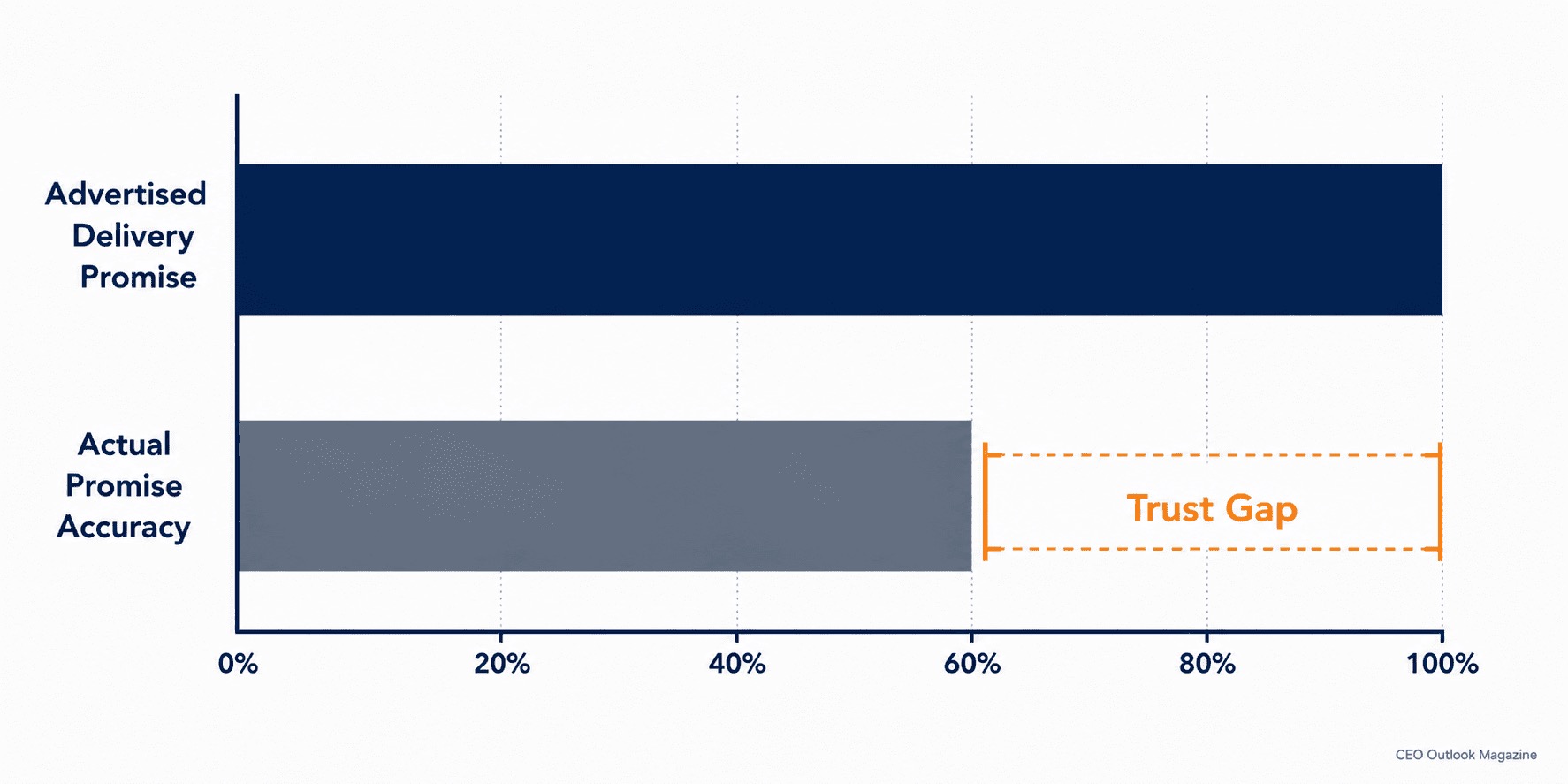
The Gap Between Promise and Performance: A meaningful share of retailers are currently failing that test. Beyond the nearly 40 percent UK delivery-time failure rate, industry analysis has been direct about what this actually means: consumers broadly believe retailers always meet their fast delivery promises, and that assumption represents a massive trust gap that is, frankly, justified by how often the underlying reality falls short. This is a genuinely dangerous position for a brand to occupy, since the gap between assumed reliability and actual performance means that when a delivery fails, it doesn't read to the customer as an isolated exception. It reads as confirmation of a pattern the customer had, until that point, not yet personally experienced.
The Paradox 20What 2026 Data Shows About Trust. Locus's Q2 2026 US Consumer Survey identifies what researchers describe as a genuine trust-speed paradox: the retailers building durable delivery trust are not the ones competing hardest on advertised speed. They are the ones competing on promise accuracy, the consistency between what a retailer tells a customer to expect and what actually happens. The survey identifies four specific architectural shifts distinguishing retailers building genuine, compounding delivery trust from those running speed-led competition without the infrastructure to back it: prioritizing promise accuracy over promise speed itself, building reliability infrastructure that makes consistent delivery performance possible at scale rather than occasional, deploying predictive communication that reinforces trust actively during the delivery window rather than only after something goes wrong, and treating exception handling as a genuine opportunity to build trust rather than as pure damage control once a failure has already occurred. Most US retailers, according to this research, have not yet fully adjusted their delivery experience strategy to reflect this reality.
Why Promises Fail Before Operations Can Deliver: A share of these failures trace back to a specific, identifiable root cause: warehouse management systems and fulfilment infrastructure that were never actually built to scale alongside the business making the promise. As Michelle Jones, Director of Presales and Solutions Consulting at Logistics Reply, has described it, a retailer scales, adds fulfillment centers, or enters a new market, and quickly discovers its underlying systems were not designed to grow with it, forcing a disruptive, expensive re-implementation cycle that strains IT teams and puts order accuracy and delivery promises directly at risk, arriving precisely when customer expectations are at their highest. This is the mechanical failure point behind many broken delivery promises: marketing often commits to speed well ahead of the infrastructure investment needed to sustain it reliably at the new scale the business is targeting.
Why This Is a Leadership Issue: This gap lands directly on brand reputation rather than staying contained inside logistics reporting. As one industry analysis put it plainly, the promise made on the shelf is only as strong as the supply chain behind it, and customers don't know or care about a retailer's carrier network or cross-dock partners. When a delivery promise breaks, they blame the brand, not the logistics team that actually executed the failed delivery. This is precisely why delivery promise-setting deserves genuine leadership scrutiny rather than being treated as a marketing decision executed independently of operational reality. The practical discipline is straightforward, if rarely applied consistently: when in doubt, err on the side of caution with delivery estimates, since it is far better to pleasantly surprise a customer with an early arrival than to disappoint them with a late one after an overly aggressive promise. When failures do occur despite genuine effort, transparency remains recoverable: 46 percent of shoppers say they want an honest explanation and a real-time update when something goes wrong. What is not recoverable is a customer concluding the original delivery promise was never realistic in the first place, a bait-and-switch rather than an honest, occasionally missed commitment.
What This Means: Implications for Logistics and Leadership. The lesson from 2026's research is clear: promise speed and promise accuracy are not interchangeable. The trust gap grows when leaders treat them as if they are. The companies that succeed are not those with the fastest advertised delivery, but those whose promises have been tested against the actual capacity of their fulfilment infrastructure.
The question for leadership is whether your delivery promise reflects real operational capacity or responds to market pressure. The answer will determine whether your brand earns or loses customer trust.