

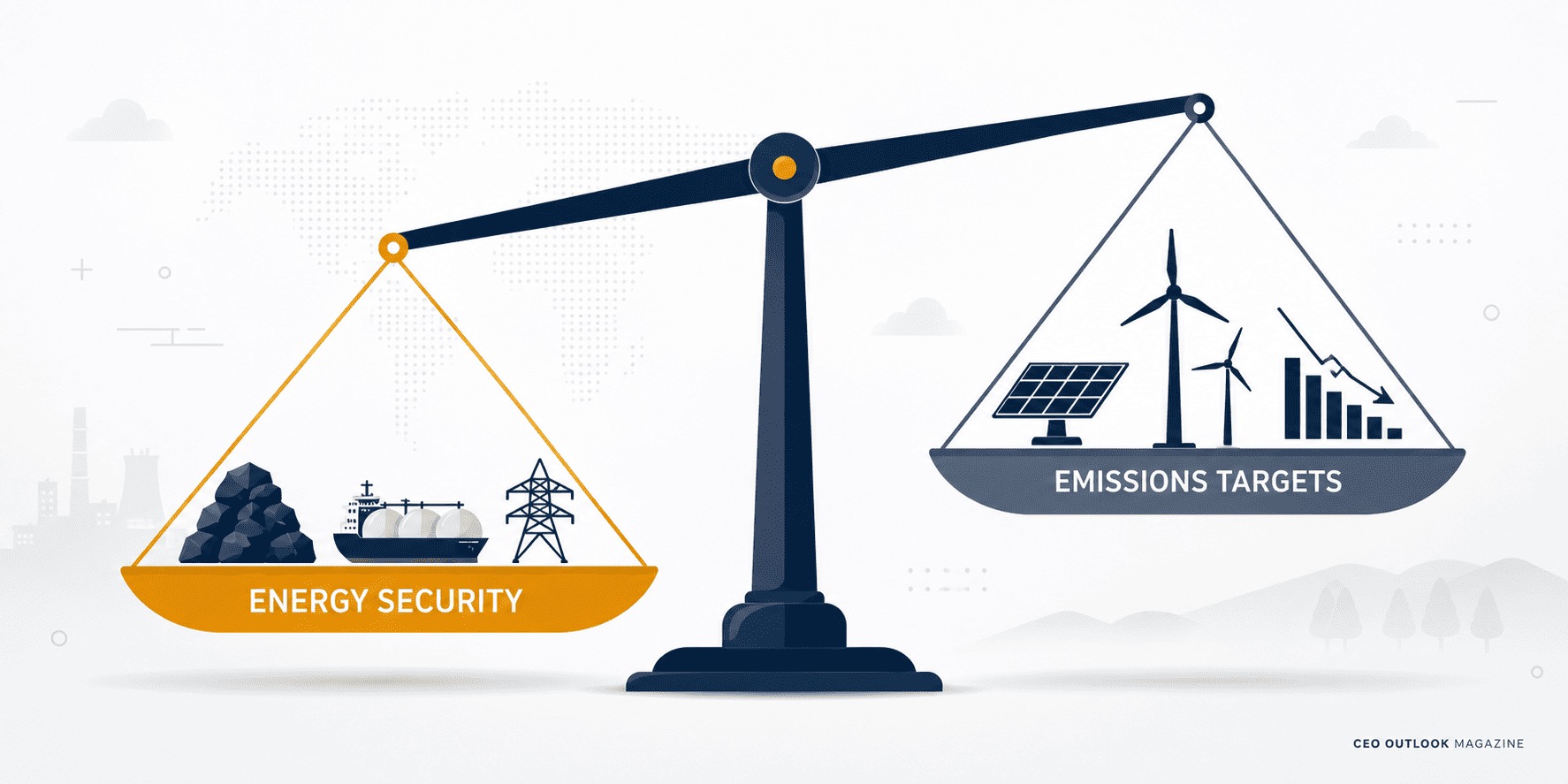
South Korea plans to retire 40 of its 61 coal-fired power plants by 2040. From 2017 to 2023, coal generation fell by 23 percent, but gas generation rose by 25 percent. Coal emissions dropped to 185 million tonnes, while gas emissions increased to 77 million tonnes. Replacing coal with gas does not deliver the emissions reductions the headline suggests. When energy security and climate targets come into conflict, governments are often prioritizing security, even as the public narrative emphasizes climate progress.
The Two Goals That Were Supposed to Reinforce Each Other
Policy has often assumed that energy security and decarbonization reinforce each other: shifting from imported fossil fuels to domestic renewables should cut emissions and reduce geopolitical risk. That logic works in some cases. The World Economic Forum's Energy Transition Index points out that for economies heavily reliant on imports, volatile fuel markets can make renewables more attractive. But this alignment only holds when renewables are the most practical domestic option. When they are not, the trade-off is immediate. Recent years have made that clear.
When the Trade-Off Gets Fudged Instead of Resolved
South Korea’s shift from coal to LNG is a clear example of a trade-off resolved through fuel substitution rather than real emissions cuts. Most retired coal capacity has been replaced with LNG, not renewables, and the data shows gas emissions rising as coal emissions fall. The net effect is less climate progress than the phaseout suggests. The government has also agreed to purchase about US$100 billion in energy from the United States, including LNG, but tariff uncertainty has put the deal’s future in question. This is not a hidden policy. The government is openly prioritizing energy security and affordability, while the public narrative overstates the climate benefit.
Why Coal Keeps Getting a Longer Life Than Planned
Wood Mackenzie's analysis identifies three specific reasons coal demand may remain stronger than expected. First, coal is still a strategic domestic resource for energy security, affordability, and jobs in several major Asian economies. Second, rapid growth in power demand from data centers and AI is leading governments and companies to run coal plants harder, rather than wait for clean alternatives to scale. Third, technology improvements like carbon capture and hydrogen co-firing are extending the life of existing coal plants. India’s 2026-27 budget allows coal plants to add carbon capture if the economics work, and Indian policy now puts energy security on par with decarbonization, treating fuel reserves and dual-fuel capability as national defense priorities. The physical realities reinforce this: gas plants can ramp up quickly, providing grid stability that renewables cannot yet match without large-scale storage, and coal allows for months of on-site fuel stockpiling, which intermittent renewables cannot provide in the face of supply shocks. It is no longer playing out only through individual country decisions. It is showing up directly in formal policy rollback. The IEA's State of Energy Policy 2026 report documents the European Union delaying implementation of its second Emissions Trading System from 2027 to 2028, Canada eliminating its consumer carbon price, and global energy efficiency policy stringency now projected to rise 30 percent over the next five years, well below the 50 percent increase that would have occurred absent the regulatory relaxations introduced in 2025. The IEA's own blunt conclusion is worth stating plainly: current climate pledges, taken in aggregate, do not imply any acceleration in energy sector emissions mitigation by 2035 compared to previous commitments. That is an international energy authority confirming, in its own official assessment, that the trade-off between affordability, security, and emissions reduction is currently favouring the first two.
The Honest Middle Ground
None of this means every security-driven fuel decision represents backsliding disguised as progress. LNG emits roughly half the carbon dioxide of coal in power generation and provides real diversification value, as shown by Japanese energy company JERA actively securing additional LNG from Australia to hedge against Middle East risks. LNG emits about half as much carbon dioxide as coal in power generation and offers real diversification, as shown by Japanese utility JERA securing more LNG from Australia to hedge against Middle East risks. However, methane leakage during extraction and transport can reduce LNG’s emissions advantage if not managed, and new LNG infrastructure risks locking in fossil fuel use for decades if decarbonization accelerates. The organizations navigating this well are the ones being explicit about which goal takes precedence under specific stress conditions, rather than assuming both can always be optimized simultaneously.
Few organizations are explicit about which priority—security or emissions reduction—takes precedence when the two are in conflict. That lack of clarity often becomes apparent only when a real supply shock forces a decision.