

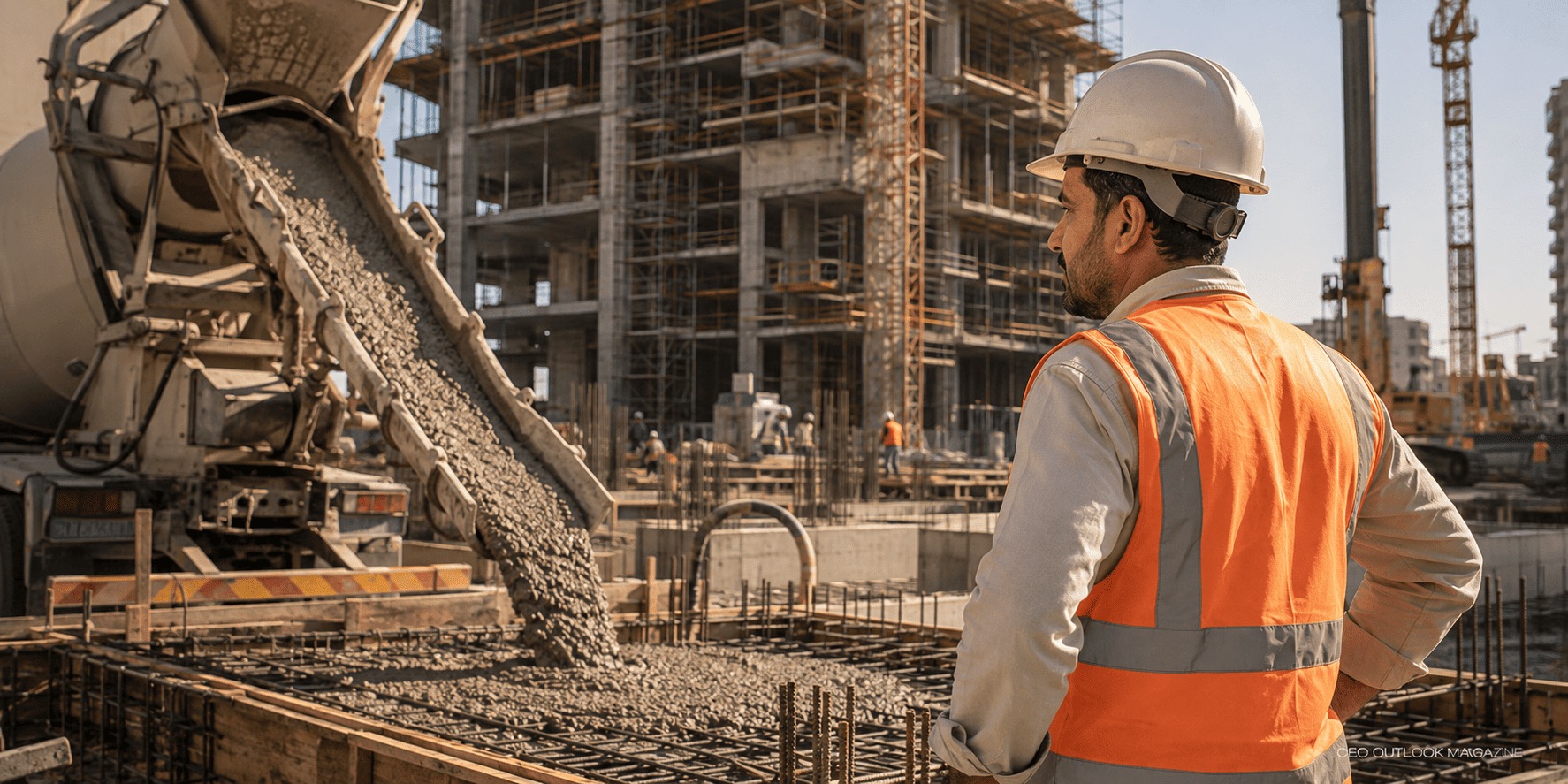
If measured as a country, the concrete industry would be the third-largest source of carbon emissions globally, trailing only China and the United States. Cement, the essential binder in concrete, accounts for about 7 to 8 percent of global CO2 emissions. For decades, the industry treated deep emissions cuts as unrealistic, given the material’s structural role and the chemistry involved. That assumption is now being tested by a change in binder chemistry that has already delivered close to a 50 percent reduction in emissions on a completed, full-scale project—without compromising structural integrity.
The Emissions Problem Hiding in Plain Sight
Concrete typically represents 50 to 85 percent of a building project’s embodied carbon. Standard production emits about 250 to 300 kilograms of CO2 per cubic meter. As the world’s second-most used material after water, and with demand rising due to urbanization and population growth, the emissions problem is only getting larger. The industry has long argued that cement is among the hardest sectors to decarbonize, mainly because emissions come from two sources: the fuel needed to reach the high temperatures for production, and the chemical process emissions released when limestone is converted to clinker, the main component of Portland cement.
The Chemistry Behind the Cut
The moThe most practical near-term solution targets the clinker itself, not just the combustion process. Limestone calcined clay cement (LC3) substitutes much of the traditional clinker with calcined clay and limestone, both of which avoid the most carbon-intensive processing steps. LC3 can cut carbon intensity by up to 40 percent with current technology. It also uses less energy and cheaper raw materials, reducing production costs by as much as 25 percent compared to conventional cement. Importantly, LC3 can be produced in existing cement plants, avoiding the need for new kilns or major capital investment. Real Project, Not a Lab Result
The strongest evidence for this chemistry comes from a completed, large-scale project rather than a controlled pilot. Holcim’s ECOPlanet low-carbon cement was used in the Alamein Downtown Towers project in Egypt, part of the Egypt 2030 sustainability strategy. The project consumed 8,200 tons of ECOPlanet cement and achieved a documented 45 percent reduction in CO2 emissions compared to conventional cement. This is not a demonstration build, but a full-scale downtown development. The result is a rare case of a low-carbon material proving itself under real operating conditions.
Why Government Procurement Is the Real Lever
The path from a proven technology to genuine industry-wide adoption runs disproportionately through public sector procurement. In the United States, about 46 per cent of all cement purchased goes into public construction. In the United States, about 46 percent of cement is purchased for public construction, giving government buyers significant leverage over market direction. Accountability is shifting from voluntary action to formal requirements. The Global Cement and Concrete Association’s Low-Carbon Rating system will require products to achieve around a 40 percent emissions reduction from the standard benchmark before 2030, increasing to about 50 percent after 2030. This phased approach gives the industry time to scale new solutions, rather than forcing a disruptive transition that could slow adoption. Sublime Systems, based in Massachusetts, uses an electrochemical process powered by electricity to convert carbon-free rock into an alternative cement with mechanical performance comparable to traditional Portland cement, avoiding the chemical process emissions inherent in conventional clinker production. The company is building a commercial-scale plant in Holyoke, Massachusetts, beginning production in 2026, with plans for a significantly larger facility by 2028. Brimstone, based in Oakland, California, is pursuing a parallel approach using non-carbonate rock that does not release CO2 when transformed into cement. Both companies received substantial US Department of Energy funding specifically to demonstrate that these processes can scale beyond the laboratory into genuine commercial production, the same test LC3 and ECOPlanet have already passed.
What This Means for Construction Leadership
For construction and real estate leadership evaluating material specifications, the practical implication is that low-carbon cement is no longer a sustainability aspiration waiting on future technology. It is a proven, commercially available solution. For construction and real estate leaders, the key point is that low-carbon cement is no longer theoretical. It is already in commercial use on large projects, and procurement standards are tightening. Next-generation technologies are in the pipeline, aiming to push reductions beyond 50 percent in the coming years. The industry’s long-held view that cement emissions are an unavoidable cost of building is now open to challenge. The Alamein Downtown Towers project shows the status quo is changing—coverage of the innovations reshaping sustainable construction.