

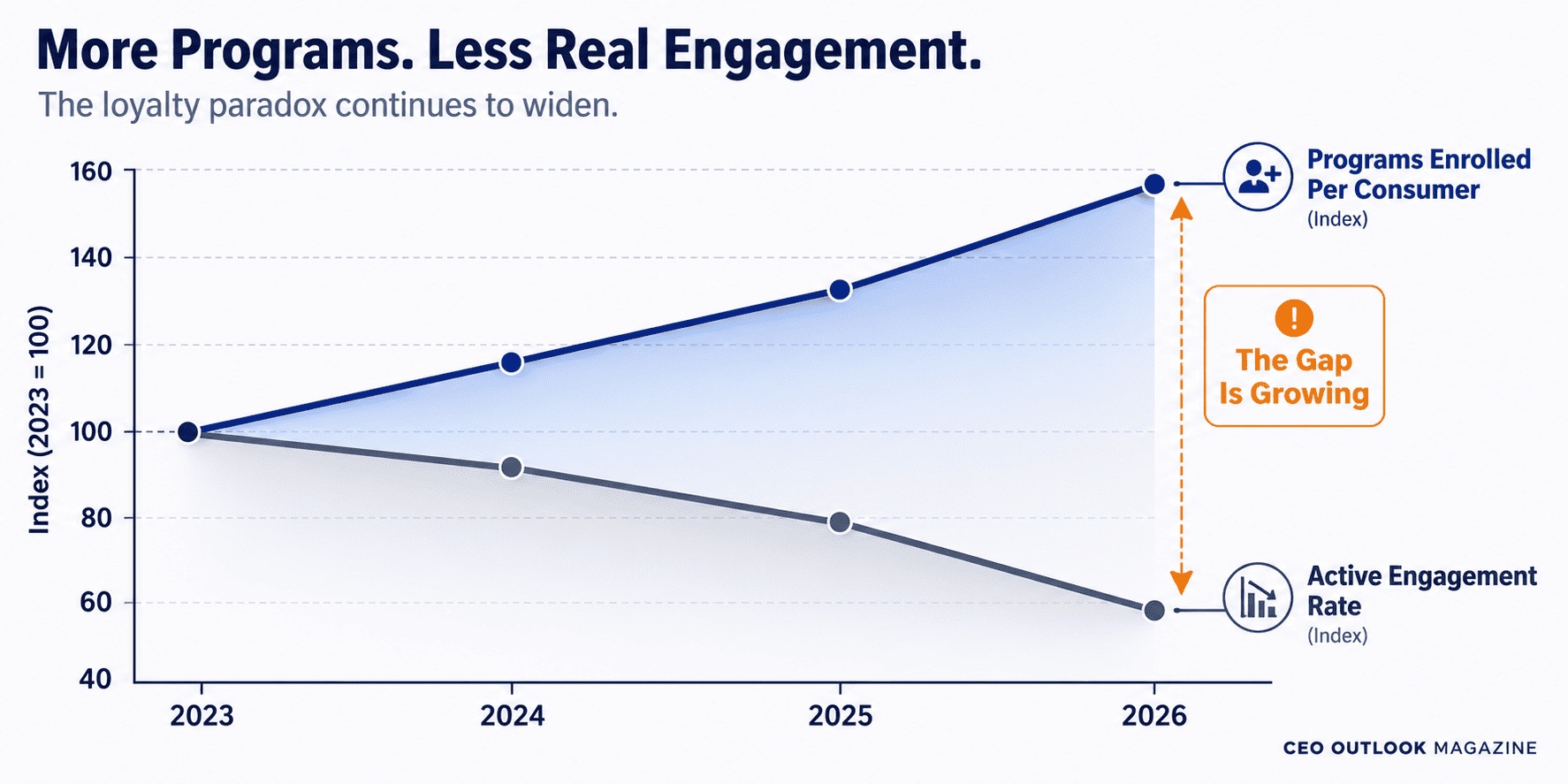
More than half of consumers now belong to at least five loyalty programs, yet they engage with only a fraction of them. Over half of all loyalty points go unredeemed. Enrollment is rising, but genuine commitment is not. The traditional approach—sign up customers, distribute points, label it loyalty—no longer delivers the retention it once promised.
The Paradox in the Enrollment Numbers
The disconnect is widening. Fewer consumers now participate in just a handful of programs, while more are spreading their enrollment across many. Participation in one to five programs dropped from 62 percent to 51 percent in a year; participation in eleven to fifteen programs increased from 7 percent to 11 percent. Consumers are not consolidating around favored brands. Switching intent is also up: 5 to 10 percent more consumers are likely to move to a competitor’s program, and over a third plan to cancel a membership entirely. Among those aged 18 to 34, that figure exceeds 50 percent.
Where All That "Loyalty" Actually Goes
A significant share of loyalty investment is wasted. Over a quarter of issued points are never used, and nearly 12 percent expire unclaimed—amounting to roughly $10 billion in lost value each year in the US alone. Even among active members, only half report any positive feeling toward the brand as a result. For many companies, the emotional return on loyalty spend is minimal.
The Self-Reported ROI That Doesn't Match the Real Data
A genuine, familiar tension is worth naming directly: 90 percent of companies self-report a positive return on investment from their loyalty programs. This optimism is hard to square with the data: high dormancy, unredeemed points, and increasing switching intent. The gap between self-reported success and actual engagement is not unique to loyalty; it reflects a broader pattern in retail metrics. If 82 percent of members never engage and cancellations are rising, positive ROI claims likely reflect minimal standards—such as any incremental transaction—rather than real, sustained behavior change. ubiquitous and largely interchangeable. As one certified loyalty marketing professional put it directly, a "good" program is no longer a competitive advantage; it is simply table stakes, and with so many structurally identical schemes competing for the same limited attention, customers have become fatigued and increasingly unresponsive to the standard mechanics of earning points and redeeming discounts. This ubiquity carries real downside risk beyond mere ineffectiveness: 65 percent of consumers report switching brands specifically because a membership program failed to deliver a genuinely better experience, meaning a mediocre loyalty program is no longer a neutral, low-risk retention tool. It can actively accelerate the churn it was designed to prevent.
What's Actually Still Working
Loyalty programs are not obsolete, but the few that succeed do so by breaking from the standard model. Yum China’s program, with 590 million members, now drives over half of total sales through deep behavioral integration. Qantas reports 19 percent annual loyalty revenue growth, showing direct profit impact. Programs that work use behavioral psychology, not just points. Most consumers are motivated by visible progress toward rewards, and a strong welcome incentive at enrollment increases engagement. Younger consumers respond to AI-driven personalization, but trust remains a barrier: most worry about how their data is used, and many would rather avoid personalization than accept opaque tracking.
What This Means for Marketing Leadership
For brand leaders, the takeaway is clear: standard points and discounts are no longer enough. Every competitor offers a similar program. Real loyalty now depends on integrating with customer behavior, using transparent data practices, and designing programs around psychological drivers like visible progress and meaningful entry incentives. Measuring success by enrollment or self-reported ROI misses the point. Engagement and redemption are what matter.
Many organizations still track loyalty program success by enrollment rather than by actual engagement and redemption. That distinction is critical for any executive serious about building durable consumer loyalty.