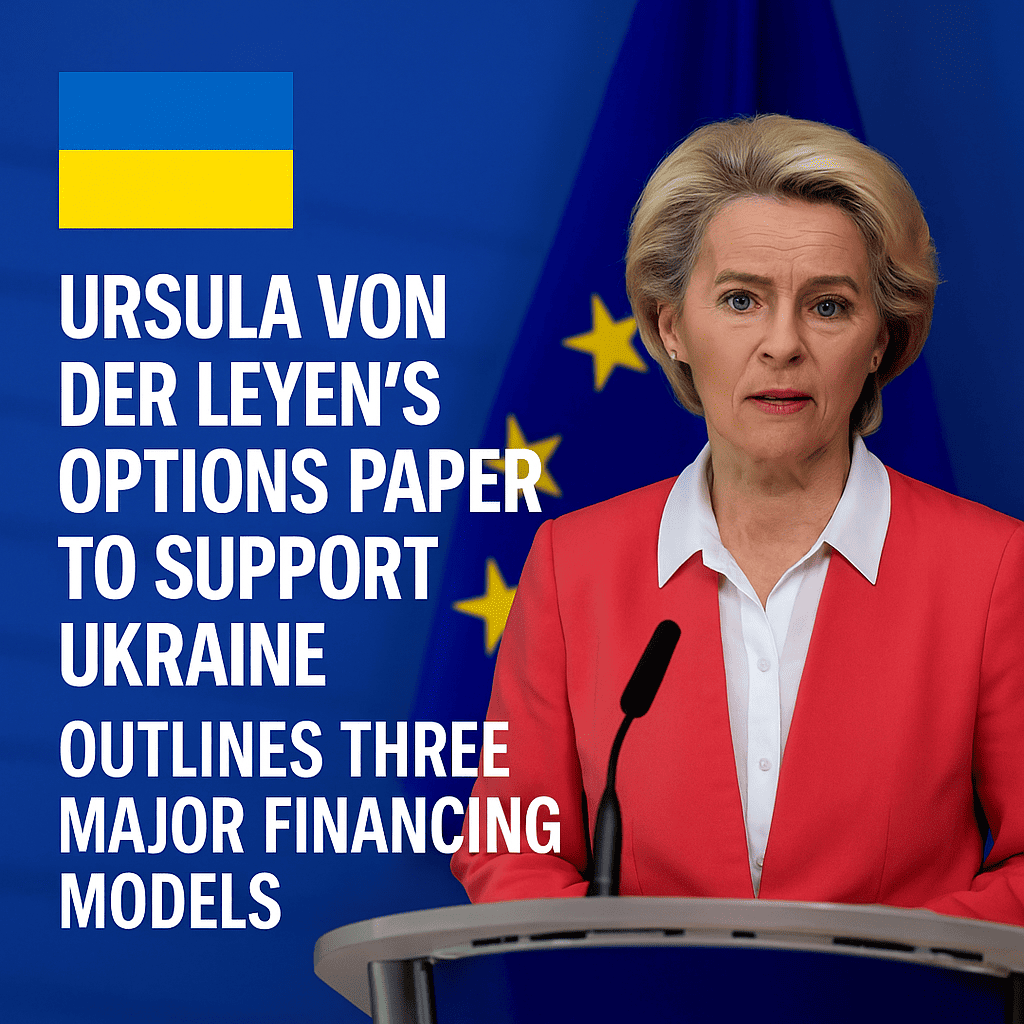
EU Commission President Ursula von der Leyen’s options paper outlines a consolidated financial strategy designed to secure Ukraine’s funding needs through 2027. The document identifies what Ursula von der Leyen’s options paper to support Ukraine means for EU leaders: a clear, structured set of choices that bridge short-term urgency with long-term commitments. The central challenge remains Ukraine’s estimated €135 billion requirement for economic stability, defence support, and essential reconstruction over the next two years.
Ursula von der Leyen’s options paper to support Ukraine presents three financing models.
First, a grant-based approach funded by EU member states that provides direct, non-repayable support.
Second, a borrowing model where the EU raises funds collectively and channels them to Kyiv as loans. This mirrors previous COVID-19 recovery financing mechanisms.
Third, a limited-recourse loan backed by profits generated from frozen Russian state assets — the most politically sensitive yet financially efficient option, as it avoids new national debt burdens.
The paper stresses that these models can work individually or as a blended mechanism. Ursula von der Leyen’s options paper to support Ukraine also outlines that grants or EU-level borrowing could serve as immediate instruments while asset-based mechanisms undergo legal scrutiny. The timeline underscores urgency: the EU aims to begin disbursements by the second quarter of 2026, with leaders expected to decide by December.
Another critical point: funding will be tied to Ukraine’s reform trajectory. Ursula von der Leyen’s options paper to support Ukraine links financial disbursement to continued progress in governance, transparency, and anti-corruption efforts. Without demonstrable reform momentum, the credibility of any financing model diminishes.
A speculative but realistic scenario includes complementing traditional oversight with AI-driven auditing tools to monitor fund deployment in real time. This could reduce corruption risks, accelerate disbursement approvals, and increase donor confidence—another potential innovation: blockchain-based asset-tracking tools for Russian-asset-backed financing, improving legal defensibility and auditability.
Overall, Ursula von der Leyen’s options paper to support Ukraine is not simply a financial blueprint but a pressure framework demanding both rapid EU action and consistent Ukrainian reform delivery.