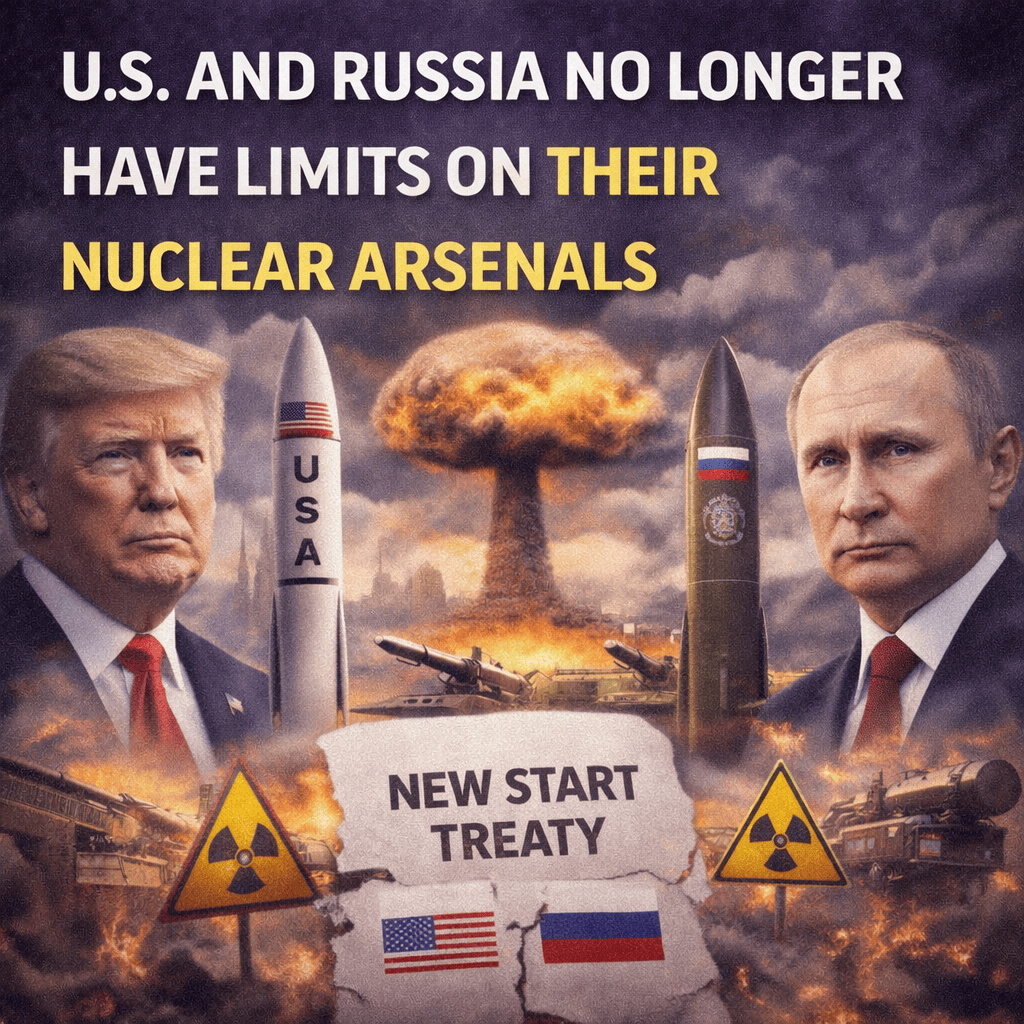
U.S. and Russia no longer have limits on their nuclear arsenals, marking a turning point in global security after the expiration of the New START Treaty. For the first time since the Cold War, the world’s two largest nuclear powers are operating without legally binding caps on deployed strategic warheads or the verification regime that kept both sides accountable.
New START, signed in 2010 and extended once, limited each country to 1,550 deployed nuclear warheads and allowed on‑site inspections and data exchanges. Those mechanisms provided predictability during periods of tension. Their disappearance removes a stabilizing layer that many defense planners relied on to assess intent and capability. As a result, the U.S. and Russia no longer have legal limits on their nuclear arsenals, even if neither side has announced immediate numerical expansion.
The collapse of the treaty did not happen suddenly. Inspections were suspended years earlier amid disputes and deteriorating relations, and Moscow later froze its participation. Washington continued to observe the ceilings informally while pushing for a broader framework. That effort stalled when President Donald Trump declined a straightforward extension and instead sought a new deal that would also include China. Beijing rejected the idea, citing the imbalance between its far smaller arsenal and those of the United States and Russia.
The absence of limits has prompted warnings from international institutions. The United Nations described the treaty’s end as a serious blow to strategic stability. Secretary‑General António Guterres urged both capitals to restore verifiable restraints, arguing that today’s security environment—marked by active wars and heightened mistrust—raises the risk of miscalculation.
Without New START, transparency drops sharply. Intelligence estimates replace inspections, and worst‑case planning becomes more likely. Analysts caution that the U.S. and Russia no longer having limits on their nuclear arsenals could encourage modernization races, pressure non‑nuclear states, and weaken the credibility of the Nuclear Non‑Proliferation Treaty. Even if warhead counts remain steady, the loss of verification erodes confidence and increases incentives to hedge.
There are practical off‑ramps. One option is a time‑bound executive agreement to restore data exchanges and inspections without waiting for a comprehensive treaty. Another is a modular framework—separate caps on warheads, delivery systems, and new technologies—paired with modern verification tools such as remote sensing and tamper‑proof telemetry. A third path is risk‑reduction: crisis hotlines, launch‑notification norms, and incident‑prevention rules that lower the chance of escalation while negotiations restart.
For now, the U.S. and Russia no longer have limits on their nuclear arsenals, a reality that underscores how fragile arms control has become. Rebuilding constraints will require political will, technical innovation, and a willingness to prioritize predictability over leverage in an increasingly crowded nuclear landscape.