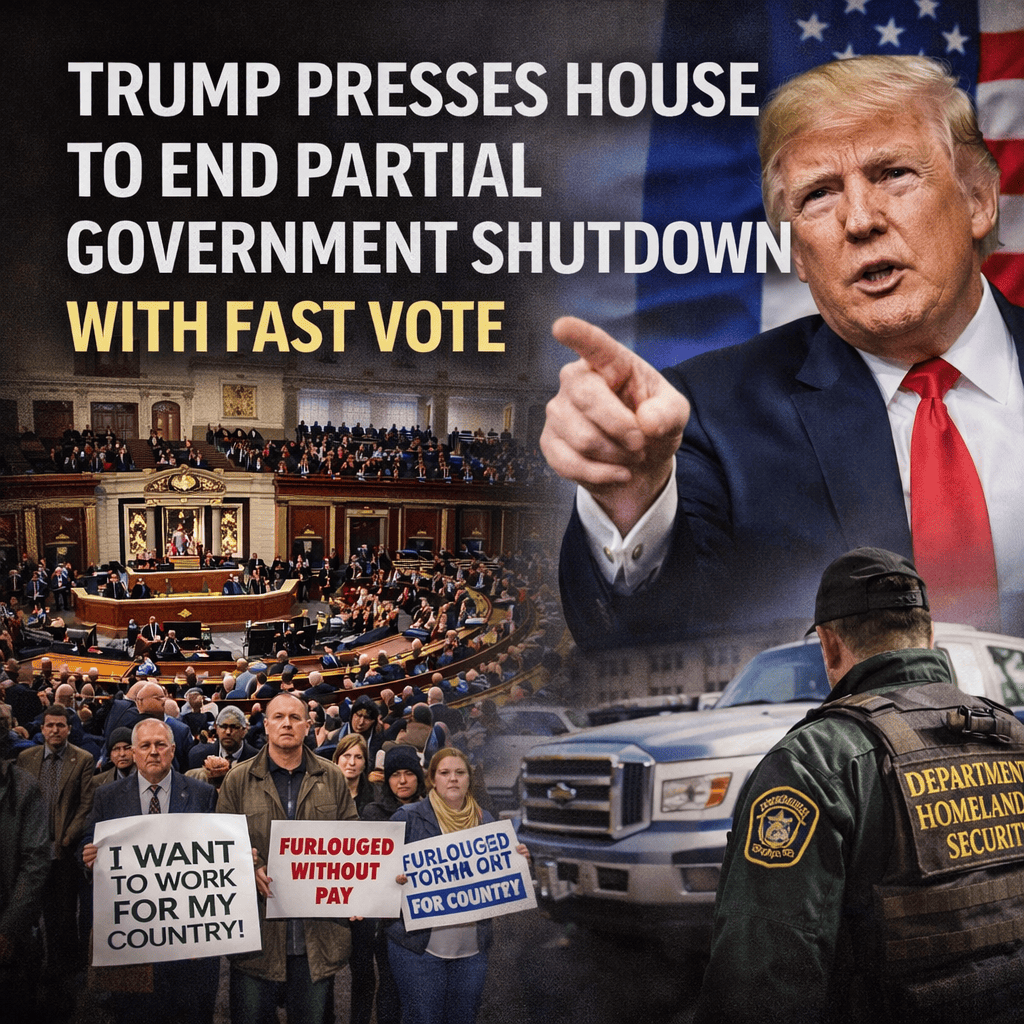
President Donald Trump has stepped up pressure on the U.S. House of Representatives to act quickly to end the partial government shutdown, calling on lawmakers to pass a Senate-approved funding bill without changes. His message is direct: delay risks deepening disruption across federal agencies and prolonging uncertainty for workers already affected by the shutdown.
The shutdown began after Congress failed to meet a funding deadline, leaving several government departments partially unfunded. The Senate responded by advancing a bipartisan package designed to keep most agencies operating through September 2026, while granting a shorter extension for the Department of Homeland Security. Trump has publicly backed the deal and urged the House to move it forward intact to end the partial government shutdown before political maneuvering escalates further.
House dynamics remain the main obstacle. Speaker Mike Johnson is navigating a narrow Republican majority, where even a small bloc of dissenters can stall legislation. Some conservative lawmakers are pushing to link government funding to stricter immigration enforcement measures, while others oppose the structure of DHS funding itself. These internal divisions complicate any rapid vote, even with presidential backing.
Democrats, meanwhile, are unwilling to provide procedural support without concessions. Their objections center on immigration enforcement practices, including expanded powers for border and interior operations. Democratic leaders argue that approving funding without guardrails would entrench policies they oppose, even as pressure mounts to end the partial government shutdown and restore normal operations.
The impact of the shutdown is already visible. Non-essential federal employees face furloughs, contractors report delayed payments, and agencies responsible for transportation, housing, and homeland security are operating with limited capacity. While core services continue, prolonged disruption raises risks around emergency preparedness, border management, and responses to severe weather events.
Trump’s strategy appears focused on speed rather than renegotiation. By demanding a clean House vote, he is attempting to isolate internal congressional disputes from the immediate need to reopen the government. The White House has warned that reopening talks on amendments could trigger weeks of further deadlock—an outcome Trump wants to avoid as comparisons resurface with the lengthy 2019 shutdown.
Several paths remain open to end the partial government shutdown. One option is a short-term continuing resolution paired with a formal timetable for immigration debates, allowing lawmakers to separate urgent funding from policy fights. Another is a segmented vote approach, reopening less controversial agencies first while isolating DHS for targeted negotiation. Both would reduce economic and administrative damage without forcing immediate consensus on divisive issues.
For now, momentum hinges on whether House leadership can marshal enough votes to act quickly. Each day of delay raises political costs, financial strain, and pressure on lawmakers from both constituents and federal workers demanding a swift resolution to end the partial government shutdown.