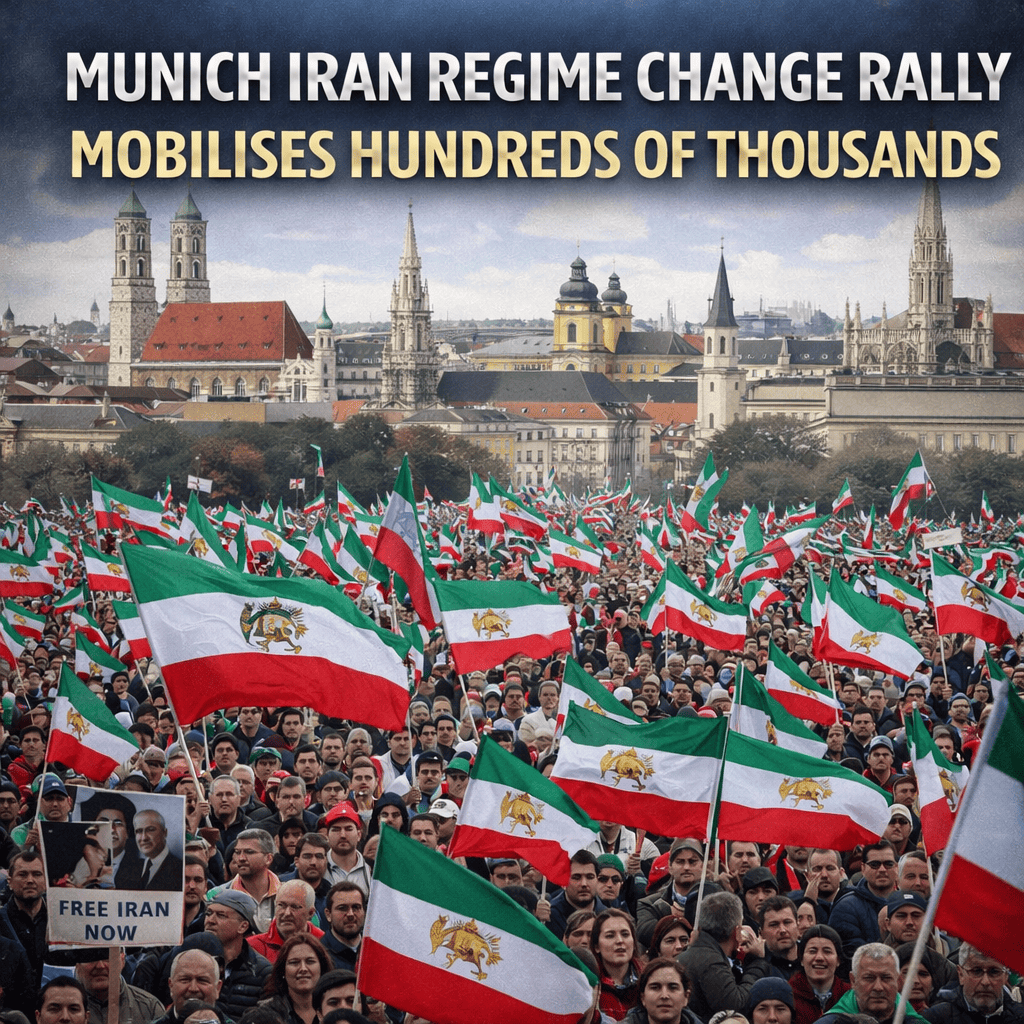
The Munich Iran regime change rally drew hundreds of thousands of demonstrators to the streets of Munich as calls for political change in Tehran intensified. The protest coincided with the Munich Security Conference, ensuring that global policymakers, diplomats, and media were confronted with visible public pressure regarding Iran’s internal situation.
Organisers described the Munich Iran regime change rally as one of the largest gatherings of the Iranian diaspora in Europe in recent years. Participants travelled from across Germany and neighbouring countries, carrying Iranian flags and banners calling for democracy, women’s rights, and an end to clerical governance. The scale of turnout reflected sustained mobilisation among overseas Iranian communities.
The rally took place amid continued unrest inside Iran. Protest movements over the past year have centred on economic grievances, political freedoms, and social restrictions. Speakers at the Munich Iran regime change rally linked their demands directly to those internal protests, arguing that diaspora activism plays a complementary role in maintaining international attention.
Chants at the demonstration focused on accountability and institutional reform. Organisers urged European leaders attending the security conference to adopt firmer measures, including expanded targeted sanctions and greater scrutiny of Iranian state-linked financial networks operating abroad. Some advocacy groups also pressed for stronger protections for Iranian dissidents residing in Europe.
German authorities implemented heightened security protocols due to the proximity of high-level diplomatic meetings. Police presence remained visible throughout the event, but officials reported that the demonstration proceeded peacefully. The orderly nature of the Munich Iran regime change rally strengthened organisers’ efforts to frame the gathering as a civic and democratic expression rather than a disruptive action.
Strategically, diaspora-led mobilisation serves multiple purposes. It influences media narratives, signals to domestic protesters that international solidarity exists, and pressures Western governments to clarify their policy stance. However, large rallies alone rarely produce policy shifts. Sustained engagement through parliamentary lobbying, coordinated legal advocacy, and structured dialogue with European institutions will likely determine longer-term impact.
The timing of the Munich Iran regime change rally amplified its geopolitical relevance. With Iran’s nuclear programme under renewed scrutiny and regional tensions affecting energy markets, the political trajectory inside Tehran carries global implications. Public demonstrations abroad reinforce the argument that Iran’s internal governance is not solely a domestic matter but a factor in international security calculations.
Speculation: If diaspora mobilisation continues at this scale and aligns with persistent domestic activism, Western capitals may face increased pressure to recalibrate engagement strategies toward Tehran. Conversely, without coordinated policy follow-up, even large demonstrations risk symbolic resonance without structural change.
For now, the Munich Iran regime change rally stands as a visible reminder that Iran’s political debate extends well beyond its borders, shaping diplomatic conversations in Europe at a pivotal moment.