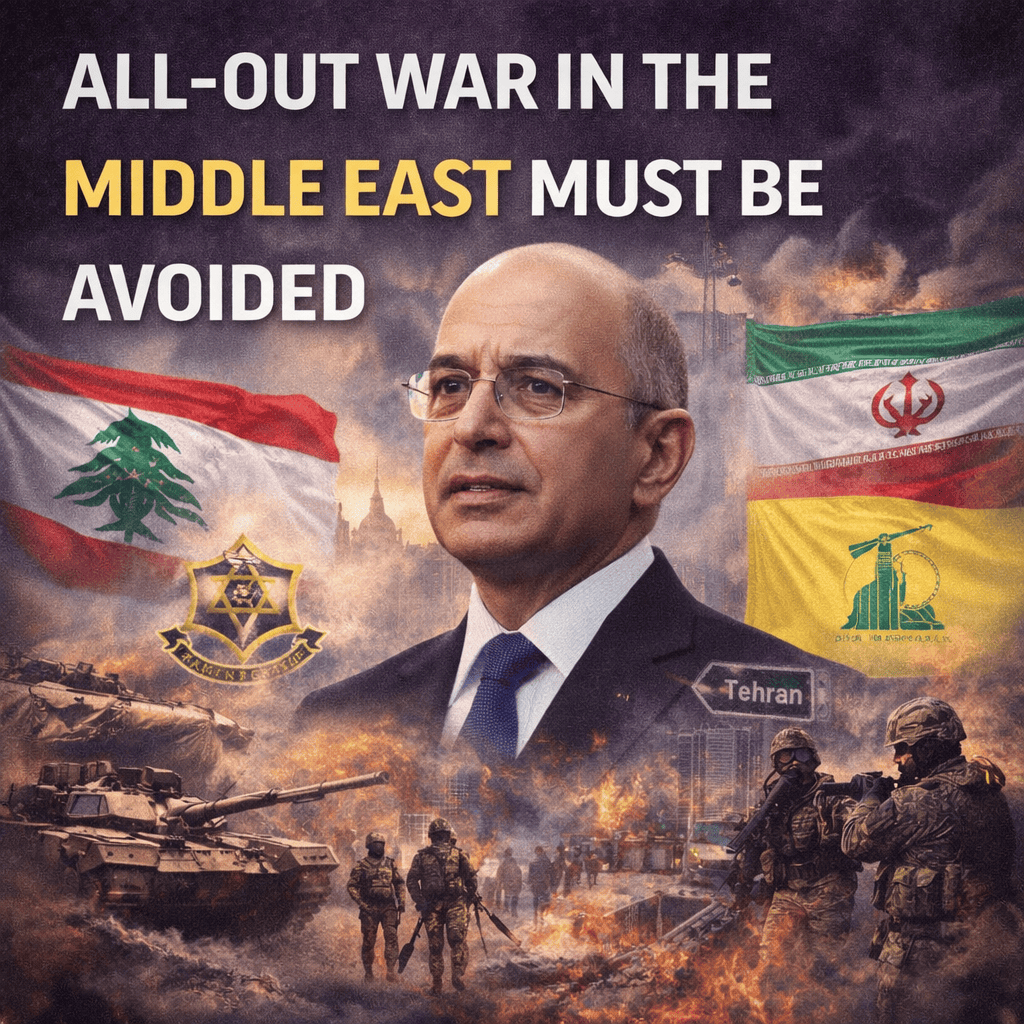
Lebanon’s prime minister, Nawaf Salam, has warned that all‑out war in the Middle East must be avoided, as regional tensions sharpen and diplomatic efforts struggle to contain the risk of escalation. Speaking to Euronews on the sidelines of the World Governments Summit in Dubai, Salam framed diplomacy as the only viable route to prevent a wider conflict that would overwhelm fragile states across the region.
Salam’s remarks come at a moment when U.S.–Iran talks are set to resume, with Oman again acting as a discreet intermediary. For Lebanon, these negotiations carry outsized importance. Any military confrontation involving Iran would likely ripple through proxy networks, pulling neighbouring countries into a conflict they can neither control nor absorb. Salam stressed that all‑out war in the Middle East must be avoided not only to prevent mass civilian suffering, but also to avert economic collapse in already strained economies.
A central issue remains Lebanon’s internal balance of power. The prime minister addressed the role of Hezbollah, whose leadership has publicly stated it would not stay neutral if Iran were attacked. Salam drew a firm line, insisting that decisions of war and peace belong exclusively to the Lebanese state. He argued that restoring clear state authority is essential if all‑out war in the Middle East must be avoided, particularly in countries where armed non‑state actors operate alongside national institutions.
Southern Lebanon remains another flashpoint. Israeli military activity near the border continues under the framework of a 2024 ceasefire, with Israel Defense Forces citing deterrence needs and Beirut describing the presence as a violation of sovereignty. The incomplete implementation of withdrawal commitments has left room for miscalculation. Salam warned that unresolved border tensions increase the risk of a spiral that could drag multiple actors into open conflict, reinforcing why all‑out war in the Middle East must be avoided through sustained diplomacy.
Beyond rhetoric, Salam outlined concrete priorities. Strengthening the Lebanese Armed Forces is at the core of his strategy. He pointed to an upcoming international support conference in Paris aimed at securing financial and logistical backing. A capable national army, he argued, reduces reliance on militias and limits the pathways through which regional wars spill into Lebanon.
European partners have already signalled support, linking financial assistance to reforms and stability benchmarks. For Salam, this external backing is not optional. It is a prerequisite for insulating Lebanon from regional shocks and maintaining internal cohesion as tensions rise.
Looking ahead, Salam advocated a layered approach: active diplomacy between Washington and Tehran, firm reinforcement of state authority at the national level, and international guarantees that discourage unilateral military action. Without these elements, he warned, restraint could give way to confrontation. His message remained consistent throughout: all‑out war in the Middle East must be avoided, because once unleashed, no country in the region would remain untouched.